









You have an idea, a budget that will not stretch forever, and investors or customers waiting for proof. Hiring the wrong team at this stage costs months you cannot recover. So before you sign anything, you need to know what a vendor actually delivers, how the work unfolds, and what it should cost.
MVP development services cover the work of turning your idea into a working product with only the features needed to test it with real users. That typically includes discovery, UX design, engineering, testing, and launch support. In the US, most projects run 8 to 16 weeks, and costs commonly range from $30,000 to $150,000 depending on scope, integrations, and any AI components.
Below, we break down what a good MVP development company includes in its scope, the four stages of a typical delivery process, and the factors that move your price up or down. We also cover how to compare vendors, including team seniority and engagement models. At Hatzs Dimensions, we have shipped products for 250+ clients, from Series A startups to Fortune 500 teams, so we draw on that experience throughout.
Why startups use MVP development services
Startups hire outside teams for one reason: speed to evidence. You do not need a finished product to learn whether people will pay for it. You need the smallest version that answers that question. MVP development services for startups exist to build that version quickly, with people who have done it many times before.
Faster access to real user feedback
Every month you spend building without users is a month of guessing. A capable team compresses that period into 8 to 16 weeks, which means you hear from real customers while your assumptions are still cheap to change. Early feedback is also the strongest asset you can bring to an investor conversation.
Take a founder in logistics who wants a full dispatch platform. An experienced team might suggest launching with only driver check-in and route assignment, then watching how dispatchers use it. That narrow release tests the core workflow and often reveals that the feature the founder planned for month six is not the one customers want first.
Lower risk than building a team from scratch
Hiring is the hidden cost of going it alone. Recruiting a senior engineer, a product designer, and a QA lead can take three to six months before anyone writes code, and you carry those salaries whether the idea works or not. An MVP development company gives you a ready team for a defined period.
| Option | Time to start | Cost shape | Main risk |
|---|---|---|---|
| In-house team | 3 to 6 months to hire | Salaries and benefits, ongoing | Slow start, fixed overhead |
| Freelancers | 1 to 3 weeks | Hourly, varies widely | Coordination gaps, uneven quality |
| MVP software development company | 1 to 3 weeks | Fixed price or dedicated team | Vendor fit, which you must vet |
Experience that prevents expensive mistakes
Scope is where most MVPs go wrong. Founders add "just one more" feature until the build takes nine months instead of three. A seasoned MVP software development company pushes back, ranks features by what they teach you, and cuts the rest from version one.

An MVP is not a smaller product. It is a sharper question.
Senior engineers also make architecture decisions that protect you later. They choose a stack you can hire for, keep the data model clean, and avoid shortcuts that force a rewrite after launch. At Hatzs Dimensions, our senior-only team has spent 7+ years shipping production systems, including AI features, so a prototype does not become a dead end when you start to scale.
What MVP development services include
Scope varies by vendor, but solid MVP software development services follow the same backbone. Ask for each item below in writing, because a quote that skips one usually hides the cost somewhere else.
Core deliverables
Most MVP app development services bundle five workstreams into one engagement. Together they take you from a rough idea to a product that real users can open on day one.
- Discovery and scoping: stakeholder workshops, user stories, a ranked feature list, and a clear definition of success.
- UX and UI design: wireframes, a clickable prototype, and a basic design system.
- Engineering: front end, back end, database, APIs, and integrations such as payments or authentication.
- QA and testing: functional tests, device checks, and security basics.
- Launch and support: cloud deployment, analytics setup, and a post-launch bug-fix window.
Extras worth asking about
Analytics deserves special attention. Without event tracking and funnels, you launch but learn nothing. Ask the vendor to instrument key actions and set up a feedback channel before release.
A launched MVP without analytics is just a smaller product with no answers.
AI features are another common add-on. If your product needs an AI agent, a recommendation engine, or document automation, confirm that the team has shipped AI to production, not just built demos. Domain expertise matters too. An MVP product development company that has built healthcare or fintech apps already knows the compliance basics you would otherwise pay to discover.
What usually stays outside the quote
Ongoing marketing, content creation, and large-scale infrastructure typically sit outside the fixed scope. So does legal work such as privacy policies and terms of service. Whether you hire an MVP development company in the USA or offshore, confirm these gaps up front so your budget holds after kickoff.
How the MVP development process works
Good MVP development services follow a fixed sequence, so you always know what is being built and why. We use four stages at Hatzs Dimensions, as laid out in what to expect in the first weeks of an engagement, and most reputable vendors run a close variant. Each one ends with a concrete deliverable you can review.
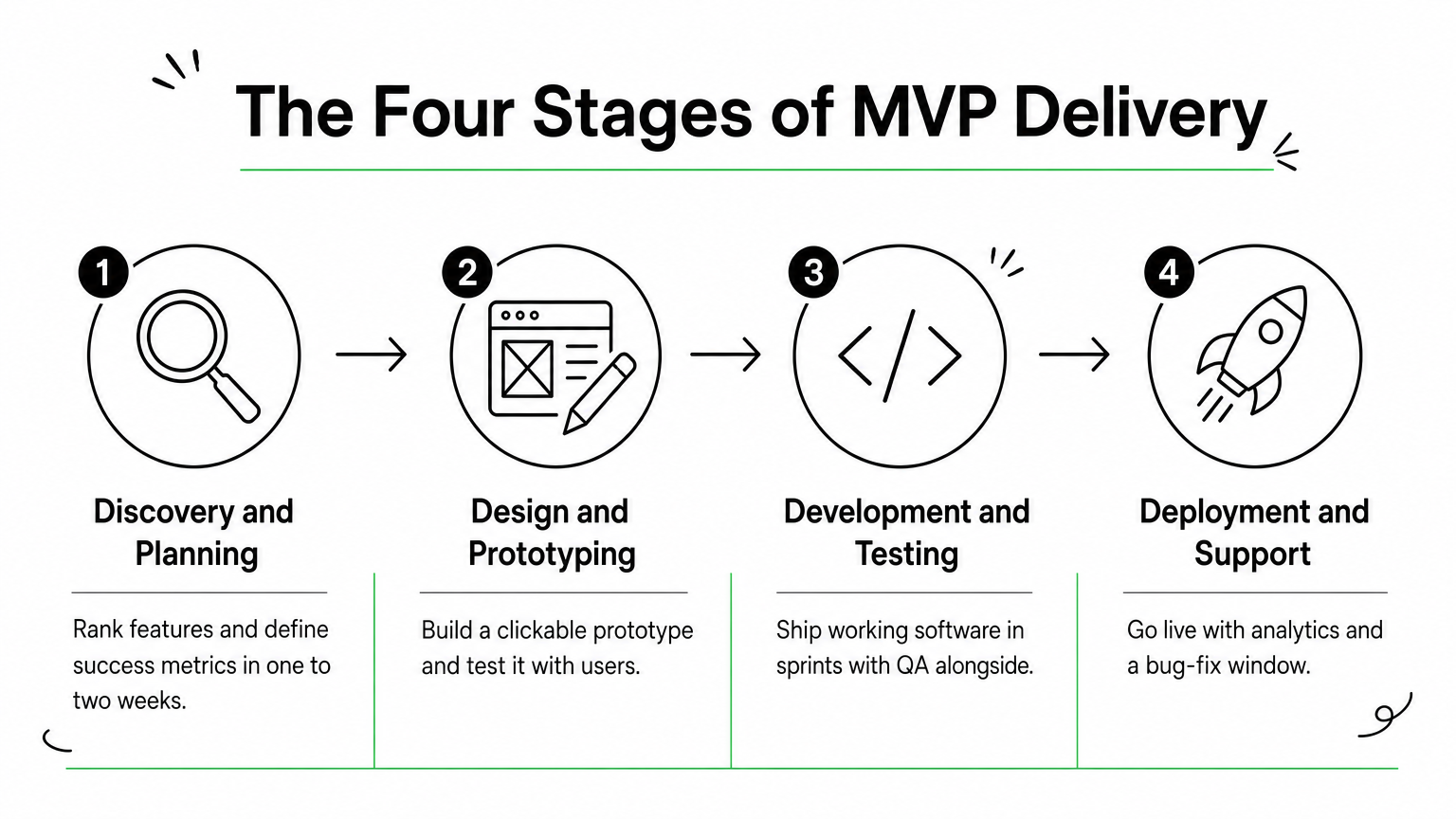
The four stages and what each produces
| Stage | Typical duration | What you receive |
|---|---|---|
| Discovery and planning | 1 to 2 weeks | Ranked feature list, user stories, success metrics, estimate |
| Design and prototyping | 2 to 3 weeks | Wireframes and a clickable prototype tested with users |
| Development and testing | 4 to 8 weeks | Working product built in sprints, QA results |
| Deployment and support | 1 to 2 weeks, plus a support window | Live product, analytics, bug-fix coverage |
Discovery decides more than any other stage. This is where you cut the feature list down to the one workflow worth testing. Design comes next, and a clickable prototype lets you put the product in front of five to ten target users before anyone writes code. Changing a prototype takes hours. Changing shipped software takes weeks.
If you cannot click through your product every two weeks, you are not seeing progress.
How development and launch run
Building happens in one- to two-week sprints. At the end of each sprint, you should see working software in a staging environment, not a slide deck. Testing runs alongside the build, so bugs surface early instead of piling up before launch.
Release is not the finish line. Your team should deploy to the cloud, switch on analytics and error monitoring, and stay on call for a defined bug-fix window. After that, the real work starts: reading the data and deciding what version two should be.
Your role during the build
You have a job in this process too. Name one decision-maker who answers questions within a day, because slow approvals stall more projects than technical problems do. Expect a weekly demo and a shared backlog you can read at any time. If a vendor cannot show you either, treat that as a warning sign before you sign.
How much MVP development costs
Price follows scope more than anything else. MVP development services in the USA usually quote against a feature list, so the clearer your list, the tighter your estimate. Treat the ranges below as a planning guide, not a promise.
Typical price ranges by complexity
| Complexity | Example | Typical cost | Timeline |
|---|---|---|---|
| Simple | One core workflow, one user role, no integrations | $30,000 to $60,000 | 8 to 10 weeks |
| Mid-level | Web and mobile, payments, admin dashboard, a few integrations | $60,000 to $100,000 | 10 to 14 weeks |
| Complex | AI features, multiple roles, data pipelines, compliance needs | $100,000 to $150,000+ | 12 to 16+ weeks |
Most startups land in the middle tier. If your product needs an AI agent or regulated data, plan for the top tier from day one. Compliance work and model testing add real engineering hours that a simple quote often leaves out.
What moves your price
Six software development cost factors explain most of the gap between two quotes for the same idea:
- Feature count: each core workflow adds design, build, and test time.
- Platforms: web only costs less than iOS, Android, and web together.
- Integrations: payments, CRM, or ERP connections each add days.
- AI and data: model work, evaluation, and pipelines raise the effort.
- Compliance: HIPAA, SOC 2, or PCI requirements add review and documentation.
- Team seniority and location: US-based senior teams cost more per hour, but they usually ship fewer defects and less rework.
Scope is the one lever you fully control. Dropping a single secondary workflow can save five figures, and you can add it back after launch once users prove they want it.
The cheapest quote is rarely the cheapest MVP, because rework is where budgets quietly double.
Fixed price or dedicated team
Fixed price suits an MVP with a stable, well-defined scope. You get budget certainty, and the vendor carries the risk of overruns. A dedicated team suits a product that is still changing every few weeks, since you pay monthly and redirect the work as you learn.

Location matters less than people assume. Searching for MVP development services near me makes sense if you want in-person workshops, but a remote senior team in your time zone delivers the same result. Whichever model you pick, ask for a line-item estimate and a written change-request process, so new costs never appear without your approval.
How to choose an MVP development company
Most vendors look alike on their websites. The difference shows up in proof and process, so judge each candidate on evidence you can verify, not on a polished pitch. Plan to compare three vendors side by side before you commit to any of them.
What to verify before you shortlist
Seniority comes first. A team of juniors learns on your budget, so ask who will actually write your code and how long each person has shipped production software. Then look for domain proof: case studies in your industry and reviews on independent platforms such as Clutch.
Use this vendor evaluation checklist to screen every candidate:
- Portfolio: live products you can open, not mockups.
- References: two clients who launched an MVP in the past year.
- Process: a written plan with stages and deliverables, like the four above.
- Ownership: you own the code and IP from day one.
- Communication: weekly demos and one named point of contact.
Questions to ask on the first call
Ask the vendor what they would cut from your feature list. A team that agrees with every request is not protecting your budget. Then ask about their last project that ran late and why. Honest answers show how they handle problems, which tells you more than a spotless reference list.
Choose the team that challenges your scope, not the one that nods at everything.
Press on specifics, too. Can the team show AI work running in production? Will they hand you a line-item estimate? An experienced MVP app development company answers both without hesitation.
Red flags that should end the conversation
Walk away if you see a quote with no line items, a promise of a full product in four weeks, or pressure to sign this week. Vague answers about code ownership are another clear warning. Price alone is the weakest reason to pick any provider of MVP development services, because rework costs more than the discount saved.
Finally, check fit. Whether you hire in the US or abroad, insist on at least four hours of time-zone overlap so questions get answered the same day. Then match the engagement model to your product: fixed price for a stable scope, a dedicated team for one that keeps changing.
Choosing your next step
Strong MVP development services come down to three things you can check: a scope cut to one core workflow, a process that shows you working software every two weeks, and a price broken into line items. Get those right and you spend 8 to 16 weeks learning from real users instead of guessing.
Your next move is simple. Write down the one question your product must answer, list only the features that answer it, and send that list to three vendors. Compare their responses on seniority, proof, and how hard they challenge your scope. The team that pushes back thoughtfully is usually the one protecting your budget.
If you want a senior-only team to review your idea, talk to Hatzs Dimensions about your MVP. We will help you define the smallest version worth building and give you a clear, line-item plan, with fixed price or dedicated team pricing to match.
هل تريدون تنمية أعمالكم؟
التصنيفات
صُمّم للجريئين
نساعد الشركات الطموحة على تحويل أفكارها إلى أنظمة ذكاء اصطناعي وبرمجيات ومؤسسات جاهزة للإنتاج. احصل على رؤى حول الذكاء الاصطناعي والأتمتة والتحول الرقمي تصلك مباشرة إلى بريدك الإلكتروني.
200+ حلاً تم تسليمها في 11+ قطاعاً، فلنبنِ معاً ما هو قادم.