











You keep hearing that autonomous AI agents will run workflows on their own, but vendor pages rarely say what that means in practice. Some describe a chatbot with a few plugins. Others promise a digital employee. If you are a CTO or product leader deciding where to invest, that gap makes it hard to judge what is real and what is demo-ware.
Here is the short answer. An autonomous AI agent is software that takes a goal, plans the steps, uses tools and data, and acts with little or no human prompting. It differs from a standard assistant because it decides what to do next, not just what to say. It also differs from agentic AI, which is the broader design approach that agents are built on.
This article walks through how these agents work, from perception and planning to tool use and memory. You will see how they compare with agentic AI, real examples across industries, and the top tools worth evaluating. We have shipped enterprise AI systems into production for 7+ years, so we also flag what tends to break once an agent leaves the prototype stage.
Why autonomous AI agents matter for your business
From answering questions to finishing work
Most automation you already own follows fixed rules. A script moves a file, a bot fills a form, and when something unexpected shows up, it stops and waits for a person. Autonomous AI agents handle the unexpected by reasoning about the goal and choosing another route. That shifts the unit of automation from a single task to a whole outcome.
Picture an insurance claims queue. A rules engine can route a document. An agent can read the claim, check the policy, request a missing photo, and pass along only the cases that need an adjuster’s judgment. Your people review exceptions instead of touching every item, which is where the capacity gain comes from.
Where the value shows up
The payoff is clearest in workflows that are high volume, multi-step, and tied to several systems. Those are the jobs where people spend hours copying context between tools. Cost reduction, faster response times, and more capacity without more headcount are the three gains we see most often.
These are results from Hatzs Dimensions client projects:
| Area | Outcome |
|---|---|
| Insurance operations | 30% lower operations costs |
| Lead handling | 300% more lead conversion capacity |
| Customer engagement | 40% higher engagement |
What you need to price in
Autonomy cuts both ways. An agent that can issue refunds can also issue the wrong refunds, and a mistake in step two carries into steps three through ten. Errors compound across steps, and every tool you hand the agent widens cost, security, and compliance exposure.
The more an agent can do without you, the more you need to know about what it did and why.
So treat the business case as two columns, not one. Savings come from removing manual work, and the offsetting spend goes to monitoring, access controls, and human review for risky actions. Teams that budget for both ship agents that stay in production. Teams that budget only for the first column tend to pause after the first costly mistake.
How autonomous AI agents work
Under the hood, autonomous AI agents run a loop instead of answering once. A language model sits at the center, but the model alone is not the agent. The agent is the model plus the tools, memory, and rules wrapped around it.
The core loop
Every agent cycles through the same four moves until the goal is met or it hits a limit you set.
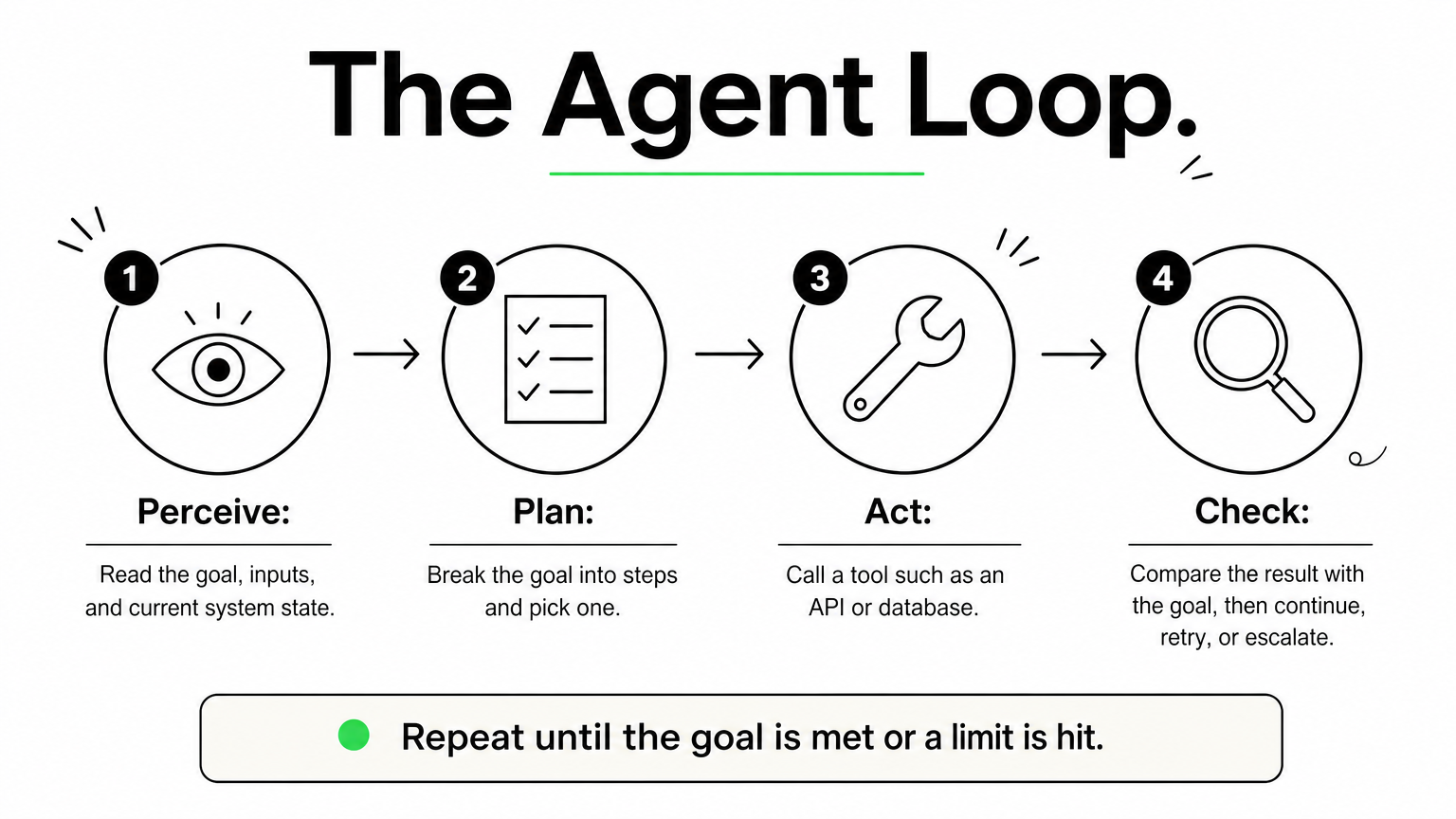
- Perceive: read the goal, the inputs, and the current state of your systems.
- Plan: break the goal into steps and pick the next one.
- Act: call a tool, such as an API, a database query, or a browser.
- Check: compare the result with the goal, then continue, retry, or escalate to a person.
Most production failures happen in the check step. An agent that cannot tell a failed action from a successful one will keep going confidently in the wrong direction, and that is how small errors compound.
An agent is only as autonomous as its ability to verify its own work.
The building blocks
Four components make that loop possible, and you should be able to name each one in any agent you evaluate.
| Component | Job | Example |
|---|---|---|
| Reasoning model | Plans and decides | A large language model |
| Tools | Take real actions | CRM API, SQL, email |
| Memory | Holds context across steps | Task log, vector database |
| Guardrails | Limit what it may do | Spending caps, approval gates |
When a vendor demo looks impressive, ask about the last two rows. Memory and guardrails separate a prototype from something you can safely leave running overnight.
Autonomous AI agents vs. agentic AI and other agents
Autonomous agents and agentic AI
Agentic AI is a way of building systems: you give a model a goal, let it plan, call tools, and adapt to results. An autonomous agent is a specific system built that way and allowed to run with minimal supervision. Some agentic systems keep a person approving every step, so they are agentic without being autonomous.
Agentic describes how a system is designed. Autonomous describes how much freedom you give it.
That distinction matters when you read vendor claims. A product marketed as "agentic" may still stop and ask you before every action.
How other agent types compare
The table below places autonomous agents next to the tools they are most often confused with.
| Type | How it decides | Example |
|---|---|---|
| Chatbot or assistant | Responds to each prompt, takes no independent action | FAQ bot |
| Rule-based bot (RPA) | Follows fixed scripts, stops on surprises | Invoice-entry bot |
| Copilot | Suggests, and you approve | Code completion |
| Autonomous agent | Plans and acts toward a goal | Claims triage agent |
| Multi-agent system | Several agents split and review the work | Researcher, writer, and reviewer agents |
Most teams should treat autonomy as a dial, not a switch. Start with a copilot that drafts while you approve, then move low-risk actions to full autonomy once your logs show consistent accuracy over a few hundred runs. Refunds, payments, and anything customer-facing can stay behind an approval gate much longer.
Real-world examples of autonomous AI agents
Examples across industries
Autonomous AI agents already run in production, mostly where work is repetitive and spans several systems. The table shows the use cases by industry we see most often, along with the part people still own.
| Industry | What the agent does | Human role |
|---|---|---|
| Insurance | Reads claims, checks policies, requests missing documents | Adjusters review flagged cases |
| Retail | Monitors stock and reorders within set limits | Buyers approve large orders |
| Healthcare | Handles scheduling and prior-authorization paperwork | Staff make clinical decisions |
| Logistics | Reroutes shipments when delays hit | Dispatchers handle exceptions |
| Software | Triages bug reports and drafts fixes | Engineers review code |
Notice what these have in common. Each agent has bounded authority, and a named person owns the exceptions. None of them is a free-roaming digital employee.
The best first agent has a narrow job, clear limits, and a person who owns the exceptions.
Tools worth evaluating
Start with AI agent platforms for business from vendors you already use. Amazon Bedrock Agents, Google Vertex AI Agent Builder, and Microsoft Copilot Studio all plug into existing cloud security and identity controls. For custom builds, open-source frameworks such as LangGraph and CrewAI give you direct control over the agent loop.
Choose based on integration depth and logging, not demo polish. Run a two-week pilot on one real workflow, and check whether you can replay every action the agent took. If you cannot, keep looking.
How to evaluate and deploy autonomous agents safely
Safe adoption comes down to two habits: judging the agent before you commit, and widening its authority only as evidence builds. The checks below work whether you buy a platform or build your own.
Questions to ask before you commit
Put the same five questions to every vendor and internal team, before any pilot starts:
- Can you replay every action, input, and tool call?
- Which permissions does the agent hold, and can you limit them per task?
- What triggers escalation to a person?
- How is accuracy measured, and on whose data?
- Where does your data go, and who can see it?
Vague answers to the first two are a dealbreaker. If you operate in healthcare, banking, or insurance, add your compliance team to this AI governance and compliance review on day one, not after the pilot.
Roll out autonomy in stages
Most failed pilots hand an agent too much freedom too early. Autonomous AI agents should earn trust in steps, with a human checkpoint at every stage:

- Shadow mode: the agent proposes actions and people perform them. Compare its choices with theirs.
- Approval mode: the agent acts only after a person signs off.
- Limited autonomy: the agent handles low-risk actions alone, under spending caps and rate limits.
- Full autonomy: the agent runs on its own, with alerts and a tested kill switch.
Earn autonomy with logged results, not with a good demo.
Move up a stage only when your logs show steady accuracy across a few hundred runs. Drop back a stage after any serious incident.
Finally, give the agent an owner. One named person should watch the dashboards, review exceptions, and decide when to expand scope. Without that owner, monitoring becomes nobody’s job, and quiet failures pile up unnoticed.
Where autonomous agents fit next
Autonomous AI agents are not digital employees, and they are not smarter chatbots. They are goal-driven software that plans, acts, and checks its own work inside limits you set. The teams that get value from them pick one narrow, high-volume workflow, keep a person on the exceptions, and widen authority only as their logs prove accuracy.
That is the whole playbook. Understand the loop, separate agentic design from real autonomy, and ask hard questions about replay, permissions, and escalation before you sign anything. Do that, and autonomy becomes a dial you control instead of a risk you inherit. Skip it, and errors compound faster than savings.
If you want a senior team to help scope your first pilot, talk to Hatzs Dimensions about building autonomous AI agents that are production-ready, with guardrails and monitoring included from day one.
هل تريدون تنمية أعمالكم؟
التصنيفات
صُمّم للجريئين
نساعد الشركات الطموحة على تحويل أفكارها إلى أنظمة ذكاء اصطناعي وبرمجيات ومؤسسات جاهزة للإنتاج. احصل على رؤى حول الذكاء الاصطناعي والأتمتة والتحول الرقمي تصلك مباشرة إلى بريدك الإلكتروني.
200+ حلاً تم تسليمها في 11+ قطاعاً، فلنبنِ معاً ما هو قادم.