











Most lists of AI agents examples stop at chatbots and thermostats. That leaves you with a definition but no idea what an agent actually does inside a business, or whether it would work in yours.
Here is the short answer. An AI agent is software that perceives its environment, makes decisions, and takes action toward a goal with little human input. A fraud-monitoring agent at a bank, a dispatch agent at a logistics firm, and a claims-triage agent at an insurer are all real examples. They differ in how much they reason, plan, and learn, which is why agent type matters when you pick one.
Below you will find 12 real-world use cases, grouped by industry across healthcare, retail, finance, and more. Each one shows what the agent does, what it replaces, and the result to expect. Our team at Hatzs Dimensions has shipped agents like these into production for enterprise clients, so we focus on what works outside the demo.
1. Custom AI agents built by Hatzs Dimensions
What the agent does
Our custom agents take a multi-step business workflow and run it from start to finish. One reads incoming insurance claims, checks them against policy data, and routes exceptions to an adjuster. Another qualifies inbound leads and books meetings. As an example of AI agents in production, this is the closest to real work, because each one is built around your systems and rules instead of a generic template.
Agent type and how it works
Most of our builds are goal-based agents that use a large language model to plan and external tools to act. Each one runs the same four-step loop:
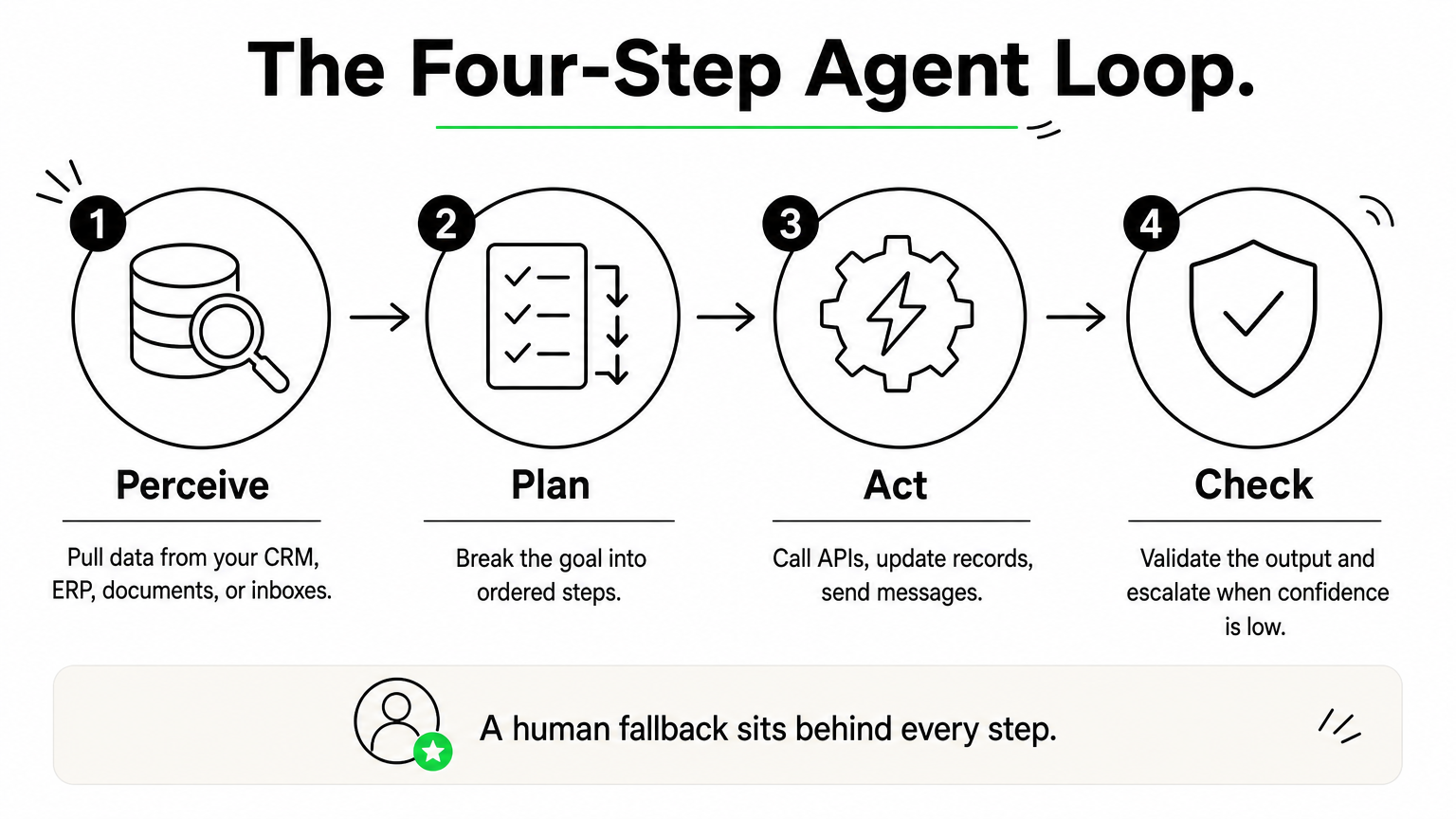
- Perceive: pull data from your CRM, ERP, documents, or inboxes.
- Plan: break the goal into ordered steps.
- Act: call APIs, update records, send messages.
- Check: validate the output and escalate when confidence is low.
Guardrails matter more than the model. We add confidence thresholds, audit logs, and a human escalation path so the agent never acts blindly on a high-stakes decision.
A production agent is a goal, a set of tools, and a human fallback, not a chatbot with a bigger prompt.
Who it is for
Mid-sized and enterprise teams are the usual fit, especially CTOs, VPs of Engineering, and founders who own a process that is repetitive, rule-heavy, and spread across several systems. It also suits you if regulators are watching and you need AI governance and compliance designed in from day one.
Delivery follows four stages: discovery and planning, design and prototyping, development and testing, then deployment and support. You can choose a dedicated team or a fixed-price project. Our senior-only engineers have 7+ years of enterprise AI work behind them, across 250+ clients and a 98% retention rate.
Business results to expect
Results depend on the process you automate, but our case studies show the range. Gains are largest where volume is high and the work is mostly rules and lookups.
| Use case | Result |
|---|---|
| Insurance operations | 30% lower operating costs |
| Lead qualification | 300% more conversion capacity |
| Customer engagement | 40% higher engagement |
2. Customer support agents like Intercom Fin
What the agent does
Fin answers customer questions in chat and email using your help center, past tickets, and product docs. It resolves routine issues end to end, such as order status or password resets, and hands off to a human with the full conversation attached when it can’t. Among AI agents examples, it is the one most customers have already met.
Agent type and how it works
The goal is a resolved conversation, not a single reply, which makes Fin a goal-based agent. Connected to your systems, it can also take actions such as issuing a refund or changing an address. Each conversation follows a simple loop:
- Read the question and the customer’s context.
- Retrieve matching articles and past answers.
- Answer, or call a tool to act.
- Escalate when confidence is low.
Who it is for
Support teams handling thousands of repetitive tickets a month get the most from it, especially SaaS and ecommerce companies. You also need a well-kept help center. Fin is only as good as the content it retrieves, so fix thin documentation first.
Business results to expect
Intercom has priced Fin at $0.99 per resolution, so you pay when the agent closes a ticket, not when it merely replies. The company reports resolution rates above 50% for teams with mature help content. Expect faster first responses and round-the-clock coverage, with your human agents focused on complex cases.
Support agents earn their keep by resolving tickets, not by deflecting them.
3. Financial data agents like Uber Finch
What the agent does
Finch is Uber’s finance agent, and it lives inside Slack. Instead of filing a ticket with the data team, an analyst types a question in plain English and gets figures pulled from governed data sources. As an AI agents example, it shows how agents close the gap between a question and an answer. Typical asks include:
- Quarterly revenue by region
- Variance against the prior period
- A summary sent to a spreadsheet
Agent type and how it works
Technically, Finch is a goal-based agent built around a language model. It turns the question into a database query, runs it, and checks the result before replying. Access follows the user’s role, so permissions stay enforced at the data layer.
- Interpret the question.
- Generate a query against curated tables.
- Return the answer with its source.
A finance agent is only as trustworthy as the data it is allowed to query.
Who it is for
Finance teams with a clean data warehouse and a backlog of ad hoc requests are the best fit. Think FP&A leads and controllers. If revenue means different things across teams, fix your metric definitions first, because the agent will faithfully return the wrong number.
Business results to expect
Uber has not published a hard ROI figure, so we won’t invent one. The realistic gain is minutes instead of days for routine questions, with analysts freed for judgment work. Measure your own baseline first: average time to answer and monthly request volume.
4. Insurance claims and underwriting agents
What the agent does
A claims agent reads the first notice of loss, pulls the policy, and checks coverage. It flags missing documents and routes exceptions to an adjuster. An underwriting agent works upstream, summarizing applications and scoring risk against your guidelines. Among AI agents examples, this one shows how agents take over paperwork-heavy work that used to eat adjuster hours.
Agent type and how it works
Claims triage is a goal-based agent. The goal is a correct, fast decision. Underwriting adds utility-based logic, weighing risk against price. A typical claim moves through three steps:
- Extract data from forms, photos, and PDFs.
- Match the facts to policy terms and limits.
- Approve simple claims, or escalate with a summary.
In insurance, the agent prepares the decision and a licensed human owns the denial.
Who it is for
Carriers, MGAs, and third-party administrators with high claim volume fit best, especially if simple claims clog your queue. You also need clean policy data and clear authority limits, because regulators expect an accountable person behind every adverse decision.
Business results to expect
Our own insurance work cut operating costs by 30%. Expect shorter cycle times on simple claims and more adjuster hours spent on complex ones. Track three numbers before launch: cycle time, touch rate per claim, and leakage.
5. Healthcare scheduling and intake agents
What the agent does
A scheduling agent books, moves, and cancels appointments by text, voice, or web chat. An intake agent collects demographics, insurance details, and symptoms before the visit and writes them into the EHR. As an example of AI agents in a clinical setting, it gives your front desk its phones back without touching medical decisions.
Agent type and how it works
Scheduling is a goal-based agent. The goal is the right slot with the right provider. Waitlist logic adds a utility-based layer that decides who gets a freed slot. A typical booking runs like this:
- Verify the patient’s identity.
- Check provider availability and visit rules.
- Book, then send confirmations and reminders.
- Hand off to staff for any clinical question.
In healthcare, the agent handles logistics and a clinician handles anything medical.
Who it is for
Clinics, specialty practices, and hospital networks with high call volume and a no-show problem are the best fit. You also need HIPAA-compliant handling: a signed business associate agreement with every vendor, encrypted data, and audit logs. Confirm your EHR exposes scheduling through an API before you start.
Business results to expect
Expect fewer missed calls and fewer no-shows, since reminders and easy rescheduling run automatically. Staff time moves from the phone to patients. Capture a baseline before launch: no-show rate, average hold time, and the share of patients who complete intake before arrival.
6. Fraud and risk monitoring agents in banking
What the agent does
A fraud agent watches card payments, transfers, and logins as they happen. It scores each transaction for risk, blocks the clearly bad ones, and opens a case with supporting evidence for the rest. Among AI agents examples in finance, this one stands out because it reviews every event around the clock, far beyond what an analyst team could cover.
Agent type and how it works
This is a utility-based agent. It weighs the cost of letting fraud through against the cost of declining a good customer. A learning component updates the model as fraud patterns shift. A flagged transaction moves through four steps:
- Collect signals such as device, location, amount, and history.
- Score the risk against the customer’s normal behavior.
- Approve, request step-up authentication, or block.
- Send borderline cases to an analyst with a short summary.
The best fraud agent is not the one that blocks the most, it is the one that blocks the right things.
Who it is for
Banks, credit unions, and fintechs with high transaction volume and a growing alert backlog are the best fit. You also need explainable decisions, because compliance teams and regulators will ask why a customer was declined. Build AI governance in from the start, not after launch.
Business results to expect
Expect fewer false positives and faster case review, which leaves analysts time for real investigations. Record your baseline before launch: false-positive rate, fraud losses in basis points, and average alert handling time. Those three numbers will show you whether the agent is paying off.
7. Retail and ecommerce pricing agents
What the agent does
A pricing agent watches competitor prices, inventory, demand, and margin targets. It then adjusts prices on its own within rules you set. It can mark down slow stock and pause discounts on items about to sell out. Among AI agents examples in retail, this one ties directly to margin, because every price change either earns or loses money.
Agent type and how it works
Pricing is a utility-based agent. It does not chase a single target. It weighs revenue, margin, and sell-through, then picks the price with the best overall payoff. A learning component refines its demand estimates as results come in. Each cycle runs like this:
- Pull sales, stock, and competitor price data.
- Forecast demand at several price points.
- Pick the best price inside your floors and ceilings.
- Publish the price, then measure the outcome.
A pricing agent should optimize inside limits you set, never set the limits itself.
Who it is for
Retailers and ecommerce brands with large catalogs and fast-moving competitor prices get the most value. You need reliable inventory and cost data, plus clear rules such as minimum margins and minimum advertised price (MAP) policies. A small catalog rarely justifies the build, since a person can reprice a few dozen items by hand.
Business results to expect
Expect faster reaction to market changes and far fewer manual price edits, with margin protected by your guardrails. Capture a baseline before launch so you can prove the gain:
- Gross margin per category
- Sell-through rate
- Hours spent on manual repricing
8. Logistics and warehouse routing agents
What the agent does
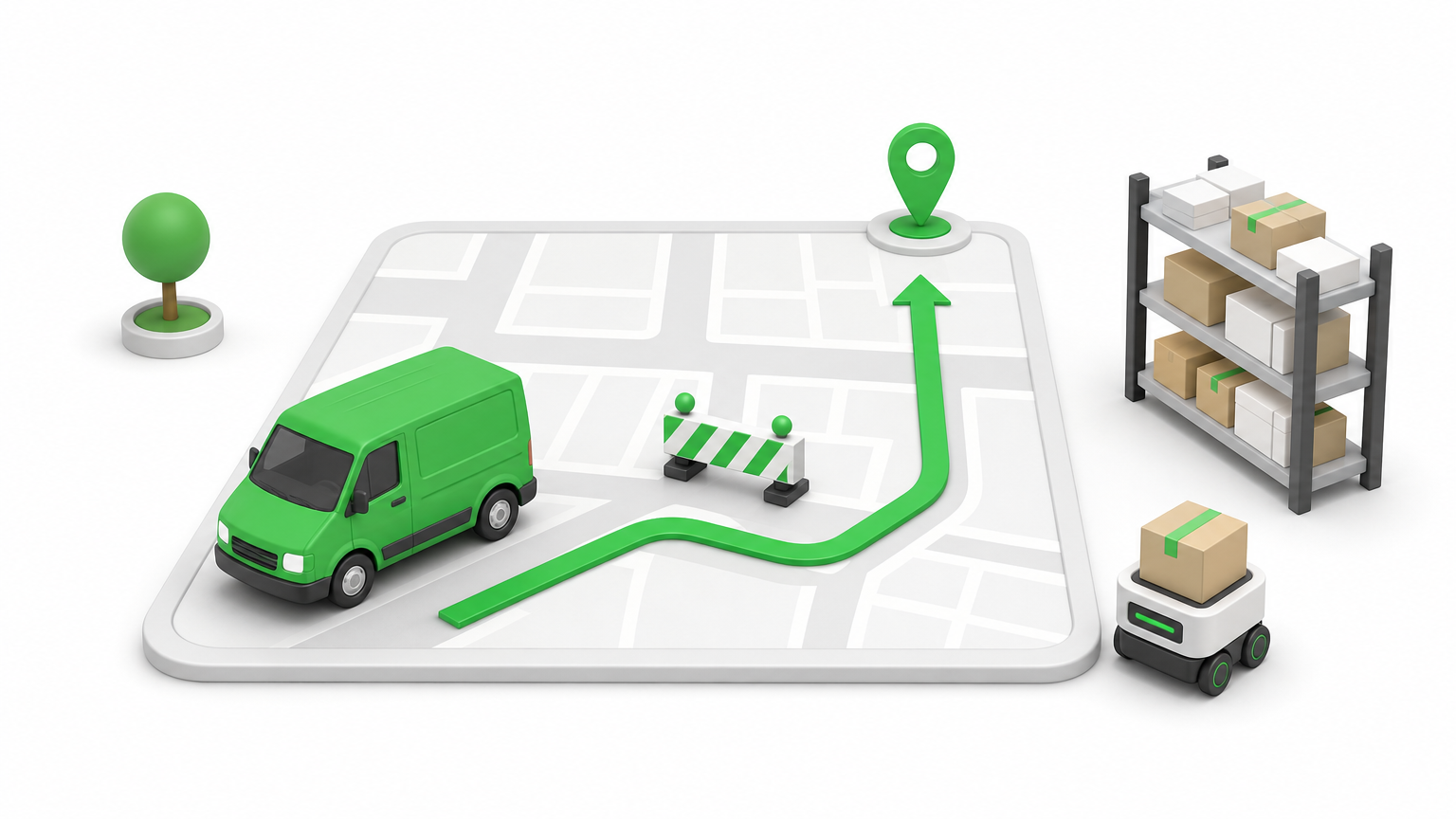
A routing agent plans how goods and vehicles move. It assigns orders to drivers, re-sequences stops when a delay hits, and directs pickers or robots along the shortest path inside the warehouse. Among AI agents examples in logistics, this one reacts to live conditions such as traffic, weather, and dock capacity, which static planning software cannot do.
Agent type and how it works
This is a utility-based agent with a planning layer. It trades off delivery time, fuel, driver hours, and promised delivery windows, then picks the best option. A learning component sharpens its arrival-time predictions over time. Each re-plan runs like this:
- Ingest orders, GPS pings, traffic, and inventory data.
- Generate candidate routes or pick paths.
- Score each one against cost and service windows.
- Dispatch the winner, then re-plan when something changes.
Routing agents win by re-planning every few minutes, not by finding one perfect plan.
Who it is for
Fleets, third-party logistics providers, and distribution centers with many daily stops or high order volume fit best. You need accurate location and inventory data, plus telematics or a warehouse management system with an API. A small fleet running fixed routes rarely needs one.
Business results to expect
Expect lower fuel and mileage costs and more on-time deliveries, with dispatchers handling exceptions instead of building routes by hand. Capture a baseline before launch so the gain is provable:
- Miles driven per stop
- On-time delivery rate
- Picks per labor hour
9. Sales and lead qualification agents
What the agent does
A sales agent replies to new leads within seconds, asks qualifying questions, and books meetings on a rep’s calendar. It also enriches records from your CRM and public company data, then scores each lead against your ideal customer profile. Among AI agents examples in sales, this one sits closest to revenue, since a fast reply often decides who wins the deal.
Agent type and how it works
Qualification is a goal-based agent. The goal is a booked meeting with a lead worth a rep’s time. Scoring adds a utility-based layer that weighs fit against buying intent. Each lead follows this path:
- Capture the inquiry from a form, email, or chat.
- Enrich it with company data and past CRM history.
- Ask follow-up questions and score the answers.
- Book a meeting, or route the lead to nurture or a human rep.
A qualification agent should hand reps better conversations, not just more of them.
Who it is for
B2B teams with high inbound volume and slow response times fit best, including SaaS companies and service providers. You also need a clean CRM and a written definition of a qualified lead. Without one, the agent just automates your confusion.
Business results to expect
We have seen 300% more lead conversion capacity in a client engagement, because reps stopped sorting and started selling. Expect faster response times and fuller calendars. Capture your baseline first:
- Speed to first response
- Lead-to-meeting rate
- Rep hours spent on unqualified leads
10. Research agents like Anthropic’s multi-agent system
What the agent does
Anthropic’s Research feature in Claude takes an open-ended question, splits it into parts, and searches the web and your connected tools in parallel. It returns a cited report instead of a pile of links. Among AI agents examples, it shows what agents do best: long, branching work that no single search can finish.
Agent type and how it works
This is a goal-based agent built as an orchestrator with workers. A lead agent plans, then spawns subagents that each chase one angle. The flow looks like this:
- The lead agent analyzes the question and drafts a plan.
- Subagents search different sources at the same time.
- Each one reports findings back to the lead.
- A citation pass checks claims against sources before the report is written.
Research agents win by dividing the question, not by thinking harder about it.
Who it is for
Analysts, consultants, product teams, and legal or market intelligence groups get the most from it. It fits breadth-first questions such as competitor scans or regulatory reviews. It fits poorly when every step depends on shared context, like most coding work. Plan to verify the citations yourself on anything that reaches a client or a court.
Business results to expect
In Anthropic’s own tests, the multi-agent setup beat a single-agent baseline by 90.2% on an internal research evaluation. Parallel searching cut research time by up to 90% on complex queries. The catch is cost, since these systems use roughly 15x more tokens than a normal chat. Save them for high-value questions. Capture a baseline first: hours per research brief, source coverage, and errors found in review.
11. Personal assistants like Siri, Alexa, and Copilot
What the agent does
Siri, Alexa, and Copilot take spoken or typed requests and act on your behalf. Among AI agents examples, these are the ones you already use daily. Copilot goes deeper at work, drawing on your email, calendar, and documents. Typical requests include:
- Set a reminder or timer
- Control smart-home devices
- Summarize a long meeting thread
Agent type and how it works
Older assistants were simple reflex agents: hear a command, fire a fixed response. Newer versions act as goal-based agents that plan multi-step tasks with a language model. Each request runs like this:
- Capture the request by voice or text.
- Pull context from your calendar, contacts, or files.
- Choose the app or tool to call.
- Confirm, then act.
The shift from voice assistant to agent is the shift from answering to doing.
Who it is for
Consumers get Siri and Alexa with their devices. Alexa+ is free with Prime or $19.99 a month otherwise, while Microsoft 365 Copilot costs $30 per user per month. Knowledge workers are its core audience.
Before rollout, audit your permissions. Copilot sees whatever a user can see, so overshared files surface in answers. Fix your access controls first.
Business results to expect
Expect time back on routine work such as meeting notes and first drafts, though gains vary by role. Run a pilot group before buying seats and track:
- Hours spent on meeting summaries
- Time to a first draft
- Weekly active use per seat
12. Self-driving agents like Waymo
What the agent does
Waymo’s driver takes a rider from pickup to drop-off with no human at the wheel. You hail a car in an app, and the agent handles lanes, signals, pedestrians, and pull-overs. Among AI agents examples, it is the most visible one operating in the physical world at city scale.
Agent type and how it works
This is a utility-based agent with a heavy learning component. It constantly weighs safety, progress, and comfort, then picks the best maneuver. The loop below repeats many times per second:
- Perceive: fuse lidar, radar, and camera data.
- Predict: estimate where nearby cars, cyclists, and pedestrians will go.
- Plan: score candidate trajectories and pick the best.
- Act: steer, brake, or accelerate.
In driving, safety is not a trade-off the agent negotiates, it is the limit everything else works inside.
Who it is for
Riders in Waymo’s service cities use it today. Cities, fleet operators, and logistics firms watch it closely for lessons. Most companies will never build one, but you can borrow the design: layered redundancy, hard safety limits, and remote human support for edge cases. Those patterns carry over to any high-stakes agent you deploy.
Business results to expect
The best public evidence is a peer-reviewed study with Swiss Re covering 25.3 million driverless miles. Compared with human drivers, Waymo cut property damage claims by 88% and bodily injury claims by 92%. Treat those as results for one mature, tightly mapped service, not a promise for every autonomous system. Your takeaway is to measure against a human baseline before you scale.
13. Simple reflex agents like thermostats
What the agent does

A thermostat reads the room temperature and switches heating or cooling on or off. That is the whole job. Among AI agents examples, it is the simplest and oldest one, and you probably own several, from motion-sensor lights to robot-vacuum bumpers. Each one reacts to what it senses right now, with no memory of yesterday.
Agent type and how it works
This is a simple reflex agent. It follows condition-action rules and ignores history, goals, and predictions. The loop is short:
- Sense the current condition, such as 68°F.
- Match it to a rule: if below 68°F, turn the heat on.
- Act, then repeat.
Because it holds no model of the world, it can’t plan ahead or handle a case its rules don’t cover. A learning thermostat like Nest adds memory and prediction, which pushes it toward a goal-based agent.
A simple reflex agent is only as smart as the rules you write for it.
Who it is for
Anyone with a fully observable, rule-bound problem is a fit. Think building controls, factory safety interlocks, or triggers such as "if stock drops below 50 units, reorder." When the right action depends on context, history, or trade-offs, choose a different agent from this list.
Business results to expect
Expect predictable, low-cost behavior. These agents are cheap to build, easy to test, and simple to audit, so they suit regulated settings where you must explain every action. The gains are small but steady. Track how often a rule fires wrongly and which situations it never anticipated. Those gaps tell you when it is time to upgrade.
Choosing the right AI agent to start with
The best of these AI agents examples share one trait: they take a narrow, high-volume process and handle it well, with a human fallback for hard cases. Start where your work is repetitive, your data is clean, and you can measure a baseline today. For most teams that means support, sales qualification, or claims triage, not self-driving cars.
Match the agent type to the problem. Fixed rules call for a simple reflex agent. Clear goals call for a goal-based agent, and real trade-offs call for a utility-based one. Pick the simplest type that works, then add guardrails and audit logs before you scale.
If you want a second opinion, our senior engineers can map your workflow to the right design. Talk to Hatzs Dimensions about building your first custom AI agent and ship one that works in production.
Want to grow your business?
Categories
Designed for the Bold
We help ambitious companies turn ideas into production-ready AI, software, and enterprise systems. Get insights on AI, automation, and digital transformation delivered to your inbox.
200+ solutions delivered across 11+ industries — let's build what's next.