











Most marketing teams do not have a tooling problem. They have a capacity problem. Email sequences, content calendars, social posts, and lead scoring all need constant attention, and hiring does not scale as fast as the backlog. That is where AI marketing agents come in, and why you are comparing platforms right now.
An AI marketing agent is software that plans and executes marketing tasks on its own, within rules you set. Unlike a basic automation that fires one trigger, an agent reads data, decides the next step, and acts. It can draft and send emails, repurpose content, schedule social posts, and score leads. The best ones keep a human approval step where brand risk is high.
Below, you will find 10 platforms ranked by what they do best across email, content, and social. For each one, we cover core strengths, limits, and who it fits. We build production AI systems for 250+ clients at Hatzs Dimensions, so we also flag integration and governance issues that sales pages tend to skip.
What AI marketing agents are and how they work
The label gets stretched to cover everything from chatbots to workflow tools, a confusion we unpack in AI agents vs agentic AI. A useful definition is narrower. An AI marketing agent pursues a goal, such as "get more trial signups from this segment," and chooses the steps to reach it. You supply the goal, the data access, and the rules. The agent handles the sequence.
The agent loop
Most agents, whatever the vendor, run the same four-step loop. Knowing it helps you separate real agent behavior from a chatbot with a new label.
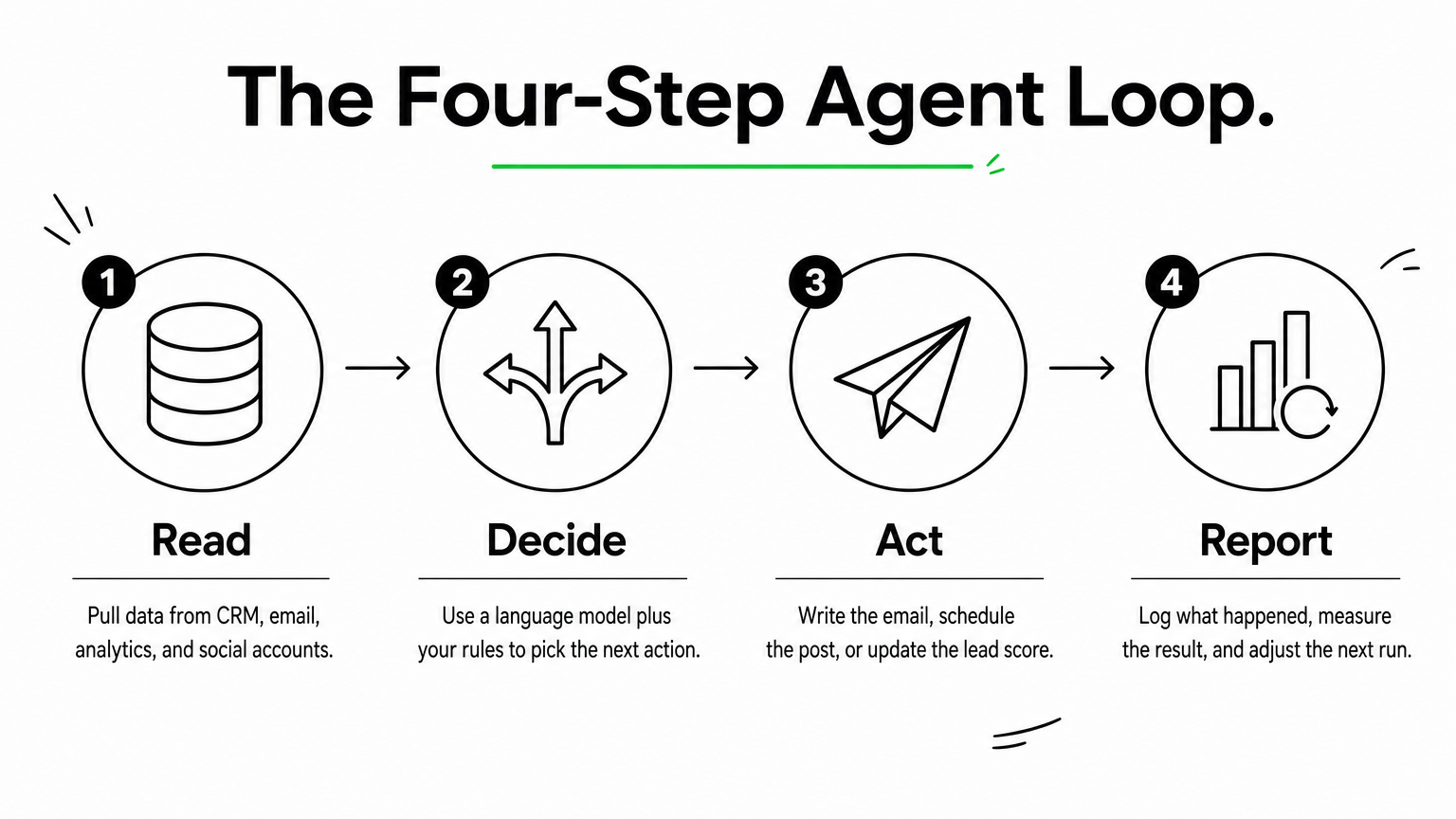
- Read: pull data from your CRM, email platform, analytics, and social accounts.
- Decide: use a language model plus your rules to pick the next action.
- Act: write the email, schedule the post, update the lead score, or launch the campaign through connected tools.
- Report: log what it did, measure the result, and adjust the next run.
Agents versus automation and assistants
| Type | Trigger | Multi-step planning | Example |
|---|---|---|---|
| Rule-based automation | Fixed event | Only the path you built | Welcome email after signup |
| AI assistant | Your prompt | No, one output per request | Draft a subject line |
| AI marketing agent | A goal or event | Yes, it plans its own path | Rework a stalled nurture sequence and queue it for approval |
Rules do not adapt, and assistants wait for you to ask. Agents fill the gap between the two, which is why the decision step matters more than the writing quality when you compare tools.
An agent is judged by the decisions it makes, not by the text it produces.
What they handle well, and where they stall
Agents do best at high-volume, repeatable work with clear success metrics. Think subject-line testing, content repurposing, social scheduling, and lead scoring. These tasks have fast feedback, so the agent can learn what works within days.
They stall when your foundations are weak. Duplicate contacts, stale CRM fields, or an undefined brand voice lead to confident but wrong decisions at scale. That is why the strongest setups pair agents with human approval on anything customer-facing and high-risk, such as pricing claims or regulated messaging.
1. Hatzs Dimensions custom AI marketing agents
What it does
We build custom AI marketing agents around your own workflows instead of selling a fixed product. Each build runs end to end across jobs like these:
- Drafting email sequences and picking send times
- Repurposing content in your brand voice
- Scheduling social posts and triaging replies
- Scoring leads and writing results back to your CRM
Best for
Mid-sized and enterprise teams with processes that off-the-shelf tools can’t handle, such as multi-system stacks or regulated messaging. One of our case studies shows lead conversion capacity up 300%.
Skip this route if you only need one channel. A SaaS agent below will ship faster and cost less.
Integrations and data
Agents plug into your CRM, email platform, analytics, and warehouse. Before launch, our data engineers fix duplicate contacts and stale fields, because weak data creates confident wrong decisions.
Custom builds also skip a vendor’s connector catalog, so internal tools and legacy systems can join the loop.
Governance and human approval
Approval gates are built in from day one. Our AI governance and compliance work defines which actions need sign-off and keeps audit logs of every agent decision.
Customer-facing actions should pass a human gate until the agent earns your trust.
Typical defaults require human review for pricing claims, regulated copy, and first sends to new segments.
Pricing and engagement model
There is no public price list, because scope drives cost. You choose between two models when you talk to Hatzs Dimensions:
| Model | Fits |
|---|---|
| Fixed-price project | Defined scope and budget certainty |
| Dedicated team | Evolving roadmap and multiple agents |
2. HubSpot Breeze agents
What it does

Breeze is HubSpot’s family of AI marketing agents built into its own platform, so there is nothing separate to install. The ones that matter for marketers:
- Content Agent drafts blog posts, landing pages, and emails.
- Social Media Agent writes posts and suggests publishing times.
- Prospecting Agent researches leads and drafts outreach.
- Customer Agent answers support and sales chats.
Best for
Teams already running Marketing Hub or the HubSpot CRM get the fastest start. It suits small and mid-sized teams that want email, content, and social in one system without stitching tools together. Skip it if your core stack is built around another CRM.
Integrations and data
Agents work from the contact, company, and deal records already in HubSpot, which is the main advantage. The app marketplace adds well over 1,000 connectors for outside tools. Data quality is the catch, because agents inherit every messy field in your CRM. Clean duplicates before you switch anything on.
Governance and human approval
Most marketing output arrives as a draft you review before it publishes, so brand-sensitive copy stays under your control. The Customer Agent can hand a conversation to a person when it cannot resolve the question.
Treat every Breeze draft as a first pass until you have audited a few weeks of output.
Set your brand voice and approval owners up front, not after the first bad post.
Pricing and engagement model
Pricing combines paid hub subscriptions with usage-based HubSpot Credits for heavier agent actions. Some Breeze features require Professional or Enterprise tiers. Rates change often, so confirm current figures on HubSpot’s pricing page before you budget. You can start self-serve, and larger accounts usually go through HubSpot sales.
3. Salesforce Agentforce for Marketing
What it does
Agentforce for Marketing runs AI agents inside Marketing Cloud Next, Salesforce’s marketing platform. You give it a campaign goal, and it plans the work through connected tools. Typical jobs:
- Draft campaign briefs and build audience segments
- Generate email and message content
- Assemble journeys and suggest optimizations
- Personalize content for each customer
Best for
Large teams already standardized on Salesforce CRM get the most from it. It suits enterprises with complex segments, several business units, and a dedicated admin or partner to run it. Smaller teams will find the setup heavy, and a lighter tool will go live sooner.
Integrations and data
Agents draw on Data Cloud, which unifies CRM, web, and commerce data into single customer profiles. That gives them more context than a standalone email tool. The trade-off is implementation effort, because you must map sources and set identity rules before the agents produce anything useful.
Governance and human approval
The Einstein Trust Layer masks sensitive data and screens output before it reaches the model, and marketers can review generated content before it sends. Those controls are strong, but they only protect you if someone configures them.
Enterprise guardrails work only when a named person owns the approval rules.
Assign approvers by campaign type before launch.
Pricing and engagement model
Expect two cost layers, and confirm current rates on Salesforce’s pricing page. Purchasing runs through Salesforce sales, often with an implementation partner.
| Layer | How it is billed |
|---|---|
| Platform | Marketing Cloud Next edition licenses |
| Agent usage | Flex Credits consumed per agent action |
Because usage scales with volume, estimate your monthly agent actions before you sign.
4. Jasper agents
What it does
Jasper is a content-first marketing platform, and its agents handle repeatable creative work in a shared workspace. Typical jobs:
- Draft blog posts, ad copy, and email copy in your brand voice
- Repurpose one asset into social posts and newsletters
- Research competitors and audiences before writing
- Run multi-step content pipelines from brief to draft
It plans and writes, but it does not send campaigns or score leads.
Best for
Agencies and brand teams that produce high volumes of on-brand copy get the most value. Skip it if you need autonomous sending or lead scoring. Pair it with an email platform from this list instead.
Integrations and data
Agents learn from brand voice settings, style guides, and uploaded knowledge, not live CRM records. Connections include Google Docs, Webflow, Zapier, a browser extension, and an API.
Because it lacks customer data, personalization stays shallow unless you feed it segment briefs.
Governance and human approval
Output lands as editable drafts in the workspace, so nothing publishes without a person. Higher tiers add SSO and admin controls, and Jasper lists SOC 2 compliance, so ask for the current report.
A content agent that cannot publish on its own is the safest first agent to deploy.
Pricing and engagement model
Pricing is seat-based and self-serve, with sales-led terms for larger teams. Rates change often, so confirm them on Jasper’s site.
| Plan | How it is sold |
|---|---|
| Pro | Per-seat subscription, monthly or annual |
| Business | Custom quote with advanced controls |
5. Klaviyo Marketing Agent
What it does
Klaviyo’s Marketing Agent is one of the few AI marketing agents built specifically for ecommerce, and it lives inside the Klaviyo platform. You describe a goal, and it plans the work from your store data. Typical jobs:
- Draft campaigns and flows with copy and layout
- Choose segments and send times
- Suggest tests based on past results
- Personalize email and SMS for each shopper
Best for
Online retailers and DTC brands, especially Shopify merchants, get the fastest payoff. Because the agent knows purchase history, it is strongest at email and SMS and light on social. Skip it for B2B lead scoring, where a CRM-centered tool fits better.
Integrations and data
Data comes from Klaviyo’s unified profiles, which combine order, browse, and email engagement history. Native integrations cover Shopify, WooCommerce, BigCommerce, and Magento, plus many helpdesk and ad tools. The catch is that output is only as good as your store sync, so verify that your product catalog and events flow correctly before you switch anything on.
Governance and human approval
Campaigns can be reviewed before they send, and you decide which agent actions are allowed. Keep approval on for discounts, because an agent that over-discounts erodes margin quickly.
Put a human gate on any offer that touches your margins.
Start with approvals on for every campaign, then relax them by campaign type once the results hold up.
Pricing and engagement model
Klaviyo bills by active profiles, with a free tier for small lists. Agent features may depend on your plan and rollout stage, so confirm current availability on Klaviyo’s pricing page before you budget. Most accounts buy self-serve, and larger ones go through sales.
6. Braze AI agents
What it does
Braze is a customer engagement platform, and its BrazeAI agents work inside Canvas journeys across email, push, SMS, and in-app messages. They decide what each customer receives and when. Typical jobs:
- Build journey steps from a plain-language goal
- Test message, timing, channel, and offer per customer
- Generate copy and subject lines for review
Best for
Consumer brands with large audiences and mobile apps get the most value, such as retail, media, and fintech. It is strongest at lifecycle messaging. Skip it for small lists, B2B lead scoring, or social publishing.
Integrations and data
Braze ingests events through SDKs, APIs, and Cloud Data Ingestion from warehouses like Snowflake, BigQuery, and Databricks. Currents streams engagement data back out to your analytics stack. The catch is that agents optimize on the events you send, so sloppy event tracking means sloppy decisions.
Governance and human approval
You can preview and test Canvas steps before launch, and you set the limits an agent works within, such as allowed offers, channels, and frequency caps.
Let an agent optimize inside boundaries you wrote, never beyond them.
Keep a person on new offers and regulated copy, and review decision logs weekly during the first month.
Pricing and engagement model
Braze sells through sales with custom quotes, usually driven by monthly active users and message volume. Agent and decisioning features may be packaged as add-ons, so confirm what your contract includes before you budget. Expect a longer onboarding than self-serve tools.
7. Iterable Nova
What it does
Nova is Iterable’s agentic AI layer for cross-channel messaging, built into its customer engagement platform. Among the AI marketing agents on this list, it focuses on journeys across email, SMS, push, and in-app. Typical jobs:
- Draft journeys from a plain-language goal
- Write copy that follows your brand voice
- Optimize send time and channel per user
- Surface audiences likely to convert or churn
Best for
Growth and lifecycle teams at mid-sized to large consumer brands get the most from it, especially when several messaging channels share one audience. Skip it if you need social publishing or long-form content creation. Pair it with a content tool instead.
Integrations and data
Iterable takes in events and profiles through APIs, webhooks, and warehouse or CDP connections such as Snowflake, BigQuery, and Segment. It also offers commerce and CRM connectors, including Shopify and Salesforce. Nova decides from the data Iterable holds, so inconsistent event names and duplicate profiles will skew its choices. Audit your tracking plan before launch.
Governance and human approval
Marketers can review and edit AI-generated journeys and copy before anything goes live. That makes Nova easy to run with a clear split of duties.
Let the agent propose the journey, and let a person approve the launch.
Keep human sign-off on first sends to new segments and on regulated copy.
Pricing and engagement model
Iterable sells through its sales team with custom quotes, usually shaped by user counts and message volume. Nova capabilities may be packaged by plan, so confirm exactly what your contract includes before you budget. Expect a guided onboarding rather than a self-serve signup.
8. Zapier Agents
What it does
Zapier Agents are AI teammates that work across the apps you already use. You describe a job in plain language, give the agent instructions and tools, and it runs on a trigger or a schedule. It is a general-purpose builder, not a marketing-only product. Typical jobs:
- Research a new lead and write a summary to your CRM
- Draft social posts or email copy and route them for review
- Score inbound form fills against your criteria
- Post a weekly campaign summary to Slack
Best for
Lean teams and ops-minded marketers get the most from it, especially when your stack mixes many tools and no single platform covers the workflow. Skip it if you need a native email engine or deep per-customer personalization. Zapier orchestrates other tools and does not replace them.
Integrations and data
Reach is the main draw. Agents connect to thousands of apps, including HubSpot, Salesforce, Gmail, Slack, and Google Sheets, and they can browse the web and read uploaded knowledge. The catch is that you design the logic yourself. A vague prompt or a missing field in a connected app produces vague results, so write narrow instructions and test on a handful of real records first.
Governance and human approval
Autonomy is yours to dial. You choose which tools an agent may use, test its runs before turning it on, and review its activity history afterward. Check current settings for approval before an action runs, and use them for anything that sends or publishes.
Start every Zapier agent in draft mode, and let a person press send.
Because one agent can touch many apps, limit its permissions to the accounts the job actually needs.
Pricing and engagement model
Billing is usage-based. Zapier meters agent work in activities, and a free tier lets you test before you commit. Paid plans scale with volume and add team features. Limits and rates change often, so confirm current figures on Zapier’s pricing page. Signup is self-serve, with sales-led plans for larger teams.
9. Lindy
What it does
Lindy is a no-code platform for building AI agents, which it calls Lindies. You describe a job in plain language, choose a trigger, and it assembles the workflow. Typical marketing jobs:
- Triage and answer inbound email
- Research a lead and draft personalized outreach
- Turn a content brief into social post drafts
- Log results to your CRM or a spreadsheet
Best for
Founders and small sales and marketing teams get the most from it, especially when inbound and outbound busywork eats the week and no engineer is available. Skip it if you need a native email engine or deep campaign analytics. Lindy automates tasks around your tools and does not replace them.
Integrations and data
Connections cover Gmail, Google Calendar, Slack, HubSpot, and Salesforce, plus thousands of other apps through its integration library. An agent only knows what you give it, so upload brand guidelines and sample emails before you ask for copy.
Governance and human approval
You can add a confirmation step that pauses an agent before it sends or publishes, and you choose which accounts it may touch. Lindy lists SOC 2 compliance, so request the current report if security reviews your tools.
Put a confirmation step in front of every action a customer will see.
Give each agent only the permissions its job needs.
Pricing and engagement model
Pricing is credit-based and self-serve, with sales-led terms for larger teams. Plans and credit allowances change often, so confirm current figures on Lindy’s pricing page.
| Tier | How it works |
|---|---|
| Free | Limited credits to test one workflow |
| Paid | Monthly credits, more agents and integrations |
| Enterprise | Custom quote with admin and security controls |
10. Sprout Social Trellis
What it does
Trellis is Sprout Social’s AI agent for social media management, built into the Sprout platform. Among the AI marketing agents on this list, it is the social-first option. Typical jobs:
- Summarize conversation trends from social listening
- Draft captions and replies in your brand voice
- Sort and prioritize inbox messages
- Surface insights from post and audience performance
It does not send email or score leads.
Best for
Social and community teams that manage several networks and a busy inbox get the most from it. Agencies and mid-sized to large brands fit well. Skip it if you need email, lead scoring, or long-form content. Pair it with an email platform or a content tool like Jasper instead.
Integrations and data
Data comes from the social activity Sprout already collects: publishing history, engagement, inbox messages, and listening topics. Sprout connects to major networks such as Facebook, Instagram, LinkedIn, X, TikTok, and YouTube, plus CRM and helpdesk tools like Salesforce and Zendesk. The catch is that Trellis sees social, not your full customer record, so cross-channel decisions stay with you.
Governance and human approval
Social mistakes are public, so approvals matter more here than almost anywhere. Sprout’s publishing approval workflows and user permissions let you require sign-off before anything goes live.
On public channels, the agent drafts and a person publishes.
Keep a human on replies to complaints and on anything touching legal or crisis topics.
Pricing and engagement model
Sprout sells per-seat plans, billed monthly or annually, with a custom quote at the top tier. Which Trellis features come with which plan can change as they roll out, so confirm current availability on Sprout’s pricing page.
| Plan level | How it is sold |
|---|---|
| Standard to Advanced | Per-seat subscription with a free trial |
| Enterprise | Custom quote through sales |
How to choose the right AI marketing agent
No single platform wins on every channel. Answer three questions in order, and your shortlist usually drops to two or three tools.
Match the agent to your main channel
Begin with the channel that eats the most hours. Specialists beat suites on depth, while suites win on fewer moving parts. Use this table to narrow the field.
| Primary need | Best fits from this list |
|---|---|
| Email and SMS for ecommerce | Klaviyo |
| Lifecycle messaging at scale | Braze, Iterable Nova |
| Email, content, and social in one CRM | HubSpot Breeze |
| Enterprise on Salesforce | Agentforce for Marketing |
| High-volume on-brand copy | Jasper |
| Social and community | Sprout Social Trellis |
| Glue across many tools | Zapier Agents, Lindy |
| Multi-system or regulated work | Hatzs Dimensions |
Check where your data lives
Data decides more outcomes than features do. An agent is only as good as the records it reads, so choose the tool closest to your cleanest data. If your purchase history lives in Shopify and Klaviyo, buy there. If it lives in Salesforce, stay there.
The best agent is the one that sits next to your cleanest data.
Before any demo, run a short readiness check and ask the vendor to show you each answer:
- Are contacts deduplicated and fields current?
- Does the agent read your CRM natively, or through a connector you must maintain?
- Can you see a log of every action it takes?
- Can you require approval before sends and publishes?
Decide between buying and building
Buy when one channel and standard workflows cover you, and use our build vs buy framework if the call is close. SaaS agents ship in weeks and cost less to run. Build when your stack spans several systems, your copy is regulated, or you need custom approval rules. That is where a custom build earns its cost.
Guardrails and getting your first agent live
Most failed rollouts of AI marketing agents skip the boring setup, not the tool choice. Spend your first week on limits, and the agent will earn trust faster once it goes live.
Set the guardrails first
Write the rules down before you connect anything. Limit permissions to the accounts the job needs, and cap send volume and spend so a bad loop cannot run all weekend.
An agent without a kill switch is a risk, not a pilot.
Your pre-launch checklist:
- A brand voice document with 10 approved and 10 rejected examples
- A banned-claims list covering pricing, guarantees, and legal terms
- Frequency caps per contact
- A weekly review of the agent’s action log
- One named owner who can pause the agent immediately
Run a 30-day pilot
Pick one channel and one metric, such as reply rate or trial signups. Keep the scope small enough that you can compare results against a control group and see what the agent changed.

| Week | Focus | Human gate |
|---|---|---|
| 1 | Clean data, write rules, connect read-only | Agent cannot act |
| 2 | Drafts only | Approve 100% of output |
| 3 | Send to a small segment | Approve first sends |
| 4 | Compare against baseline | Relax approvals on low-risk tasks |
Measure at day 30, then decide to expand, adjust, or stop. If the agent beat your baseline with clean logs, add a second channel. If it did not, fix the data before blaming the tool, starting with a data governance framework.
Picking your first agent
Your best pick comes down to three things: your main channel, where your cleanest data lives, and how much control you need. Choose the tool closest to that data, and you skip most of the problems that sink rollouts.
Start small, whatever you choose. Run a 30-day pilot with one channel, one metric, and a person approving every send. AI marketing agents earn their place by beating a baseline, not by looking impressive in a demo.
If your stack spans several systems or your messaging is regulated, an off-the-shelf tool may not fit. In that case, talk to Hatzs Dimensions about a custom AI marketing agent, and we will scope a pilot with approval gates built in from day one.
هل تريدون تنمية أعمالكم؟
التصنيفات
صُمّم للجريئين
نساعد الشركات الطموحة على تحويل أفكارها إلى أنظمة ذكاء اصطناعي وبرمجيات ومؤسسات جاهزة للإنتاج. احصل على رؤى حول الذكاء الاصطناعي والأتمتة والتحول الرقمي تصلك مباشرة إلى بريدك الإلكتروني.
200+ حلاً تم تسليمها في 11+ قطاعاً، فلنبنِ معاً ما هو قادم.