











Most companies do not have a data problem. They have an ownership problem. Reports disagree, nobody knows who can approve access to a customer table, and every AI pilot stalls when someone asks where the training data came from. A data governance framework is what fixes that.
In short, a data governance framework is a documented system of roles, policies, processes, and standards that defines how your organization collects, stores, secures, and uses data. It answers four questions: who owns the data, who can use it, what rules apply, and how you prove it. Most frameworks, including DAMA-DMBOK and the DGI model, are built from the same handful of parts.
Below, you will find the core components of a framework, a side-by-side look at the major models, and practical examples you can adapt. We also cover how to build one step by step. Our team has put these frameworks into production for enterprise and regulated clients, so the guidance comes from delivery work, not theory.
Why a data governance framework matters
Without governance, every team defines data on its own. Sales counts a customer as a signed contract, finance counts an invoiced account, and support counts anyone with a ticket. None of them is wrong, but together they are unreliable. A framework gives the business one set of definitions, owners, and rules, so those arguments end before the quarterly report.
The cost of ungoverned data
Bad data is expensive in ways that rarely show up on one line item. Analysts spend days reconciling spreadsheets instead of analyzing them. Marketing emails the same person three times. Operations ships to stale addresses. Duplicate and inconsistent records drain hours every week, and decisions built on the wrong number are harder to catch than the hours lost.
Ownership is the root cause. When nobody is accountable for a dataset, nobody fixes it. A good framework for data governance names an owner and a steward for each critical domain, so a quality issue has an address. In our delivery work, this one change resolves more problems than any tool purchase.
Regulation and AI raise the stakes
Rules on data keep tightening, and regulators expect evidence, not good intentions. A data privacy governance framework lets you show where personal data lives, why you hold it, and who has touched it. The table shows what common regulations ask of your data practices.
| Regulation | What it expects from your data practices |
|---|---|
| GDPR | Lawful basis for processing, records of processing, data subject rights |
| CCPA/CPRA | Right to know, delete, and opt out of sale or sharing |
| HIPAA | Safeguards for protected health information, minimum necessary access |
| GLBA | Protection of customer financial information |
| EU AI Act | Documented data governance for training data in high-risk AI systems |
AI adds a second layer of risk. Models inherit every flaw in their training data, so a biased or stale dataset becomes a biased or stale decision. If you cannot trace data lineage and consent, you cannot explain an output to an auditor or a customer. AI governance starts with data governance, which is why stalled AI pilots so often trace back to missing ownership.
What you gain in practice
Teams that put a framework in place usually see the same gains, and most appear within the first two quarters:
- Trusted numbers: one definition of each key metric, so reports match.
- Faster access: clear approval paths replace weeks of email chains.
- Lower risk: audit trails, retention rules, and access controls you can show on request.
- Cheaper operations: fewer manual fixes, less duplicate storage, less rework.
- AI readiness: documented, quality-checked data that models can safely use.
A framework does not slow data use down. It makes data safe enough to use at speed.
Scale is where the payoff grows. A startup can survive on tribal knowledge, but an enterprise data governance framework has to hold across dozens of systems, several regions, and thousands of users. Skipping it early does not save time. It just moves the cleanup to a moment when more data, more teams, and more regulators are involved.
Core components and pillars of a framework
Labels vary between models, but the data governance framework components are nearly the same everywhere. Think of them as six pillars. If one is missing, the others carry extra weight until something cracks.
The six pillars at a glance
| Pillar | What it covers | Typical artifact |
|---|---|---|
| People and roles | Owners, stewards, governance council | RACI chart |
| Policies and standards | Usage, retention, naming, definitions | Data policy |
| Processes | Access requests, issue escalation, change control | Workflow |
| Data quality | Accuracy, completeness, timeliness | Quality scorecard |
| Security and privacy | Classification, access, consent | Classification scheme |
| Metadata and lineage | Glossary, catalog, traceability | Data catalog |
Most failed programs over-invest in one row, usually tooling, and ignore the people row. Fix that imbalance first.
People come first
Start with roles and accountability. A governance council of five to eight senior leaders sets priorities and settles disputes. Data owners are accountable for a domain such as customer, product, or finance. Stewards do the daily work: fixing records, maintaining definitions, and answering questions from analysts.

A policy nobody owns is a document, not governance.
Write each role down with its decision rights. If two people think they approve access to the same table, you have recreated the original problem with better titles.
Policies, quality, and metadata
Policies turn intent into rules people can follow. Cover classification, retention, access, and acceptable use, and keep each one to a page or two. Long policies do not get read, and unread policies do not get enforced.
Quality only works when it is measurable. Set thresholds such as "98% of customer records have a valid email" and publish a scorecard each month. Pair that with a business glossary and a catalog, so everyone can see what a field means, where it came from, and who to ask about it.
Security and privacy complete the set. Classify data by sensitivity, tie access to role, and log who touched what. These controls are also the evidence an auditor will ask for first.
Popular data governance frameworks compared
No single model wins every time. The major frameworks overlap heavily, so the real question is which one fits your size, industry, and tolerance for process. If you searched for the DGI data governance framework or DAMA-DMBOK, this comparison shows where each one earns its place.
Side-by-side comparison
The table below lines up the four models we see most often in enterprise work. Use it to narrow the field to one or two candidates before you read the source material.
| Framework | Origin | Best for | Main strength | Main drawback |
|---|---|---|---|---|
| DAMA-DMBOK | DAMA International | Large, mature data teams | Complete vocabulary across 11 knowledge areas | Dense, and too heavy to adopt whole |
| DGI Framework | Data Governance Institute | Organizations starting out | Simple structure that executives grasp quickly | Light on technical detail |
| DCAM | EDM Council | Banks and financial services | Capability scoring you can show regulators | Built around financial sector needs |
| COBIT | ISACA | IT-led, audit-driven companies | Strong controls and audit alignment | Treats data as part of IT governance |
DAMA-DMBOK and DGI in practice
DAMA-DMBOK is a reference book, not a recipe. It places data governance at the center of a wheel of 11 knowledge areas, including quality, security, and metadata. Treat it as a shared vocabulary and a gap checklist. Trying to implement every chapter is how a ten-person team stalls for a year.
The DGI framework works better as a starting blueprint. It organizes ten components into three groups: rules, people, and processes. That maps cleanly to the six pillars covered earlier, and it is easy to draw on one slide for a steering committee. Its weakness is technical depth, so you will fill in quality and metadata details yourself.
How to choose
Match the model to your constraints, not to its reputation. A bank under supervisory review will lean toward DCAM because examiners recognize it. A mid-sized retailer with no data office will get further with DGI. In our experience, most clients end up with a hybrid: DGI’s structure for the operating model and DAMA’s definitions for the vocabulary, plus whatever regulatory controls their industry demands.
Pick the model that fits your regulators and your culture, then borrow from the rest.
How to create a data governance framework
Building a framework is less about writing documents and more about getting decisions made. If you want to know how to create a data governance framework that people actually follow, start with one business problem and expand only after it works. The sequence below is the one we use with clients.
Seven steps from kickoff to operation
Each step produces a concrete output, which keeps the project from drifting into endless workshops.
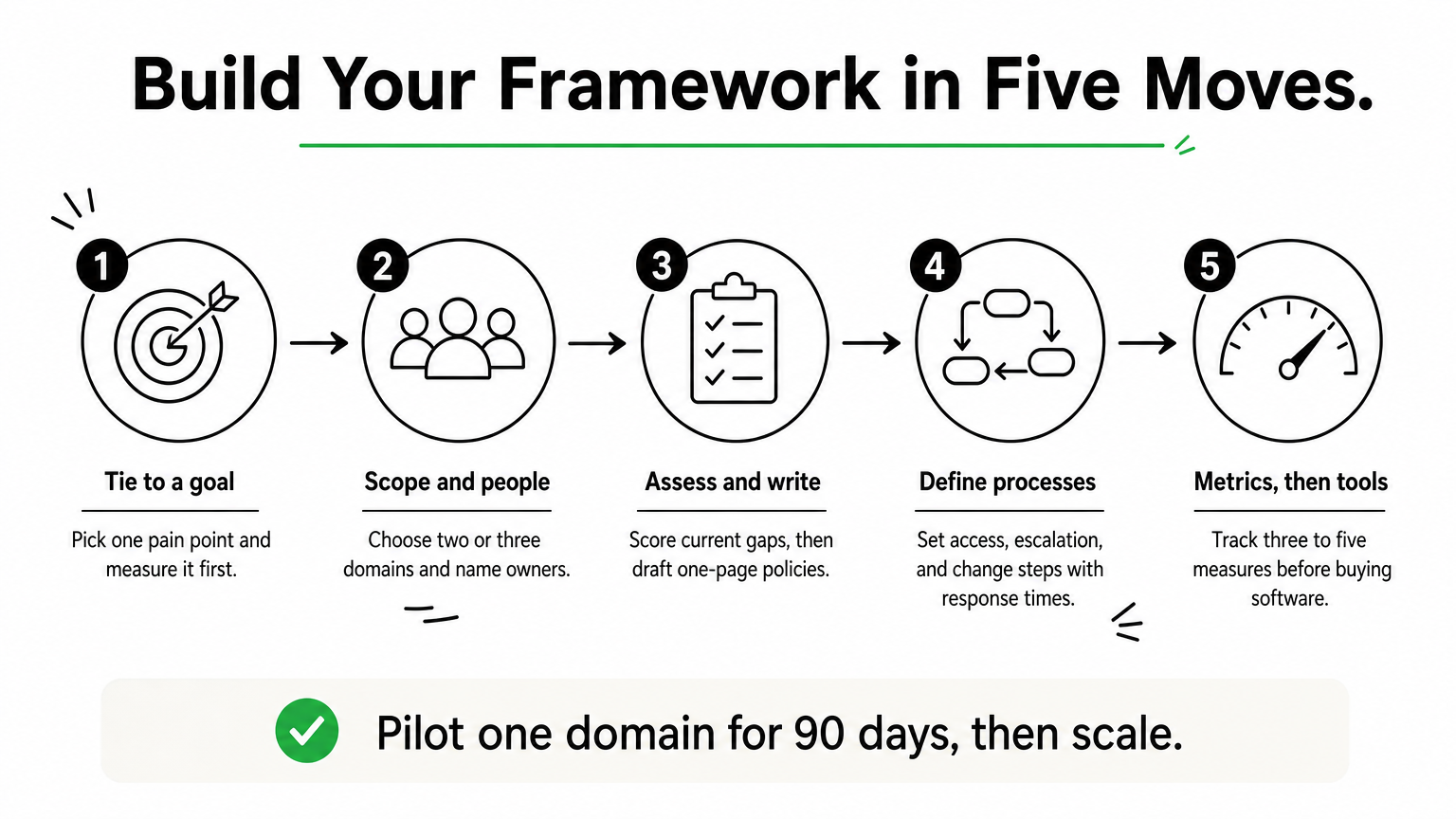
- Tie it to a business goal. Pick one pain point, such as conflicting revenue reports or an audit finding, and measure it before you begin.
- Set the scope. Choose two or three critical domains, such as customer and product. Leave the rest for later.
- Name the people. Appoint a council, an owner per domain, and stewards. Use names, not departments.
- Assess the current state. List the systems that hold critical data, then score quality, access, and documentation gaps against your chosen model.
- Write minimum viable policies. Cover classification, access, quality thresholds, and retention in a page or two each.
- Define the processes. Set up access requests, issue escalation, and change approval, each with a response time.
- Choose metrics, then tools. Track three to five measures, and buy a catalog only after roles are settled.
Pilot first, then scale
Run the full cycle on a single domain for about 90 days. Customer data is a common choice because every team touches it. Publish the first quality scorecard by week six and log every council decision, so the pilot leaves an audit trail from day one.
Start with one domain, one owner, and one measurable problem.
Once the pilot shows a result, such as a falling duplicate rate or faster access approvals, extend to the next domain and reuse the same roles and templates. Teams that skip the pilot usually produce a polished framework that nobody has tested against real work. Teams that run it get a proven operating model and an internal success story that makes the next rollout easier to fund.
Data governance framework template and diagram
Documents beat discussion only when they are short. A data governance framework template should fit on one page, and a data governance framework diagram should fit on one slide. If either runs longer, people stop reading it.
A one-page template you can copy
Copy the outline below into a shared document and fill in every blank. It mirrors the seven build steps, so each answer comes from work you have already done.
DATA GOVERNANCE FRAMEWORK: [Company name]
1. Business goal: [problem] | baseline: [x] | target: [y]
2. Scope: [domains] | [systems] | [regions]
3. Roles
   Council chair: [name]
   Data owner, [domain]: [name]
   Data steward, [domain]: [name]
4. Policies: classification, access, retention, quality, acceptable use
5. Processes: access request (response time: [x] days),
   issue escalation, change approval
6. Quality thresholds: [field] at or above [x]%
7. Metrics: [3 to 5 measures]
8. Review: council monthly, framework annually
Blanks matter more than prose. A field that says "TBD" next to an owner means nobody is accountable yet, and the template is only a wish list.
A template works only when every blank holds a name or a number.
A diagram executives can read in a minute
Next, draw the structure as layers of accountability. Keep it to one slide, with decision rights flowing down and issues flowing up.
[ Governance council: priorities, disputes ]
                  |
[ Data owners: one per domain ]
                  |
[ Data stewards: quality, definitions ]
                  |
[ Policies | Processes | Standards ]
                  |
[ Customer data | Product data | Finance data ]
Read it top to bottom. Each layer answers to the one above it, and every box has a named person, not a department. Add tools such as your catalog only at the bottom, so nobody mistakes software for the framework itself.
Framework examples for enterprise, big data, and privacy
The six pillars stay the same across organizations. What changes is where you put the weight. These data governance framework examples are composites drawn from our client work, so you can see how the structure bends under different pressures.
Enterprise: a federated model for a multi-region insurer
Large organizations rarely succeed with a fully central team. A federated model works better: a small central office sets policy, and each business domain owns its data. At a typical insurer, the chief data officer chairs the council, with owners for claims, policy, and billing, and stewards embedded in each line of business.
- Central office (4 to 6 people): standards, tooling, and monthly scorecards.
- Domain owners: approve access and accept quality targets.
- Regional leads: adapt policies to local law.
In an enterprise, centralize the rules and decentralize the accountability.
Big data: govern at the point of ingestion
A big data governance framework cannot rely on manual review. Volume and speed are too high, so controls move into the pipeline. Tag and classify data when it lands, and apply stricter rules as it moves toward the zones people actually use. This zone model is common in data lakes.

| Zone | Governance applied |
|---|---|
| Raw | Source logged, sensitive fields auto-tagged, restricted access |
| Curated | Quality checks, schema validation, lineage captured |
| Trusted | Certified definitions, named owner, broad access |
Privacy: built around personal data
A privacy-led framework starts with an inventory of personal data: what you hold, why, where it sits, and the lawful basis for using it. Add consent records and retention schedules to that inventory, and assign a privacy officer as the owner.
Requests then become a process with a clock. GDPR gives you one month to answer an access request, and CCPA gives you 45 days. Build the request workflow and deadline tracking once, and every regulation you add later reuses it.
Choosing software to support your framework
Software should serve the framework, not define it. Data governance framework software automates work your roles and policies already describe, which is why tool selection comes last in the build steps. If you buy before owners are named, you end up with an expensive catalog nobody maintains.
What the main tool types do
Most products fall into five categories. Each one supports a specific pillar from earlier.
| Tool type | Job it does | Pillar supported |
|---|---|---|
| Data catalog and glossary | Search, definitions, ownership | Metadata and lineage |
| Data quality tools | Profiling, rules, monitoring, scorecards | Data quality |
| Privacy and access management | Classification, consent, request tracking | Security and privacy |
| Lineage and observability | Trace data flows, alert on pipeline breaks | Metadata and lineage |
| Workflow and policy management | Approvals, attestations, audit trail | Processes |
Platforms such as Microsoft Purview bundle several categories, which cuts integration work. Specialist tools go deeper on one job. A specialist makes sense when a single pillar, often quality, is your biggest gap.
Questions to ask before you buy
Score every vendor against the same checklist, and ask for answers on your own data, not a polished demo.
- Does it connect to your warehouse, CRM, ERP, and cloud storage without custom code?
- Can stewards use it without help from engineering?
- Does it capture lineage automatically, or only when someone documents it?
- Can it enforce policies, or does it only record them?
- What is the full cost at rollout, including licenses, integration, and training?
Mistakes that waste the budget
Test before you commit. Run a proof of concept on your pilot domain for 30 days and measure it against the baseline from step one. A tool that cannot move that number will not move it at scale either.
Buy software to enforce decisions you have already made, not to make them for you.
Finally, watch for lock-in and scope creep. Pick tools that export your metadata in open formats, so a vendor change does not erase years of glossary work. Roll features out one domain at a time, and keep the owners from your template in charge of every configuration choice.
Putting your framework to work
A data governance framework works when everyone can see who owns what. The six pillars, the model comparison, the template, and the tooling checklist all serve that goal. Name the owners first, write short policies people will read, and let software enforce decisions you have already made.
Start small. Pick one domain, run it for 90 days, and measure the result against your baseline. A proven pilot beats a polished document, and it gives you the evidence to expand into the next domain with the same roles and templates.
If you want a senior team to design the roles, policies, and tooling, or to connect governance to your AI roadmap, talk to the engineers behind our data governance and BI services at Hatzs Dimensions. We will help you build a framework your teams actually use.
Want to grow your business?
Categories
Designed for the Bold
We help ambitious companies turn ideas into production-ready AI, software, and enterprise systems. Get insights on AI, automation, and digital transformation delivered to your inbox.
200+ solutions delivered across 11+ industries — let's build what's next.