











People use the terms interchangeably, and that causes real problems when you scope a project or evaluate a vendor. If you are comparing AI agents vs agentic AI, the short version is this: they are not the same thing, and mixing them up leads to mismatched budgets and expectations.
An AI agent is a single software component built to complete a defined task, such as answering support tickets or pulling data from a CRM. Agentic AI is the broader approach, where one or more agents plan, decide, and act toward a goal with minimal human direction. Think of agents as the workers and agentic AI as the system that coordinates them. Both differ from generative AI, which creates content when prompted but does not act on its own.
Below, we define each term, show how they relate, and walk through practical examples. We also explain where generative AI fits. Our senior engineers have shipped enterprise AI systems into production for over 7 years, so the guidance here comes from real deployments, not theory. By the end, you will know which one your use case calls for.
Why the difference between AI agents and agentic AI matters
Most teams first hit this distinction in a budget meeting. Someone asks for "an agentic AI solution," engineering hears "a chatbot with a few tools," and finance hears "a platform." The label sets the scope, and a wrong label means a wrong estimate. Settling the agentic AI vs AI agents question early also keeps your project plan honest before any code is written.
It changes what you scope and budget
A single AI agent has a narrow job, a short list of tools, and a clear finish line. Think of an agent that classifies inbound support tickets and drafts replies. You can scope it in a short discovery phase and test it against a fixed set of real examples.
Agentic AI is a different build. You are designing several agents, the logic that hands work between them, shared memory, and rules for when the system must stop and ask a person. The orchestration layer takes most of the effort, not the individual agents. Teams that price an agentic system like a single agent usually run out of budget at integration.
It changes your risk profile
An agent that drafts a reply can be wrong in a small, visible way. A system that plans its own steps, calls your billing API, and updates customer records can be wrong in ways that compound before anyone notices. Autonomy raises the cost of every mistake, so the controls you need grow with it.
The more freedom a system has to act, the more it needs guardrails, logging, and a human checkpoint.
The table below shows how the same questions get different answers depending on what you are building.
| Question | Single AI agent | Agentic AI system |
|---|---|---|
| Scope | One defined task | A goal that spans many tasks |
| Main build effort | Prompts, tools, evaluation | Orchestration, memory, guardrails |
| Impact of an error | Usually limited to one output | Can cascade across steps and systems |
| Oversight needed | Spot checks and sampling | Audit trails and approval gates |
Regulated industries feel this most. In banking, insurance, and healthcare, compliance teams ask what a system is allowed to do on its own. "It’s an agent" does not answer that. They want defined decision boundaries and a clear AI governance record of who approved what.
It changes how you evaluate vendors
Vendors use both terms loosely. A product with one model call and a button can end up marketed as "agentic." Four questions cut through the pitch:
- Does it plan multiple steps on its own, or follow a fixed script?
- Which systems can it act on, and with what permissions?
- What happens when it fails or is unsure?
- Can you see and audit every action it takes?
Clear answers tell you whether you are buying a capable single agent or a coordinated system. Both can be the right purchase. The problem starts when you pay for one and expect the other.
How to tell AI agents and agentic AI apart in practice
Definitions only help if you can apply them to a real system. When you review a demo, an architecture diagram, or your own backlog, run a few simple tests instead of trusting the label. The tests below settle most debates about AI agents vs agentic AI in a few minutes, and they look at behavior, not marketing.
Four tests you can run on any system
Each test asks what the system does, not what the vendor calls it. Count how many rows lean right in the table. One is a hint. Three or four means you are dealing with agentic AI.
| Test | Leans toward an AI agent | Leans toward agentic AI |
|---|---|---|
| Goal | A defined task, such as "classify this ticket" | An outcome, such as "resolve this customer’s issue" |
| Planning | Follows a path someone designed | Builds and revises its own steps |
| Coordination | One component does the work | Several agents hand work to each other |
| Memory | Context lasts one session | State persists across tasks and days |
Planning is the most telling test. An agent walks a path that an engineer drew. An agentic system chooses its own path, changes it when a step fails, and decides when the goal is met.
One request, two designs
Consider a customer refund request. Built as an AI agent, the system reads the message, checks the refund policy, and drafts a reply for a person to approve. The task is fixed and the output is one reply.
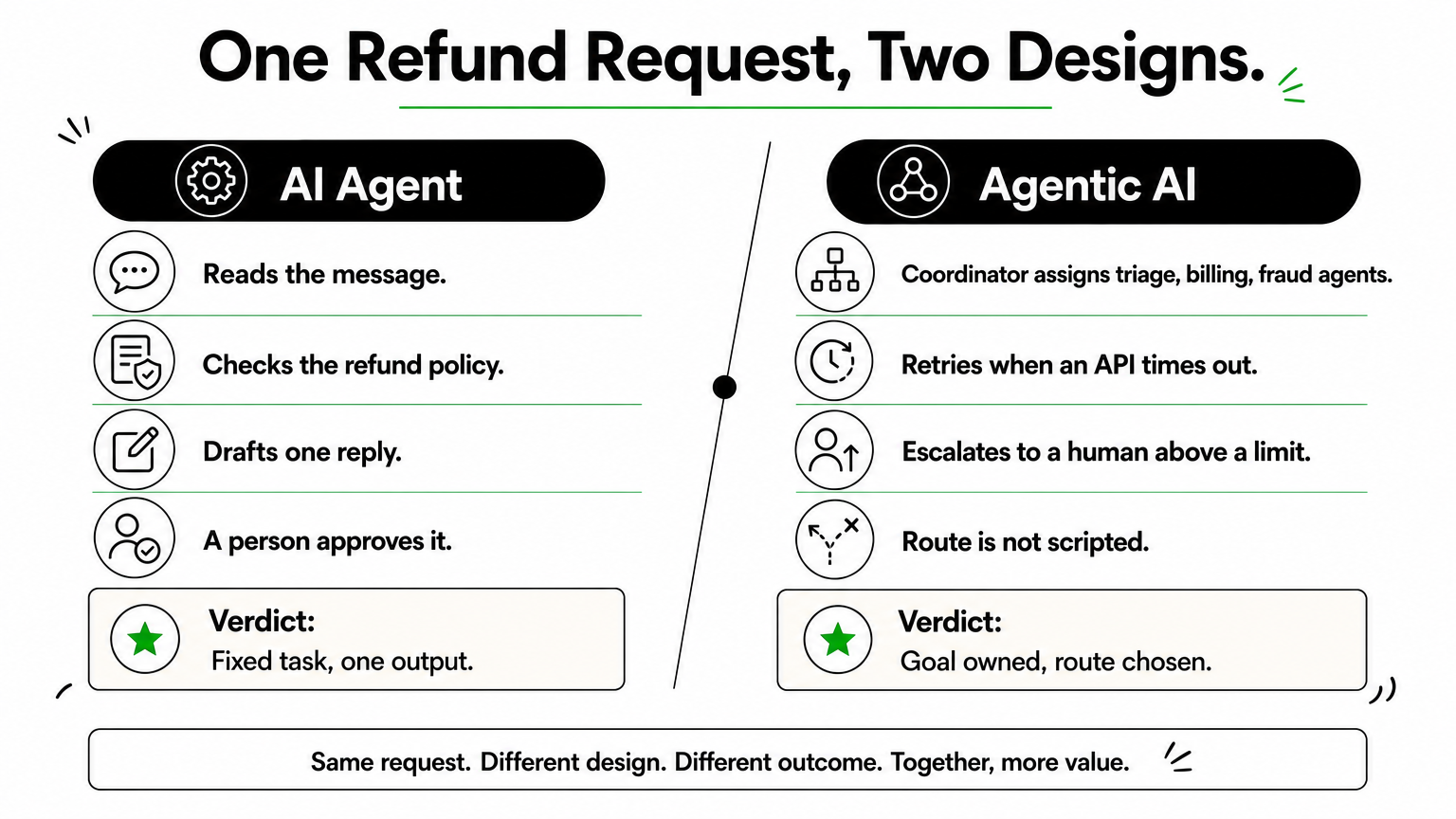
Agentic AI treats the same request as a goal: resolve this refund. A coordinator assigns a triage agent, a billing agent, and a fraud-check agent, retries when an API times out, and escalates to a human when the amount passes a set limit. Nobody scripted the exact order of those steps.
If one component finishes a named task, it is an agent. If the system chooses the route to an outcome, it is agentic AI.
Where the line blurs
Plenty of products sit in the middle. A single agent with a loop and five tools can plan within one task without any coordination. Call it an agent with agentic traits, and ask what it can do without a person. That answer, not the label, should drive your risk review and your budget.
How generative AI, AI agents, and agentic AI compare
Three terms get blurred together in most vendor decks, so it helps to place them on one scale. Generative AI creates, an AI agent acts, and agentic AI pursues a goal. Each step up adds capability, and each adds risk.
Generative AI produces, it does not act
Generative AI takes a prompt and returns content such as text, code, images, or summaries. Ask it for a refund email and you get a polished draft. It does not send the email, check the refund policy, or notice that the customer has written twice. A person carries every output into the next system, so a human stays in the loop for each step.
Side-by-side comparison
The table shows where the three differ on the points that affect cost and oversight.
| Generative AI | AI agent | Agentic AI | |
|---|---|---|---|
| Core job | Create content | Complete a defined task | Reach a goal across tasks |
| Starts when | You write a prompt | A trigger or request arrives | A goal is set |
| Acts on systems | No | Yes, through a few tools | Yes, across many systems |
| Planning | None | Follows a designed path | Builds and revises its own plan |
| Human role | Uses every output | Approves or samples | Sets goals and limits |
Notice that the jump from generative AI to an agent is about access to tools. The jump from an agent to agentic AI is about who decides the route. Those are different engineering problems with different price tags.
They stack, they do not compete
Most AI agents run on a generative model. The model reads the request and reasons about it, and the agent wraps that model with instructions, tools, and a task. Agentic AI then coordinates several of those agents. The same model can sit under all three, which is why the labels confuse buyers.
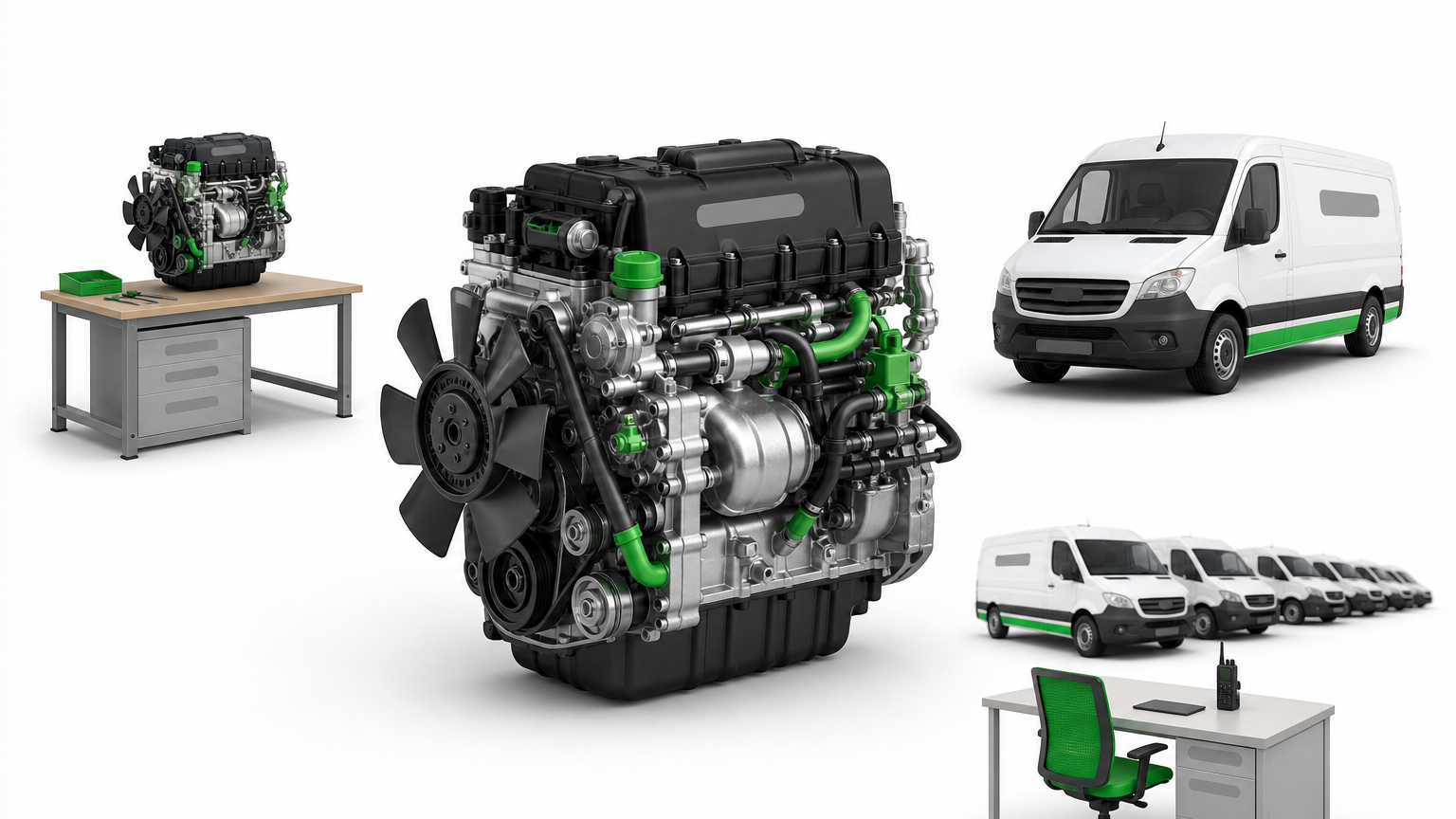
Generative AI is the engine, an AI agent is a vehicle built around it, and agentic AI is the fleet with a dispatcher.
So the agentic AI vs AI agents question is about scope, not about which model you license. You can start with one agent, prove it on real data, and add coordination later. Building in layers lets you add autonomy only where your testing shows it is safe.
Real-world examples of AI agents and agentic AI
AI agent examples make the split concrete. Across industries the pattern repeats: an agent owns one task, while an agentic system owns an outcome.
Examples of single AI agents
Most production AI today is agents. Each has a single trigger, a few tools, and a clear finish line, so you can measure accuracy on a fixed test set before launch. Typical examples:

- A support agent that tags tickets and drafts replies
- An accounts payable agent that extracts invoice lines and posts them to your ledger
- A sales agent that qualifies inbound leads and books meetings
Examples of agentic AI systems
Agentic AI appears where work crosses systems and the route changes case by case. The table shows one industry at both levels, with the agentic version owning the whole outcome.
| Industry | AI agent | Agentic AI |
|---|---|---|
| Insurance | Extracts data from a claim form | Runs a claim from intake to payout recommendation, checks coverage, flags fraud, routes exceptions |
| Logistics | Predicts a delivery delay | Reroutes the shipment, rebooks the carrier, notifies the customer |
| Banking | Summarizes a KYC document | Runs the onboarding review, requests missing documents, escalates edge cases |
The difference between agentic AI vs AI agents is less about intelligence and more about how much of the journey the system owns.
Start narrow, then connect
Nothing in the agentic column is exotic. Each row is several agents plus coordination, memory, and escalation rules. The practical path is to deploy one agent first, prove it on real data, then connect it to others.
Also watch for cosmetic claims. A demo that runs a scripted five-step flow is an agent with a long script. Ask the vendor to show the system recovering from a failed step. If it cannot, it is not choosing its own route.
How to decide which approach fits your business
Choosing between AI agents vs agentic AI is a business decision before it is a technical one. Three questions drive it: how predictable the work is, how costly a mistake would be, and whether your systems are ready. Start with the work, not the technology, because the right answer changes from one process to the next inside the same company.
Match the approach to the work
Look at the process you want to improve and count the decisions inside it. Fixed steps with a clear finish line point to an agent. Variable routes across several systems point to agentic AI.
- Choose a single AI agent when the task repeats, inputs look alike, and success is easy to measure. Invoice extraction and ticket tagging fit this.
- Choose agentic AI when each case needs different steps and the goal is an outcome, such as handling a claim or recovering a delayed shipment.
- Choose neither yet when the process is undocumented. If your own team cannot describe the steps, software cannot learn them.
Check your readiness
Next, test your AI readiness by checking whether your foundations can support autonomy. An agent needs clean access to the right data and a few reliable APIs. An agentic system also needs shared memory, logging, and approval gates, and those take real engineering time to build and test.
Risk tolerance matters just as much. If an error touches money, health records, or legal exposure, limit what the system can do alone and keep a person at the final checkpoint. Teams in banking and insurance often start with agents that recommend, then let them act only after months of clean results.
Give a system the least autonomy that solves the problem, then grant more only as your evidence builds.
Match the engagement model
Budget shape follows scope. A single agent with a defined task suits a fixed-price project, since you can test it against real examples and know the finish line. An agentic system grows as you add agents, tools, and rules, so a dedicated team usually fits better. Either way, pilot one workflow first. Measure error rate, time saved, and how often a person had to step in, then decide whether the next workflow earns more freedom.
Common misconceptions, including ChatGPT and agent types
Three myths come up in almost every scoping call. Each one leads to the wrong purchase or the wrong level of oversight, so it pays to clear them up before the AI agents vs agentic AI discussion goes any further.
Myth: ChatGPT is agentic AI
A plain chat session is generative AI. You type a prompt, it returns text, and you decide what happens next. Nothing acts on your systems and nothing pursues a goal after the reply appears.
The line moves when tools enter the picture. Give a model a browser, your calendar, or code execution plus a task, and it behaves like a single AI agent. Even then it is one agent. It is not a coordinated system with shared memory, escalation rules, and several specialized agents.
Myth: agentic means no humans
Agentic describes who chooses the route, not who is accountable. Production systems keep approval gates on anything touching money, records, or legal exposure. Teams that remove people entirely usually put them back after the first costly error.
Autonomy is a setting you tune per workflow, not a switch you flip for the whole system.
Myth: the classic agent types are the same as agentic AI
Textbook AI, such as Russell and Norvig’s Artificial Intelligence: A Modern Approach, sorts agents into five types. These describe how one agent decides, not how many agents work together.
| Type | How it decides | Example |
|---|---|---|
| Simple reflex | Fixed if-then rules on current input | Spam filter rule |
| Model-based | Rules plus a memory of the world | Inventory monitor |
| Goal-based | Picks actions that reach a target | Route planner |
| Utility-based | Weighs trade-offs to maximize a score | Dynamic pricing engine |
| Learning | Improves from feedback | Recommendation engine |
A goal-based agent is still one agent. Agentic AI is a system-level property: several agents, any of these types, coordinated toward an outcome. So when someone says "it’s a learning agent, so it’s agentic," ask how many components share the goal and who decides the route. Those two answers settle it.
Putting the two terms in their place
The difference comes down to scope. An AI agent completes a defined task, while agentic AI coordinates several agents toward a goal and chooses its own route. Generative AI sits underneath both, creating content but not acting. Once you see that, the AI agents vs agentic AI debate stops being about labels and starts being about how much of an outcome you want a system to own.
For your own projects, test behavior instead of trusting vendor names. Start with one agent, prove it on real data, and add autonomy only where results justify it. Give a system the least autonomy that solves the problem, and keep human checkpoints wherever money, records, or compliance are at stake.
If you are weighing agentic AI vs AI agents for a real workflow, our senior engineers can help you size it. You can scope an AI agent pilot with Hatzs Dimensions and get a plan that fits your process and risk level.
هل تريدون تنمية أعمالكم؟
التصنيفات
الوسوم
صُمّم للجريئين
نساعد الشركات الطموحة على تحويل أفكارها إلى أنظمة ذكاء اصطناعي وبرمجيات ومؤسسات جاهزة للإنتاج. احصل على رؤى حول الذكاء الاصطناعي والأتمتة والتحول الرقمي تصلك مباشرة إلى بريدك الإلكتروني.
200+ حلاً تم تسليمها في 11+ قطاعاً، فلنبنِ معاً ما هو قادم.