











Intelligent agents in AI are systems that perceive their environment, decide what to do, and act to reach a goal. A thermostat, a robot vacuum and a software agent that reads invoices and updates your ERP all qualify. They differ in how much they remember, plan and learn. The term comes from the textbook definition of AI: anything that senses and acts can be an agent, and it is "intelligent" when its actions reliably move it toward its objective.
This guide covers why AI intelligent agents matter, how the perceive-decide-act loop works, and the parts every agent needs. It then walks through the five classic types, shows how to choose and implement the right one, and gives real examples. It also answers a common question: is ChatGPT an intelligent agent?
Hatzs Dimensions builds custom AI agents for businesses, so the focus here is practical. You will see where the textbook categories show up in real systems and where the definitions get blurry.
Why intelligent agents in AI matter
Intelligent agents matter because they move AI from producing output to finishing work. That shift changes what you can automate and how you measure results.
From answering questions to finishing tasks
A classifier that labels an invoice saves one click. An agent that reads the invoice, matches it to a purchase order, flags a mismatch and routes it for approval handles the whole task. The value comes from the loop, not from any single prediction.
Agents also adapt to context. A fixed script breaks when an input changes. An agent evaluates the situation each time and picks an action, which is why they suit messy, multi-step processes.
What changes for a business
When you think in agents, three things shift:
- Fewer handoffs. One system carries a task across your CRM, inbox and internal tools.
- Decisions at data speed. The agent reacts to new information as it arrives instead of waiting for a weekly review.
- A clear success measure. Every agent needs a defined performance measure, so you can judge it on results instead of impressions.
An intelligent agent is valuable because it owns an outcome, not because it generates an answer.
How intelligent agents work, step by step
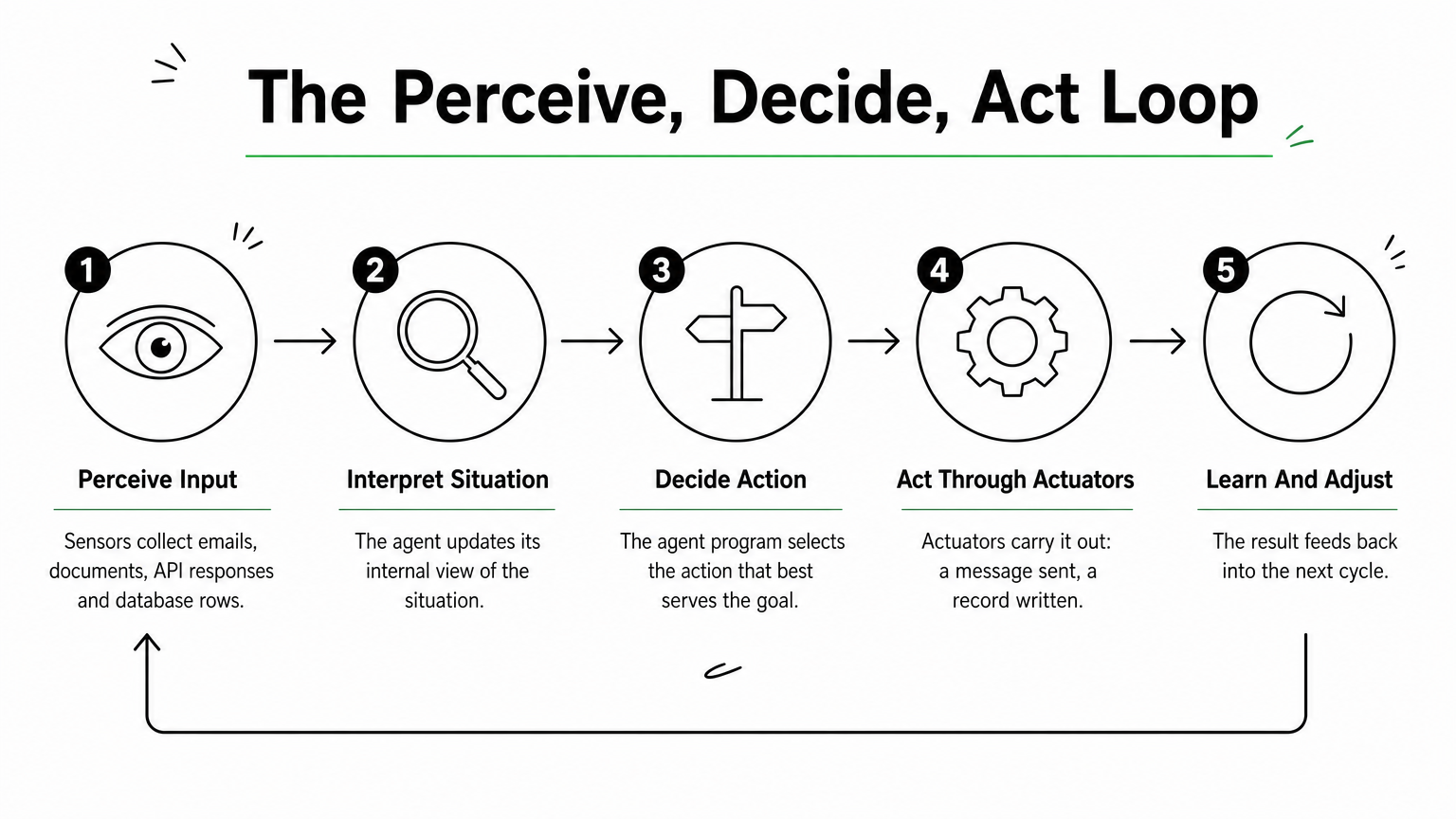
An intelligent agent works in a continuous loop: it senses, updates its picture of the world, chooses an action and acts. Then it senses again to see what happened.
The perceive, decide, act loop
- Perceive. Sensors collect input. For software, that means API responses, emails, documents or database rows.
- Interpret. The agent updates its internal view of the situation.
- Decide. The agent program selects the action expected to serve the goal best.
- Act. Actuators carry it out: a message sent, a record written, a motor turned.
- Learn or adjust. The result feeds back into the next cycle.
The architecture: PEAS and the agent program
Textbook AI describes an agent’s setup with PEAS: Performance measure, Environment, Actuators and Sensors. The agent function is the abstract mapping from what the agent has perceived to what it does. The agent program is the code that implements that mapping. Here is PEAS for an invoice-processing agent:
| PEAS element | Invoice-processing agent |
|---|---|
| Performance measure | Correct matches, time per invoice, exceptions caught |
| Environment | ERP, email inbox, vendor portal |
| Actuators | ERP writes, emails, approval tasks |
| Sensors | API reads, document parsing, inbox monitoring |
A rational agent is one that picks the action expected to maximize its performance measure given everything it has perceived. Rational does not mean perfect. It means the best choice with the information available.
Define the performance measure before you build anything, because every other part of the agent follows from it.
The five types of intelligent agents
The five standard types are simple reflex, model-based reflex, goal-based, utility-based and learning agents. Each one adds a capability to the one before it.
Comparing the types side by side
| Type | Decides using | Example | Main limit |
|---|---|---|---|
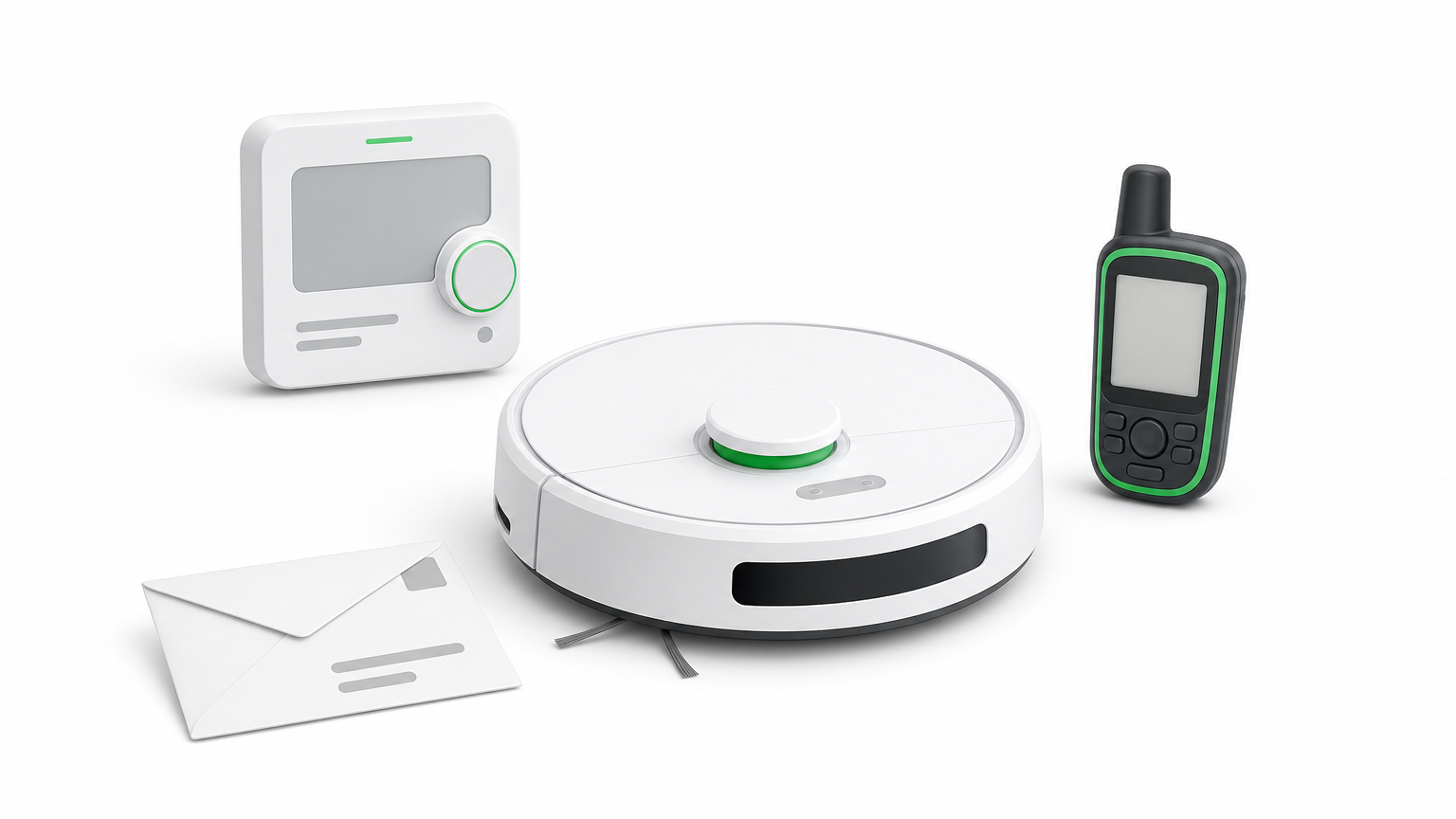
| Simple reflex | Current input and fixed rules | Thermostat | Fails when it cannot see the full situation |
| Model-based reflex | Rules plus an internal model of the world | Robot vacuum with a room map | Still follows fixed rules |
| Goal-based | A target state and planning | GPS route planner | Treats all paths to the goal as equal |
| Utility-based | A score for how good each outcome is | Trip planner balancing time, cost and comfort | Needs a well-defined utility function |
| Learning | Experience that improves its own behavior | Spam filter that learns from user corrections | Needs data and feedback to improve |
What separates one type from the next
Each step up adds one idea. Memory lets the model-based agent handle what it cannot see right now. Goals let the agent plan a sequence of actions instead of reacting to one input. Utility lets it trade off competing aims, such as speed against cost, when several routes reach the goal.
Learning is different because it can be added to any of the other four. A learning component critiques results and updates the agent’s behavior. Most production systems are hybrids that combine several types.
You do not pick a type for its prestige. You pick the simplest one that handles your environment.
How to choose and implement the right agent type
Choose the simplest agent type that handles how predictable and how visible your environment is. More capability means more cost, more testing and more ways to fail.
Match the type to the environment
- Stable, fully visible, rule-driven: a simple reflex agent. Think routing a ticket by keyword.
- Partly hidden information: a model-based agent that tracks state, such as order status across systems.
- Multi-step work with a clear end state: a goal-based agent.
- Real trade-offs between outcomes: a utility-based agent, such as balancing discount depth against margin.
- A changing environment with feedback available: add a learning component.
Steps to implement one
- Write the performance measure in numbers, such as a 90% correct-match rate.
- Map the environment and tools the agent must read from and write to, using tool integrations.
- Start with the narrowest agent that could work, on one workflow.
- Add guardrails and human approval for high-risk actions.
- Measure against the baseline, then widen scope.
This is the approach behind the AI agents we build: custom agents that carry out multi-step tasks, connect to your CRM, ERP and internal tools, and answer from your own company knowledge.
Start with one workflow and one measurable goal, then grow the agent only when the numbers justify it.
Real-world examples of intelligent agents
Intelligent agents already run in homes, vehicles and back offices. The common thread is a loop of sensing and acting toward a defined goal.
Examples across industries
- Autonomous vehicles use cameras and radar as sensors, plan routes and weigh safety against speed.
- Fraud detection agents watch transactions, score risk and block or flag payments, and they improve as analysts confirm outcomes.
- Warehouse robots build a model of the floor, plan paths and avoid collisions.
- Customer support agents read a request, look up account data and resolve or escalate it.
- Back-office agents process claims, invoices or onboarding steps across several systems.
Is ChatGPT an intelligent agent?
A plain chat interface is mostly reactive. It responds to a prompt and stops, so it is closer to a language model than a full agent. It behaves like an agent when it is given tools, a goal and permission to take several actions in a loop.
The same logic answers the question of the smartest AI agent. No single ranking exists, because an agent is only as good as its performance in a specific environment. Judge candidates on your task, not on general reputation.
A language model becomes an agent when it can act toward a goal, not just answer.
What to remember about intelligent agents
An intelligent agent senses, decides and acts toward a goal, and the five types differ only in how much they remember, plan, weigh and learn. The best choice is rarely the most advanced one. It is the simplest type that handles your environment, measured against a clear performance goal.
If you are weighing where agents could remove manual work in your business, talk to Hatzs Dimensions about building an AI agent for your workflows.
Want to grow your business?
Categories
Designed for the Bold
We help ambitious companies turn ideas into production-ready AI, software, and enterprise systems. Get insights on AI, automation, and digital transformation delivered to your inbox.
200+ solutions delivered across 11+ industries — let's build what's next.