











Agents architecture in AI is the structural design of an AI agent: the model that reasons, the memory it reads and writes, the planning logic that breaks a goal into steps, the tools it calls, and the orchestration layer that ties these parts together. In plain terms, it is the blueprint that decides how an agent takes in information, chooses what to do next, and acts on the world without a human steering every step.
This guide goes past the bare definition. You will see why architecture matters more than most teams expect, how to assemble an agent layer by layer, which agent types and design patterns exist, and how a real system fits together. Use it to scope a first agent or to diagnose one that already misbehaves.
At Hatzs Dimensions, our senior engineers design and ship AI agents into production for enterprises and growth-stage companies. The advice below comes from that work. Pick the simplest architecture that meets the requirement, then add complexity only where it earns its place.
Why agents architecture in AI matters
Architecture matters because it decides what your agent costs, how fast it responds, and whether you can trust what it does. The same language model can power a dependable system or an erratic one, depending on how you wire it. Good agents architecture in AI is what turns a clever demo into something you can run in production.
Architecture sets cost, latency, and reliability
Every reasoning step in an agent is usually a model call. A loop that thinks one step at a time sends the full conversation history to the model on every turn, so cost and latency grow with each step. A fixed plan that a cheaper model executes costs less, but it adapts poorly when a step returns something unexpected. You are always trading one property against another.

- Cost: the number of model calls per task, and the size of the model behind each one.
- Latency: sequential steps add up, while parallel branches shorten the wait.
- Reliability: loops can drift off task, and every added step is another chance to fail.
- Auditability: a clear structure shows which component made which decision, which risk and compliance teams will ask about.
Model choice is one decision. Architecture is the decision that contains all the others.
Agentic versus non-agentic systems
A plain language model takes an input and returns an output. That is enough for summarizing, drafting, and answering a question from a single prompt. An AI agent adds a loop: it observes its situation, reasons about what to do, acts through a tool, and checks the result before deciding again. Some designs add a learning step so the agent improves with feedback.
The distinction also separates workflows from agents. A workflow follows a path you defined in advance, which suits repeatable jobs such as validating records. An agent chooses its own steps, which suits open-ended problems such as research or coding. If your task has a fixed path, build a workflow and enjoy the lower cost and tighter control.
Is ChatGPT an agent or an LLM?
ChatGPT is a product, and a large language model is one component inside it. The model generates text. Around it sit the application layer, memory features, and tools such as web search, file analysis, and code execution. When those tools and a decision loop let the product pick its own next step and act on outside systems, it behaves as an agent.
So the useful question is not about brand names. Ask whether the system chooses its own next action and changes something beyond the chat window. If it does, you are dealing with an agent and need to design for it.
How to build an AI agent architecture layer by layer
Build the architecture in layers: input, reasoning, memory, planning, tools, and orchestration, with guardrails around all of them. Each layer has one job, and each forces one design decision that you should settle before you write code.
The core components and the decision each one forces
| Component | Its job | Decision it forces |
|---|---|---|
| Perception (input layer) | Receives messages, events, documents, or API data and normalizes them | Which formats and triggers does the agent accept? |
| Reasoning model | An LLM interprets context and chooses the next action | One large model, or smaller models per task? |
| Memory | Holds task state and past knowledge | What persists, for how long, and who can read it? |
| Planning | Breaks a goal into steps and revises when results surprise | Plan upfront, or step by step? |
| Tool use | Calls APIs, databases, code runners, and browsers | Which tools, and with what permissions? |
| Orchestration | Controls order, loops, handoffs, retries, and stop conditions | One agent, or several? |
Memory deserves extra care. Working memory holds the state of the current task, such as which steps are done and what data you already have. Long-term memory stores past interactions and knowledge, usually reached through retrieval from documents or databases. Retrieval also grounds answers in real data, which reduces hallucination.
Two cross-cutting pieces sit around every layer in agents architecture in AI. Guardrails limit what the agent may do, for example by capping spend or requiring approval before any write action. Observability records every model call, tool call, and decision so you can debug and audit later. Teams often skip both until the first incident, then add them under pressure.
Each component is a decision you make once on purpose or many times by accident.
A build order that keeps risk low
Order matters as much as the parts. Start small and let real failures justify each addition.
- Define the task boundary and a measurable success criterion.
- Start with a single model call plus retrieval, and test it against real examples.
- Add tool integrations one at a time, read-only first and write access last.
- Add a reasoning loop only when a single pass demonstrably fails.
- Add long-term memory only for facts the agent must carry across sessions.
- Build evaluation and logging before launch, not after.
- Split into multiple agents only when one agent’s context or tool list becomes unmanageable.
Types of AI agent architectures
AI agent architectures are classified in two ways: by how the agent decides, and by how many agents cooperate. The first gives you the classic agent types. The second gives you single-agent and multi-agent systems and their topologies.
The five classic agent types
These five types come from classical AI and still describe the decision logic inside modern systems.
| Type | How it decides | Example |
|---|---|---|
| Simple reflex | Condition-action rules on the current input only | A rule that flags a known spam phrase |
| Model-based reflex | Keeps an internal picture of the world | A robot vacuum tracking mapped rooms |
| Goal-based | Searches for actions that reach a defined goal | A route planner |
| Utility-based | Scores outcomes and picks the best tradeoff | A pricing engine balancing margin and conversion |
| Learning | Improves its behavior from feedback | A recommendation system |
Modern LLM agents usually blend goal-based, utility-based, and learning behavior. Related labels describe the same ideas from another angle. Reactive designs map situations straight to actions, deliberative designs plan from an internal model, and cognitive designs such as belief-desire-intention separate what the agent knows, what it wants, and what it has committed to doing.
Single-agent and multi-agent systems
A single-agent system has one decision-maker with centralized control. It is simpler to build, cheaper to run, and far easier to debug. Its limits show up when one agent must juggle many domains or high volume.
A multi-agent system splits work among specialized agents that coordinate, hand off, or run in parallel. You gain specialization and speed, and you pay with coordination overhead and harder debugging. Default to a single agent and split only when you can name the specific limit you hit.
Vertical, horizontal, and hybrid topologies
Multi-agent systems follow one of three shapes:
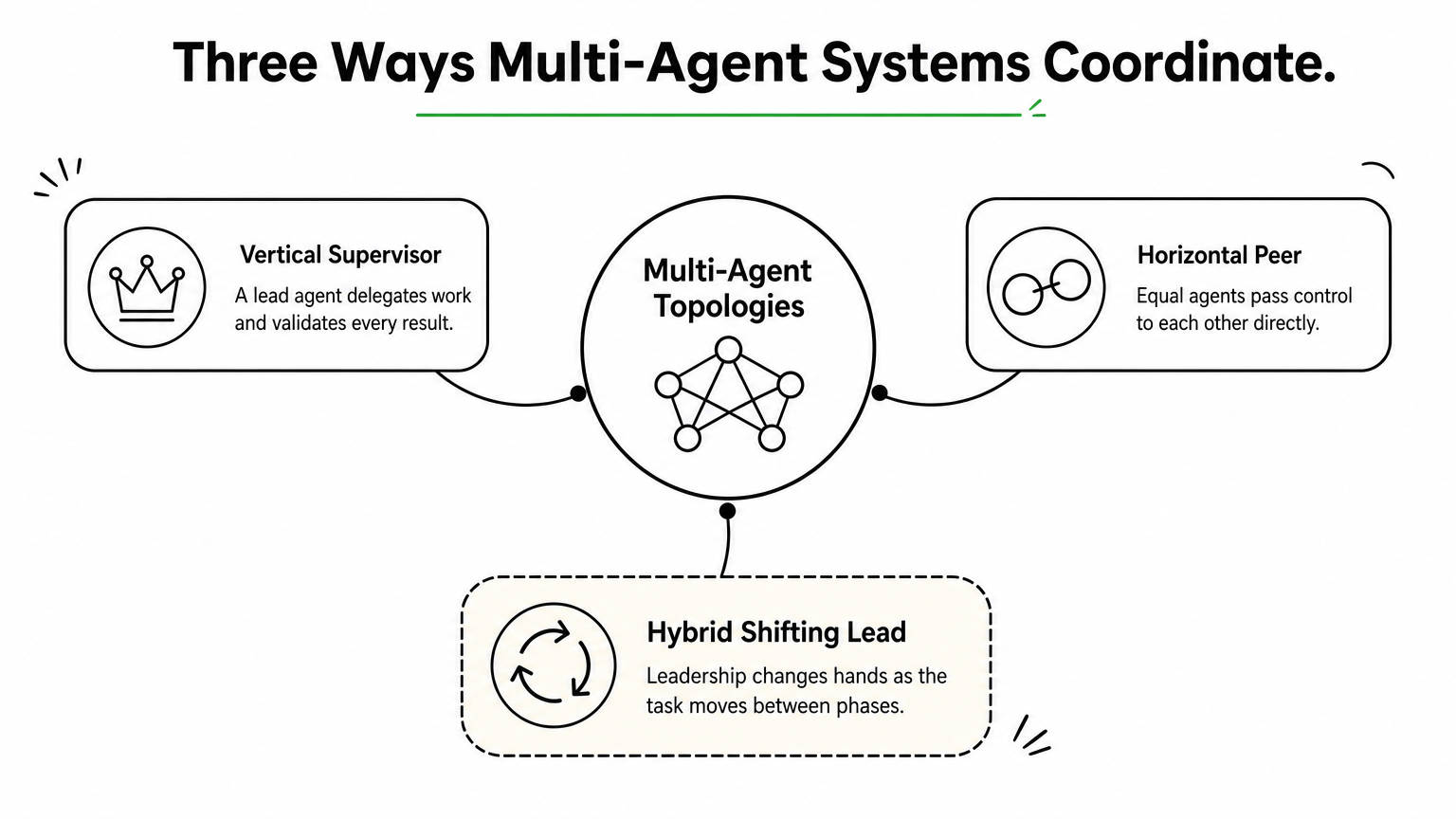
- Vertical (supervisor): a lead agent decomposes the task, delegates, and validates results. Accountability is clear, but the lead can become a bottleneck and a single point of failure.
- Horizontal (peer): equal agents pass control to each other. It suits brainstorming and conversational handoffs, but needs clear protocols or it turns chaotic.
- Hybrid: leadership shifts with the phase of the task. It is the most versatile and the hardest to manage.
Choose the least complex topology that still fits the task, because every extra agent adds a coordination cost.
Design patterns for structuring an agent system
A small set of patterns covers most production AI agents architecture. Some compose model calls into workflows, and others shape how a single agent reasons. Knowing both sets lets you match the pattern to the problem instead of reaching for a fashionable one.
Workflow patterns for composing model calls
| Pattern | How it works | Use it when |
|---|---|---|
| Prompt chaining | Each call takes the previous output, with optional checks between steps | The task has fixed sequential steps, such as extract, classify, format |
| Routing | A classifier sends each input to the right handler, model, or tool | Inputs vary in type or difficulty |
| Parallelization | Independent subtasks run at once, or one task runs several times and results are voted on | You need speed or higher confidence |
| Orchestrator-workers | A central model splits the task, assigns workers, and adapts the plan | You cannot predict the subtasks in advance |
| Evaluator-optimizer | One model generates, another critiques against criteria, and the first revises | Quality is checkable, for example by running tests |
Reasoning patterns for a single agent
ReAct is the common default. The agent thinks, acts, observes the result, and thinks again. It is flexible, but it plans one step at a time and pays for a full model call at every step.
Plan-and-execute has a planner write the whole plan first, then a lighter executor carries it out. It is cheaper for tasks with clear dependencies, but it needs a replan step to recover when a result surprises it. Reflection lets the agent critique its own output or failure, store the critique, and retry with it in context. Use it when the same mistakes keep recurring across runs.
How to choose between them
Work from the most constrained pattern toward the most open one. If the steps are known, chain them. If inputs differ, add a router. If subtasks are unpredictable, use orchestrator-workers. If you can check quality automatically, add an evaluator. Reach for a free-running agent loop last, and only when you cannot predict the path ahead of time.
The more predictable the task, the less autonomy the architecture should grant.
A worked example and the mistakes to avoid
A claims intake agent shows how the layers fit together in agents architecture in AI, and a short list of common mistakes shows where they usually break. The example is illustrative, but the structure applies to many document-heavy processes.
Example: an insurance claims intake agent
Imagine an agent that handles incoming claims. Here is how each layer maps to a design choice:

- Perception: accepts emails, web forms, and attached photos or PDFs, then extracts structured fields.
- Routing: a classifier sends simple claims, such as a clearly covered glass repair, down a fixed prompt chain. Ambiguous claims go to an orchestrator.
- Memory and retrieval: the agent retrieves the policy text and keeps the claim’s state, so it never guesses at coverage terms.
- Tools: read access to the policy database, and write access to the claims system only through an approval step above a set amount.
- Evaluator: a second check confirms that extracted fields match the source documents before anything is saved.
- Human review: low-confidence or high-value claims go to an adjuster with the agent’s reasoning attached.
Notice that most of this is a workflow. The autonomous part is limited to the cases that need it.
Mistakes that sink agent projects
Going multi-agent too early is the most common error. A single agent with the right tools and prompts solves more problems than teams expect. The second is granting write access without an approval step, which turns a reasoning error into a real-world one.
Other frequent mistakes:
- Skipping an evaluation set, so nobody can tell whether a change helped.
- Stuffing all history into the prompt instead of retrieving what is relevant.
- Leaving out stop conditions, which lets loops run up cost.
- Treating governance and compliance as a late-stage task instead of a design input.
An agent is only as safe as its permissions and as good as its evaluation.
Turning the blueprint into a working system
Agents architecture in AI comes down to a few honest decisions: what the agent perceives, how it reasons, what it remembers, which tools it may touch, and who controls the loop. Start with the simplest structure that solves the task, add a pattern only when a real failure demands it, and keep guardrails and logging in place from day one.
If you are weighing these choices for your own product or process, an experienced second opinion saves months. Talk to the Hatzs Dimensions team about designing and shipping your AI agent architecture.
Want to grow your business?
Categories
Designed for the Bold
We help ambitious companies turn ideas into production-ready AI, software, and enterprise systems. Get insights on AI, automation, and digital transformation delivered to your inbox.
200+ solutions delivered across 11+ industries — let's build what's next.