






The best company for app development is one that has shipped apps like yours, shows you who will actually build it, and prices the work in a way you can check. Of the six teams below, Hatzs Dimensions suits you if you want AI features and a senior-only team. TechAhead fits apps that handle regulated data, and WillowTree fits large consumer audiences. Utility suits a design-led MVP, Savvy Apps suits fully native iOS and Android, and Cheesecake Labs suits one React Native or Flutter codebase.
The hard part is not finding agencies. Directories list hundreds, every site calls itself the best, and quotes for the same brief can differ by a factor of three. You end up with a dozen tabs open and no clear way to compare a studio that builds MVPs against a consultancy that serves Fortune 500 brands.
This article covers what each company builds, who it fits, and how to approach its pricing. It then gives realistic dollar ranges for a custom build and ends with a comparison table and the questions to ask before you sign. Hatzs Dimensions is listed first because it is our company. The other five are ordered by project type, not by a ranking.
1. Hatzs Dimensions: custom apps with AI built in
Hatzs Dimensions is a custom software and AI agent development company that builds native and cross-platform mobile apps for startups and enterprises. It fits teams that want the app and the AI or data layer behind it from one partner.
What it offers
Its mobile work covers native iOS apps in Swift and SwiftUI, native Android apps in Kotlin and Jetpack Compose, and React Native apps built from a single codebase. For cross-platform builds, the company cites 95% code reuse and 40% faster time to market. Every project runs through the same four steps: discovery and planning, design and prototyping, development and testing, then deployment and support.
- Mobile: iOS, Android, and cross-platform apps.
- Beyond mobile: web apps, APIs, ecommerce, CMS, and UI/UX design.
- AI and data: AI agents, GenAI consulting, machine learning, and data engineering.
- App maintenance: 24/7 monitoring and a stated 99.9% crash-free rate.
Who it suits and what it costs
This is a fit for CTOs, founders, and product leaders who want an app that automates work or uses data, not just a screen layer. The team is senior-only, and the company reports 200+ long-term projects since 2019. Most partners stay for over three years. One example is BrokerOS, where it cut insurance operations costs by 30%.
Hatzs Dimensions offers two engagement models. The Fixed Price Model sets scope, timeline, and budget upfront and holds to them. Dedicated Teams suit work that shifts as you learn. It does not publish rates, so request an estimate against your brief and check it against the ranges later in this article.
Choose a partner that builds the app and the intelligence behind it together, not one without the other.
2. TechAhead: enterprise apps for regulated industries
TechAhead is an enterprise-focused mobile developer that has built apps since 2009 and says it has delivered more than 3,000 of them. It suits companies where security and compliance shape the brief.
What it offers
TechAhead builds native iOS and Android apps as well as React Native and Flutter apps. It also lists AI and machine learning, IoT integration for wearables and industrial devices, and healthcare apps built to HIPAA standards. Typical healthcare work includes remote patient monitoring and EHR connections.
- Enterprise mobile: custom apps for large organizations.
- AI and ML: prediction, natural language, and automated decisions.
- IoT: connected devices and real-time data.
- Healthcare and telemedicine: HIPAA-aligned patient tools.
Who it suits and what it costs
It fits enterprises in healthcare, finance, and retail that need an experienced vendor for sensitive data. TechAhead says it works with Fortune 500 clients and ranked first globally in Clutch’s Spring 2025 app development awards. Treat both as claims to verify through reference calls.
TechAhead describes its estimates as detailed and tailored to your requirements before work begins. Bring the same written brief you give every other candidate, so the quotes are comparable line by line.
If your app touches patient or financial data, weigh compliance experience above portfolio polish.
3. WillowTree: consumer apps at large-brand scale
WillowTree, a TELUS International company, is a digital product consultancy known for consumer apps at big brands, especially in streaming and entertainment. It suits organizations that need scale and experience more than a small studio’s flexibility.
What it offers
The company builds iOS, Android, and web apps and handles systems architecture, backend engineering, quality assurance, and security and compliance. It also works with AR, voice-enabled apps, and connected-device systems. Many enterprises hire it to modernize legacy systems alongside new mobile work.
- Product builds: mobile and web for consumer and enterprise clients.
- Engineering depth: architecture, backend, QA, and security.
- Emerging formats: AR, voice, and connected devices.
- Modernization: updating older systems.
Who it suits and what it costs
It fits large consumer brands launching or rebuilding an app with a big audience. Published roundups list clients such as HBO, Domino’s, Fox, American Express, National Geographic, and PepsiCo. Early-stage founders with a first MVP will usually get a better fit from a studio sized for that stage.
Expect consultancy-style, scoped engagements. Ask for a phased estimate, with discovery priced separately from the build, so you can judge the approach before committing the full budget.
A consultancy this size earns its fee on scale and complexity, so match it to a project that needs both.
4. Utility: design-first studio for MVPs
Utility is a digital product studio that leads with design and validation, which makes it a strong pick for founders and brands that want a prototype tested before a full build.

What it offers
Its process runs in five parts: market research, product planning, prototype design, development including the backend, and launch support including App Store submission. The team emphasizes rapid prototyping and MVP development so you can validate an idea quickly. It also builds e-commerce and content-driven apps.
- Rapid prototyping: testable screens before engineering starts.
- MVP development: a focused first release.
- E-commerce apps: shopping and checkout experiences.
- Content-driven apps: media and publishing products.
Who it suits and what it costs
It fits startups and established brands that care most about user experience and want evidence before scaling. Published roundups name clients such as Airbnb, Coca-Cola, and the NBA. If your requirements are already fixed and technical, a design-first studio may be more than you need.
The validation-first approach lets you stage spend. You can pay for research and a prototype first, then decide on the build. Ask Utility how it prices each stage separately.
If you are not sure the idea works, buy the prototype first and the full app second.
5. Savvy Apps: native iOS and Android specialists
Savvy Apps is a mobile app development company founded in 2009 that builds native apps in Swift and Kotlin. It suits consumer products and government projects where performance and security matter.
What it offers
The team writes native code for each platform, and its focus on user experience shows in how it describes its work. It builds consumer apps that everyday people use and handles government projects with strict security and compliance rules. Its industry focus includes media, entertainment, sports, healthcare, and food services.
- Native development: Swift for iOS, Kotlin for Android.
- Consumer apps: products for broad audiences.
- Government work: apps with strict compliance requirements.
- Industry focus: media, sports, healthcare, and food services.
Who it suits and what it costs
It fits organizations that want the best possible performance on each platform and can fund two codebases. Public-sector buyers with security requirements are a natural audience. If speed to market matters more than platform polish, a cross-platform app development company is the better comparison.
Native work means separate iOS and Android builds, so ask for an estimate per platform and a recommendation on which to launch first. That alone can cut your first-release budget.
Go native when platform performance is the product, not just a nice-to-have.
6. Cheesecake Labs: cross-platform builds from one codebase
Cheesecake Labs is a US-based software company that builds mobile and web apps with React Native and Flutter. It suits startups and scale-ups that want one codebase for iOS and Android.
What it offers
The company delivers cross-platform apps using React Native and Flutter and adds product strategy and UX/UI design to the engineering. Its listed experience covers fintech, healthcare, and retail platforms. It also provides maintenance and support after launch, which matters for any app you plan to run for years.
- Cross-platform engineering: React Native and Flutter.
- Product strategy: scoping and roadmap help.
- UX/UI design: interface design before build.
- Maintenance: ongoing support for enterprise clients.
Who it suits and what it costs
It fits startups, scale-ups, and enterprise teams that want to reach both platforms at once without paying for two builds. Fintech and healthcare buyers should confirm the team’s compliance experience for their specific rules. Apps that need heavy graphics or deep device processing may favor native instead.
A single codebase typically costs less than two native builds, as the cost section below shows. Ask for a quote that separates design, build, and support, so you can compare it fairly with a native proposal.
One codebase buys speed and savings, as long as your app does not need native-only performance.
What a mobile app costs to build
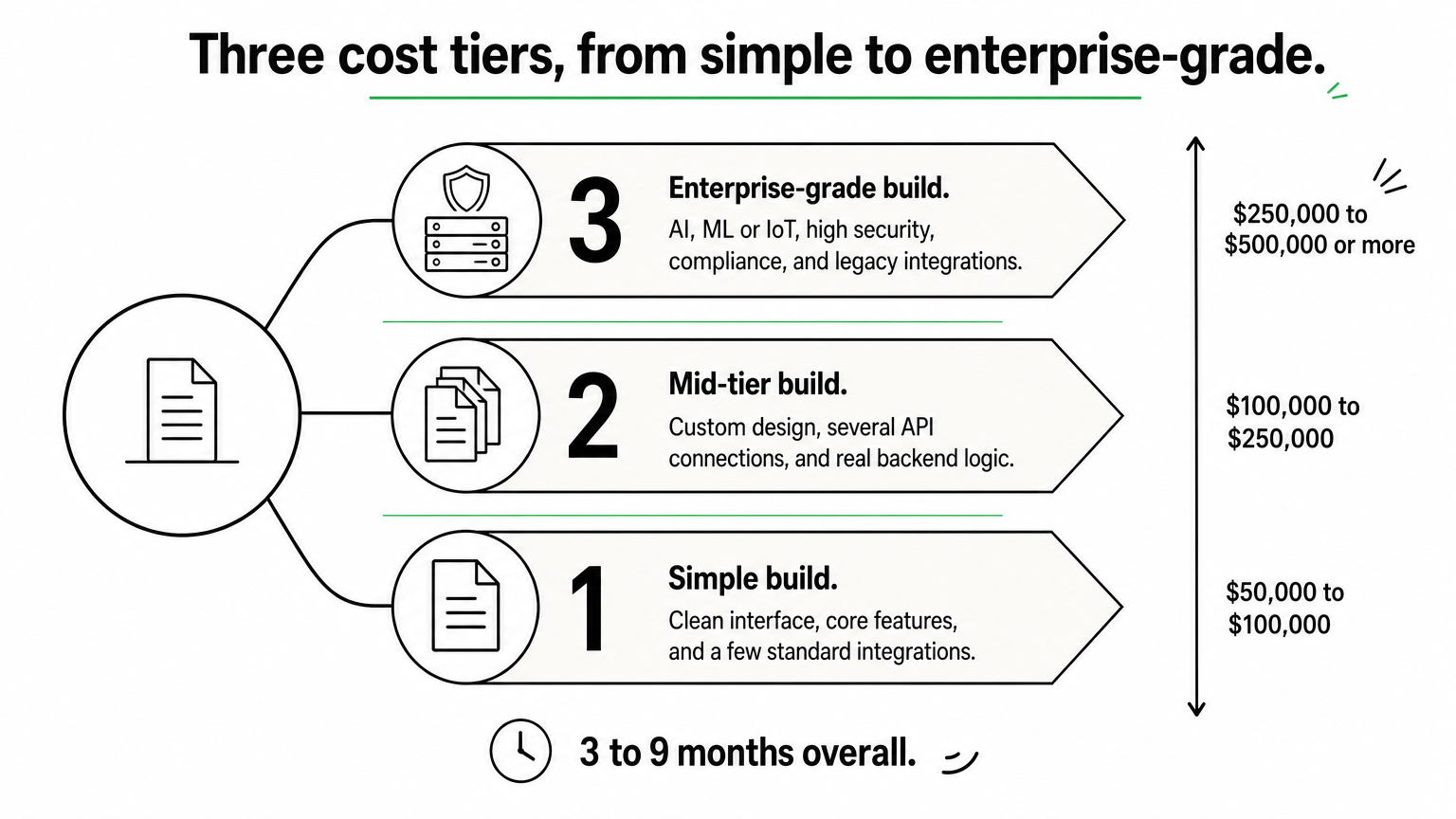
Commonly cited ranges put a custom business app in the US at $50,000 to $500,000 or more, depending on complexity, integrations, and compliance. These are market ranges from vendor pricing guides, not quotes. Your real number depends on the scope you write down.
Cost ranges by app complexity
Three tiers cover most projects. Overall, expect 3 to 9 months from concept to launch. Simple builds can launch in 3 to 4 months, while enterprise-grade apps often run past 6.
| Tier | Typical cost | What it usually includes |
|---|---|---|
| Simple | $50,000 to $100,000 | Clean interface, core features, a few standard integrations |
| Mid-tier | $100,000 to $250,000 | Custom design, several API connections, real backend logic |
| Enterprise-grade | $250,000 to $500,000+ | AI, ML or IoT, high security, compliance, legacy integrations |
Hourly rates and hiring in-house
Experienced mobile developers at agencies commonly charge $50 to $150 or more per hour. Take a mid-tier app with a $150,000 budget. At those rates, you get roughly 1,000 hours at $150 or 3,000 hours at $50. That spread is why rate alone tells you little. Ask how many hours each team estimates for your scope.
Hiring in-house costs more up front. A senior US mobile developer typically earns $120,000 to $180,000 a year in salary. A team of four therefore runs $480,000 to $720,000 a year before benefits, recruiting, and tools. For a single app, a dedicated agency team or fixed-price project usually costs less than building that team.
What moves the price
A few choices change the total software cost more than anything else:
- Features: real-time sync, AI personalization, and complex workflows take more engineering hours.
- Platforms: two native apps cost more than one cross-platform codebase.
- Integrations: legacy systems, payment gateways, and third-party APIs add scope.
- Compliance: HIPAA, GDPR, or CCPA work adds time in regulated industries.
- Engagement model: fixed price suits a defined scope, while a dedicated team suits scope that will change.
The cheapest quote is rarely the lowest cost, because missing scope comes back as change orders.
How to compare and shortlist a developer
Send every candidate the same one-page brief, then compare their answers on relevant work, who builds, platform judgment, and post-launch support. The table below puts the six companies side by side to help you pick two or three for a first call.
Side-by-side comparison
| Company | Best for | Platform approach | Standout detail |
|---|---|---|---|
| Hatzs Dimensions | Apps with AI or data features | Native iOS, native Android, React Native | Fixed price or dedicated team |
| TechAhead | Regulated enterprise apps | Native, React Native, Flutter | Building apps since 2009 |
| WillowTree | Large consumer brands | iOS, Android, web | Streaming and entertainment work |
| Utility | Design-led MVPs | Prototype first, then build | Five-step process from research to launch |
| Savvy Apps | Native consumer and government apps | Swift and Kotlin | Founded in 2009 |
| Cheesecake Labs | Startups wanting one codebase | React Native, Flutter | Fintech, healthcare, retail experience |
Questions to ask every candidate
Whether you are hiring a large agency or a small custom mobile app development studio, the same questions separate strong teams from weak ones.
- Can you show shipped work with similar users, integrations, or compliance rules?
- Who will actually write the code, and how senior are they?
- Why native or cross-platform for this app, and what are the risks?
- How do you handle changes, delays, and scope creep?
- What does support look like after launch, and what does it cost?
Then check independent review platforms such as Clutch for projects like yours, and call at least one reference. A top-rated profile means little if no review matches your type of app.
Judge a developer by answers to your specific brief, not by the size of its client list.
Where to start your shortlist
The right company for app development depends on your app. Regulated data points toward a team with compliance experience, and an unproven idea points toward a design-first studio. If platform performance is the product, go native, and if budget and speed lead, go cross-platform. Pick two or three teams, send the same brief, and compare scoped estimates against the cost ranges above.
If your app needs AI features, automation, or a senior-only team behind it, you can talk to Hatzs Dimensions’ mobile app team about your app and get a scoped estimate for either a fixed-price project or a dedicated team.
Want to grow your business?
Categories
Designed for the Bold
We help ambitious companies turn ideas into production-ready AI, software, and enterprise systems. Get insights on AI, automation, and digital transformation delivered to your inbox.
200+ solutions delivered across 11+ industries — let's build what's next.