











The best AI agent development services come from providers that have shipped agents into production, connect them to your real systems, and build governance in from the start. Hatzs Dimensions suits mid-sized and enterprise teams that want custom agents and software engineering from one partner. Accenture and IBM Consulting suit very large, multi-country programs. Neurons Lab suits financial services firms. Itransition, instinctools, and Emerline suit mid-market buyers who want a flexible engineering partner or a fast MVP.
Choosing is hard because every provider claims the same things: autonomous workflows, enterprise-grade security, fast delivery. Meanwhile, published cost estimates for enterprise agents run from about $50,000 to $300,000 and up, and many pilots never reach production. You need to know who has actually done the work, what the engagement will cost, and how long it will take.
This guide compares seven providers in the same format, then explains what the services include, what they typically cost, and how to judge a proposal. We build agents at Hatzs Dimensions, so we list ourselves first. Judge every provider, us included, against the checklist near the end.
What custom AI agent development services include
Custom AI agent development services cover the full path from picking a use case to keeping a live agent accurate: discovery, design, build, integration, testing, deployment, and monitoring. Typical enterprise projects cost roughly $50,000 to $300,000+ and take 6 to 10 weeks for a proof of concept and 3 to 6 months for a production agent. Treat those figures as a planning range, not a quote.
What a provider actually delivers
A good provider does more than wire a language model to a chat window. An agent has to understand a goal, plan steps, call your tools, and hand off to a person when it is unsure. That takes engineering around the model, and the integration work usually costs more than the model itself.
Look for these deliverables in any proposal:
- Use-case discovery with success metrics, such as handle time, error rate, or cost per ticket.
- Agent design, including tools, memory, guardrails, and escalation rules.
- System integration with your CRM, ERP, ticketing, and data platforms.
- Knowledge grounding, so answers come from your documents and not from the model’s guesses.
- Testing and evaluation of both normal behavior and failure cases.
- Deployment, monitoring, and support after launch.
Typical costs and timelines
Four things move the price: data readiness, integration depth, the number of agents, and security requirements. A pilot costs less than a production system. The table shows how scope maps to time.
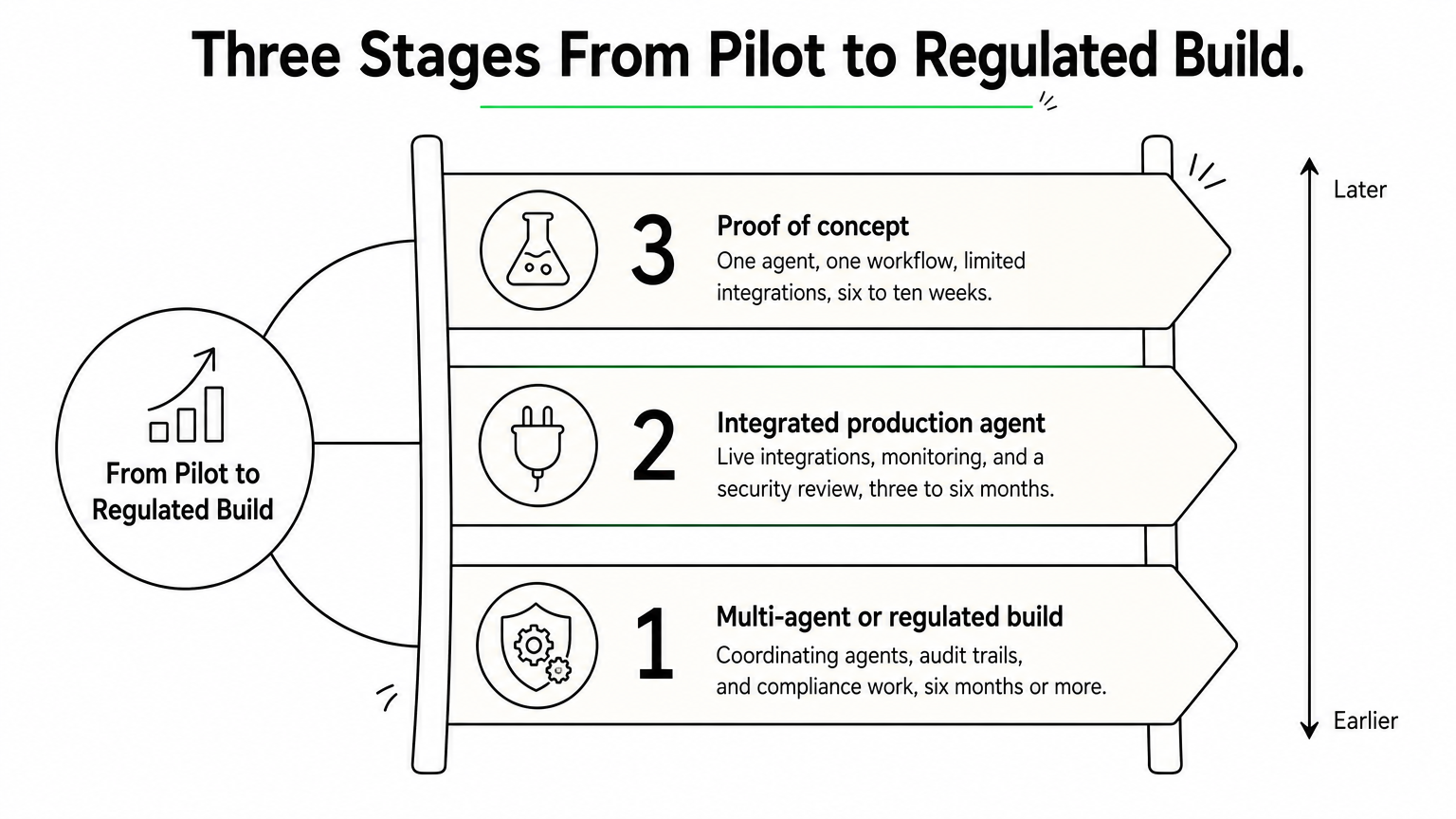
| Stage | Typical timeline | What you get |
|---|---|---|
| Proof of concept | 6 to 10 weeks | One agent, one workflow, limited integrations |
| Integrated production agent | 3 to 6 months | Live integrations, monitoring, security review |
| Multi-agent or regulated build | 6+ months | Several coordinating agents, audit trails, compliance work |
Some specialists with reusable accelerators report faster delivery, such as a proof of concept in about two weeks and production in two to four months. Ask to see what is reusable and what is built from scratch.
Here is a hypothetical example. A mid-sized insurer wants one agent that triages claims intake from its CRM and document store. A quote of $120,000 over four months works out to $30,000 a month. Under a fixed price, you pay $120,000 for the agreed scope. Under a dedicated team at the same monthly rate, month five costs another $30,000, but you can change direction along the way.
Price an agent by scope and integrations, not by the model it uses.
Hire a company, use a builder, or use a framework
Hire a development company when your workflow touches several systems, your industry is regulated, or you lack in-house AI engineers. Use a low-code agent builder when the workflow is simple and your IT team wants to iterate itself. Use a framework such as LangChain or AutoGen when you have strong engineers and need full control.
So yes, you can develop an AI agent yourself. The catch is scale. A prototype takes days. Production needs error handling, security, evaluation, and maintenance, and that is where most internal efforts stall. A company is the right call when the cost of a failed pilot exceeds the cost of expert help.
1. Hatzs Dimensions
Hatzs Dimensions builds custom AI agents and the software around them, which makes it a fit when an agent needs to plug into real products and systems. It is an AI agent and custom software development company with a senior-only engineering team that has 7+ years of experience shipping enterprise-grade AI systems into production.

What you get
The AI Agents service covers custom agents that carry out multi-step tasks, connect to your CRM, ERP, and internal tools, and answer from your own company knowledge. The company builds six agent types. It also offers adjacent services that most agent projects end up needing:
- Intelligent automation that replaces repetitive manual work with AI-driven workflows, delivered through a five-stage approach.
- LLM and chatbot development, including RAG over your documents and generative AI consulting.
- AI governance and compliance, mapped to the EU AI Act, NIST AI RMF, and ISO/IEC 42001.
- Machine learning solutions for predictive models tied to your goals.
Every project follows the same four steps: discovery and planning, design and prototyping, development and testing, and deployment and support. You pick the engagement model. The Fixed Price Model locks scope, timeline, and budget upfront. Dedicated Teams scale as your needs shift.
Best fit and trade-offs
Hatzs Dimensions suits mid-sized to large companies and growth-stage firms in industries such as insurance, banking, healthcare, retail, and logistics. It has completed 200+ long-term projects since 2019, and most partners stay for over three years. For BrokerOS, it cut insurance operations costs by 30%.
Choose Hatzs Dimensions when the agent is one piece of a larger software build.
Weigh two trade-offs. There is no public price list, so request a scoped quote, ideally fixed-price for the pilot. And a senior-only team is not the cheapest route for a throwaway prototype. If you only need a quick demo, a builder tool will cost less.
2. Accenture
Accenture is the choice when an AI agent program spans countries, business units, and legacy platforms, and you want one accountable partner for all of it. It is one of the world’s largest professional services firms, with around 800,000 people serving clients in more than 120 countries.
What you get
Accenture provides end-to-end data and AI services, from strategy through governance. Its AI Refinery Distiller Agentic Framework is an enterprise platform for building, deploying, and scaling multi-agent systems. The pitch is industrialization: moving beyond pilots to repeatable, production-ready deployments.
Typical elements include:
- Strategy and use-case design at program level.
- Platform-based multi-agent build and integration.
- Governance and trust frameworks for regulated settings.
- Global delivery across regions and industries.
Best fit and trade-offs
Accenture fits Fortune 500 companies and public sector bodies running complex, multi-country transformations in finance, healthcare, manufacturing, retail, energy, and government. Agents are designed as part of a wider platform strategy, coordinating work across existing systems.
Accenture fits when agents are one workstream in a company-wide transformation.
The trade-off is scale itself. Large consultancies tend to sit at the top of the cost range and move through more layers of process. If you need one agent live in a quarter, a smaller team will likely reach production faster and cost less.
3. IBM Consulting
IBM Consulting suits organizations that must run agents across on-premise and multi-cloud environments and keep tight audit control. It is the professional services arm of IBM, which carries decades of enterprise IT experience and a long history in AI, from early Watson to current enterprise platforms.
What you get
IBM Consulting Advantage for Agentic Applications provides modular components to design, simulate, and deploy multi-agent systems in cloud and hybrid environments. Agents often integrate with IBM’s wider stack, including Watson services and data management platforms, so the lifecycle is managed end to end instead of agent by agent.
Expect these emphases:
- Modular, customizable agent architecture.
- Human-in-the-loop controls and auditability.
- Hybrid cloud deployment for data residency and compliance needs.
- Agents for business process automation, IT operations, and industry workflows.
Best fit and trade-offs
IBM fits large enterprises and government organizations with mission-critical systems, particularly in financial services, telecommunications, healthcare, manufacturing, and the public sector. It is strong where agents must connect to complex legacy environments such as core banking or telecom infrastructure.
IBM Consulting fits when legacy integration and auditability matter more than speed.
The trade-off is ecosystem pull. A platform-driven approach works best when you are comfortable building around IBM technology. Ask which components are required and which you can swap for tools you already own.
4. Neurons Lab
Neurons Lab is a specialist for financial institutions that need compliant agents built on top of banking, insurance, or wealth management systems. It is an AI-exclusive consultancy based in the UK and Singapore, serving clients across North America, Europe, and Asia, and it reports over 100 AI projects delivered since 2019.

What you get
Neurons Lab focuses on agentic systems for compliance-heavy financial workflows. It is an AWS Advanced Tier partner and offers reusable accelerators. ARKEN targets wealth management relationship intelligence, and NeuraChat targets customer support agents.
The company states that a proof of concept can be ready in as little as two weeks and that accelerator-based builds reach production in two to four months. It also passes on AWS cloud credits and grants to reduce upfront cost. Treat those timelines as the provider’s own claims and ask for references.
- End-to-end consulting from discovery to deployment.
- Integration with CRM, core banking, and claims systems.
- Phased rollout to validate return early.
Best fit and trade-offs
Neurons Lab fits mid-sized to enterprise banks, insurers, and wealth managers that treat AI as a strategic priority and have struggled to get past pilots. It reports that a wealth management agent raised relationship manager capacity by 30%.
Neurons Lab fits when your domain is financial services and regulation drives the design.
The trade-off is narrowness. Outside financial services, its accelerators and references matter less. If your workflows sit in retail, logistics, or healthcare, a cross-industry engineering partner is the safer match.
5. Itransition
Itransition is a good middle path when you want enterprise-style discipline without the overhead of a giant consultancy. It is a software development and IT consulting company founded in 1998, with more than 3,000 professionals serving clients in 40+ countries, from startups to enterprises.
What you get
Itransition’s agent work is practical and end to end. It helps you identify high-impact use cases, define success metrics, and design an agent roadmap. It then builds everything from assistive copilots to more autonomous agents that handle complex workflows with little supervision.
- Data preparation, model integration, and agent logic design.
- Integration with CRM, ERP, e-commerce, and data platforms, so agents perform real actions.
- Monitoring, performance tracking, and security controls.
- ISO-certified quality and information security processes.
Best fit and trade-offs
Itransition fits mid-sized businesses and enterprises in healthcare, finance, manufacturing, retail, insurance, and high-tech that want custom agents at a cost-conscious engineering rate. Its delivery model pairs Western client presence with cost-efficient engineering talent.
Itransition fits when you want broad engineering capacity and cost control.
The trade-off is generalism. A 3,000-person firm covers many technologies, so confirm that the team assigned to your project has built agents before, not only conventional software. Ask for named engineers and relevant references.
6. instinctools
instinctools suits teams that want to start small and scale, with a hands-on, engineering-led partner. It is a software product development and consulting firm founded in 2000, with headquarters in Germany and the United States and delivery roots in Eastern Europe.
What you get
Its agent work is workflow-oriented. It designs conversational agents and copilots that retrieve data, trigger backend processes, and coordinate tasks across systems. A notable strength is multi-agent systems, built with orchestration logic, task decomposition, and observability so they run transparently in production.
- Discovery and architecture design.
- Data engineering, model integration, and testing of both functional and AI-specific behavior.
- DevOps practices, monitoring, and long-term support.
- ISO 9001 and ISO 27001 certified delivery processes, with attention to GDPR.
Best fit and trade-offs
instinctools fits mid-market firms and enterprises in healthcare, financial services, manufacturing, retail, automotive, and media. Clients value its agility and its ability to start with a pilot and grow it into a larger system.
instinctools fits when you want a mid-sized partner who treats agents as maintainable software.
The trade-off is reach. A mid-sized firm will not match a global consultancy for multi-country rollouts or a large partner ecosystem. If your program spans dozens of regions, check capacity before committing.
7. Emerline
Emerline is built for speed to a first version. It helps global companies and startups turn ideas into end-to-end AI solutions, with an emphasis on fast MVPs and scalable software.
What you get
Its services follow the full agent lifecycle, from consulting through proof-of-concept development to custom agent builds. It also handles integration and agent training and personalization, plus ongoing improvement and maintenance. Its work spans manufacturing, logistics, healthcare, e-learning, real estate, retail, e-commerce, fintech, legal, and insurance. Named clients include FUCHS, 3QC, and CPG Data.
- AI consulting and PoC development.
- Custom agent development and integration into existing systems.
- Training and personalization of agents.
- Maintenance after launch.
Best fit and trade-offs
Emerline fits startups and global companies that want a working MVP quickly and plan to extend it. Its range of industries means it can adapt to different data and workflow shapes.
Emerline fits when the goal is a validated first version, not a locked-down enterprise program.
The trade-off is depth in regulated settings. If you need formal audit trails and governance mapped to specific frameworks, ask for compliance references and certifications before you sign.
How to compare AI agent development companies
Compare providers on proof of production delivery, integration depth, governance, industry fit, and commercial terms, in that order. A slick demo tells you little. What matters is whether the team can connect an agent to your systems and keep it reliable after launch.
Seven questions to ask before you sign
Put these to every shortlisted provider and write down the answers:
- Which agents are live in production today? Ask for specifics, such as the workflow, the integrations, and the measured result.
- Which of our systems will the agent connect to, and how? Vague answers about "seamless integration" are a warning sign.
- How do you evaluate the agent? You want test sets, failure-case reviews, and monitoring, not a single demo.
- How do you handle security and compliance? Look for access controls, audit logs, and relevant standards such as ISO 27001, SOC 2, or GDPR.
- Who owns the code, prompts, and data pipelines? Confirm IP terms in writing.
- What does the pilot cost, and what decides the production price? Ask for a fixed price on the pilot.
- What happens after launch? Check support terms, retraining, and who fixes a failing agent.
Ask every provider to name a live agent, the systems it touches, and the number it moved.
Side-by-side summary
| Provider | Scale and base | Strongest at | Best for |
|---|---|---|---|
| Hatzs Dimensions | Senior-only team, 200+ projects since 2019 | Custom agents plus software engineering, fixed-price or dedicated team | Mid-sized to enterprise teams |
| Accenture | About 800,000 people, 120+ countries | Platform-led multi-agent programs | Global transformations |
| IBM Consulting | Enterprise consultancy of IBM | Hybrid cloud, governance, legacy integration | Regulated, mission-critical systems |
| Neurons Lab | UK and Singapore, AI-exclusive | Financial services agents | Banks, insurers, wealth managers |
| Itransition | 3,000+ staff, 40+ countries | Broad engineering at controlled cost | Mid-sized firms and enterprises |
| instinctools | Germany and US, founded 2000 | Multi-agent workflows, start small and scale | Mid-market firms |
| Emerline | Global, startup friendly | Fast MVPs and PoCs | Startups and fast-moving teams |
If two providers look equal, choose the one that will run a short, paid pilot against your own data. A pilot reveals more than any proposal.
Pick a partner by proof, not by pitch
The right AI agent development service is the one that has already put agents into production for a workflow like yours. Large consultancies fit multi-country programs, specialists fit regulated verticals, and mid-sized engineering firms fit teams that want speed and control. Plan on $50,000 to $300,000+ and 3 to 6 months for a production agent, and start with a fixed-scope pilot to test the fit.
If you want custom agents built by a senior team that can also handle the software, cloud, and governance around them, talk to Hatzs Dimensions about scoping your first workflow.
Want to grow your business?
Categories
Tags
Designed for the Bold
We help ambitious companies turn ideas into production-ready AI, software, and enterprise systems. Get insights on AI, automation, and digital transformation delivered to your inbox.
200+ solutions delivered across 11+ industries — let's build what's next.