











The best cross platform app development company for you is the one whose framework, engagement model, and team size match your product, not the one with the longest client list. Of the six picks below, Hatzs Dimensions suits businesses that want React Native with fixed-price or dedicated-team options. Purrweb suits startups building an MVP on a fixed budget. Goji Labs suits teams that want strategy before code. Intellectsoft suits enterprise programs. GeekyAnts suits teams that care about design systems, and Somnio Software suits Flutter-first builds.
Most vendor pages make the same promises: one codebase, faster launch, native feel. What you actually need to know is which stack a studio leads with, what size of client it is built for, and where it is a poor fit. This article profiles each company with the same two questions, what it offers and who it suits. After the list you get a framework comparison and a checklist for vetting any cross-platform mobile app development company.
We put Hatzs Dimensions first because we build cross-platform apps ourselves, and we say plainly where we are not the right choice. The details on the other five come from what those companies publish about themselves, so confirm current scope and rates with each one before you commit.
1. Hatzs Dimensions
Hatzs Dimensions is a strong pick when you want one React Native app for both iOS and Android, delivered by a senior team under a fixed-price or dedicated-team model.
What it offers
Hatzs Dimensions is a custom software and AI company that has completed 200+ long-term projects since 2019. Its cross-platform service builds React Native apps from a single codebase. The company cites 95% code reusability, 60 FPS performance, and a 40% faster time to market. When a feature needs fully native code, it also builds iOS apps in Swift and SwiftUI and Android apps in Kotlin and Jetpack Compose.

- Process: discovery and planning, design and prototyping, development and testing, deployment and support.
- Engagement: a Fixed Price Model that sets scope, timeline, and budget upfront, or Dedicated Teams that scale with your workload.
- After launch: app maintenance with 24/7 monitoring and OS compatibility updates.
One React Native codebase covers both stores, and native builds stay available when a feature demands them.
Who it suits
It suits CTOs, founders, and product leaders at growth-stage companies and enterprises that want a mobile app connected to AI, data, or cloud work, since one team covers all of it. Clients range from Series A startups to Fortune 500 firms, and most partners stay for over 3 years. For BrokerOS, the team cut insurance operations costs by 30%.

It is not the right pick if you have already committed to Flutter or Kotlin Multiplatform. Its cross-platform work is built on React Native, so a Flutter-first studio such as Somnio Software, covered below, is a closer match.
2. Purrweb
Purrweb is a good choice if you are a startup validating an idea and want a launch-ready cross-platform app on a fixed budget and timeline.
What it offers
Purrweb is an international design and development studio that builds mobile apps with React Native and Flutter. It reports more than 300 shipped mobile applications, mostly for early-stage startups in fintech, healthcare, and marketplaces. Design, development, and QA sit under one roof.
- Stack: React Native and Flutter.
- Model: fixed-cost, mobile-first MVPs.
- Focus: startups worldwide.
Purrweb’s narrow focus on fixed-budget MVPs is its selling point and its limit.
Who it suits
It suits founders who want to know the number before the build starts and plan to launch within a few months. Choosing between two frameworks inside one studio also lets the product, not the vendor’s habit, decide the stack.
It is less suited to large enterprise systems or teams that only want on-site staff augmentation. If your app has to plug into legacy ERPs or heavy compliance workflows, look at an enterprise-oriented partner instead.
3. Goji Labs
Goji Labs fits product-focused startups and small to mid-sized businesses that want to settle what to build before anyone writes code.
What it offers
Goji Labs is a strategy-led agency that runs discovery, design, and engineering as one flow. It ships iOS and Android apps and pairs them with React-based web development, so a product that spans phone and browser can stay with one team. It was founded in 2014 and has a team of 70-plus.
- Strengths: product strategy, UX, mobile and web builds, AI features.
- Portfolio niches: legal tech, media, nonprofits, and investment platforms.
- Named clients: KCRW and WWF.
Hire Goji Labs when the open question is what to build, not just how.
Who it suits
It suits teams with a clear problem but a fuzzy feature list, especially in regulated or mission-driven niches. The size is a plus here: small enough for direct founder attention, broad enough to cover UX, build, and AI.
If you already have a locked spec and only need extra engineers, you will pay for strategy work you do not need. A staff-augmentation vendor is cheaper for that job.
4. Intellectsoft
Intellectsoft is the right pick when the mobile app is one piece of an enterprise digital transformation that must connect to existing systems.
What it offers
Intellectsoft has built enterprise software since 2007. Cross-platform mobile sits beside custom software, AI and machine learning, data and BI, and UX design. That range matters when an app must reach ERPs, legacy platforms, or compliance-heavy workflows. Engagements typically run as dedicated teams, staff augmentation, or MVP builds.
- Scope: enterprise software plus cross-platform mobile.
- Named clients: Eurostar, Jaguar, and Guinness.
- Models: dedicated teams, staff augmentation, MVP builds.
Choose Intellectsoft for integration depth, not for the leanest possible MVP.
Who it suits
It suits established companies that need a mobile product wired into existing infrastructure and can handle enterprise-style procurement. The client list signals comfort with large organizations and multi-stakeholder delivery.
It is overkill for a solo founder who wants a lean app shipped fast. The wider consulting offer adds cost and process that a small MVP does not need.
5. GeekyAnts
GeekyAnts suits teams that want deep Flutter and React Native expertise along with a consistent design system across many screens.
What it offers
GeekyAnts has built cross-platform apps since 2006 and is well known among developers. It created NativeBase, a widely used React Native component library. It works across Flutter, React Native, and Expo, and pairs engineering with design-system work. It reports 550-plus projects for clients such as WeWork, ICICI, and Olive Garden.
- Stack: Flutter, React Native, Expo.
- Models: managed or fractional teams.
- Extras: design systems and AI feature work.
A reusable design system is what keeps a large cross-platform app consistent as it grows.
Who it suits
It suits companies scaling an existing product or adding AI features, where framework depth and reusable components pay off over many releases. The managed and fractional models let you grow a team without hiring in-house.
For a one-off MVP with a handful of screens, a smaller studio is usually simpler and cheaper to manage.
6. Somnio Software
Somnio Software is the best fit when you have deliberately chosen Flutter and want a studio that treats it as its default stack.
What it offers
Somnio is a digital product agency of 95-plus people covering strategy, design, and engineering. Where most firms list Flutter as one option, Somnio builds around it, which suits the single-codebase, pixel-consistent UI Flutter is known for. Its CTO is a Google Developer Expert, and it supports the framework with Kotlin, Swift, and Firebase.
- Stack: Flutter first, with Kotlin, Swift, and Firebase.
- Industries: fintech, healthcare, education, and retail.
- Named clients: Siigo and Tracer Golf.
Somnio makes sense only if Flutter is a deliberate choice, not an open question.
Who it suits
It suits brands that want custom, animation-rich interfaces that look identical on both platforms, and teams that value a vendor with recognized Flutter credentials.
If you are stack-agnostic, or your developers already work in JavaScript, a framework-flexible studio gives you more room to choose later.
How to choose a cross-platform app development company
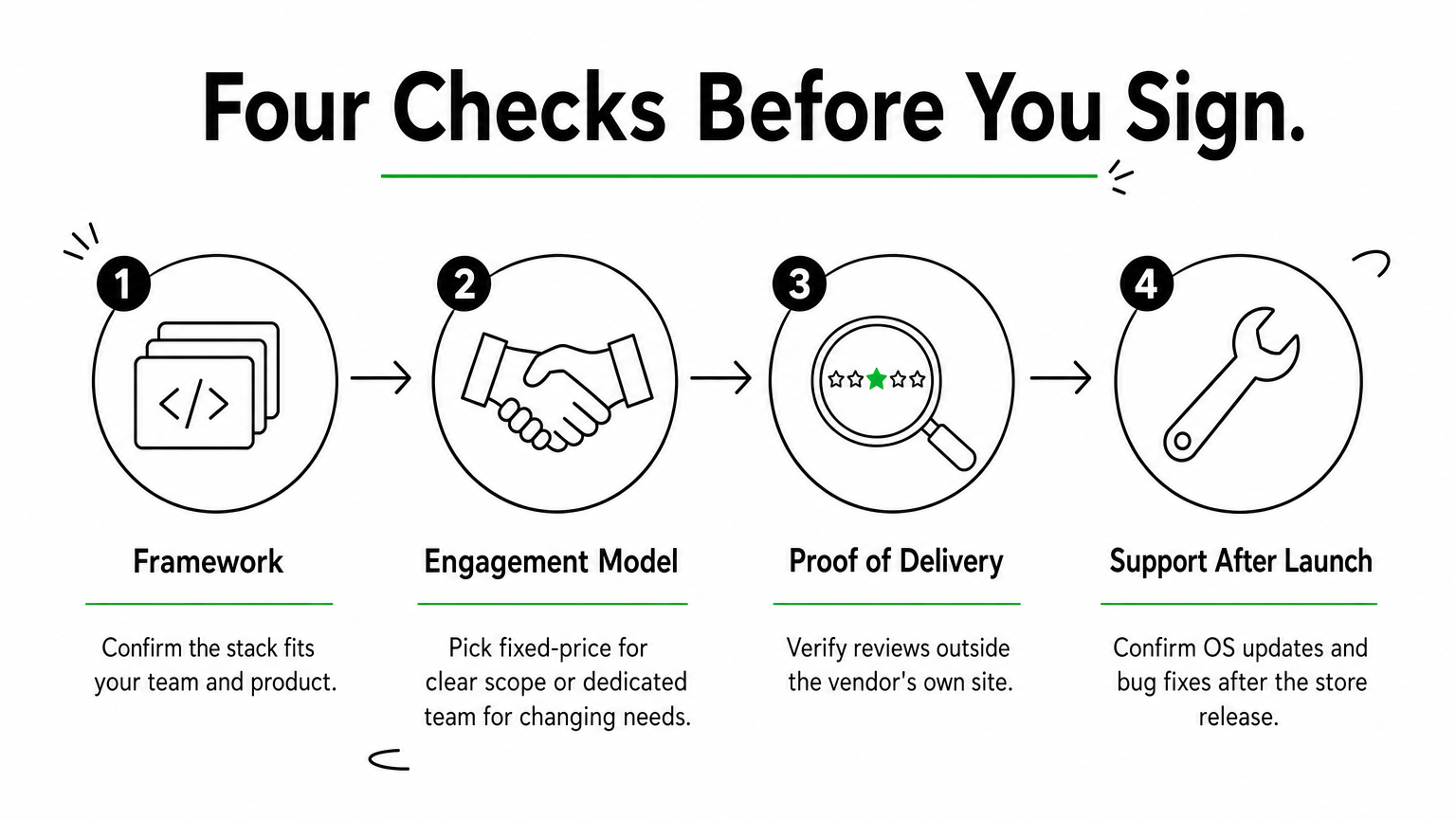
Choose by checking four things in order: the framework, the engagement model, the proof of delivery, and what happens after launch. A multi-platform app development company that fails any of these is a risk, however good its pitch.
Match the framework to your team and product
The table below covers the main frameworks you will hear about. Xamarin still appears in vendor listings, but .NET MAUI is its evolution, so new projects usually start there.
| Framework | Language | Backed by | Best when |
|---|---|---|---|
| React Native | JavaScript | Meta | Your team knows JavaScript and you want a large library ecosystem |
| Flutter | Dart | You need a custom, pixel-consistent UI and rich animation | |
| Kotlin Multiplatform | Kotlin | JetBrains | You want to share business logic and keep native UI |
| .NET MAUI | C#, XAML | Microsoft | You are a .NET shop, or you are leaving Xamarin.Forms |
Ask the vendor which framework it would pick for your product and why. A studio that answers the same way for every project is selling its stack, not solving your problem.
Check delivery model, proof, and support
Fixed-price work suits a clear scope and a firm budget, while a dedicated team suits requirements that will change. Ask which the vendor defaults to, since it shows how they think about risk.
Then verify proof outside the vendor’s own site. Read reviews on Clutch or GoodFirms, and ask for work in your industry rather than a wall of logos. Finally, confirm that the vendor stays on after the store release for OS updates and bug fixes, because launch is the start of maintenance, not the end of the project.
Pick the framework with your team in mind, then pick the vendor whose delivery model fits your budget.
Choosing your shortlist
A good cross-platform partner matches your stack, your budget model, and your stage. Use the six profiles to narrow the field to two or three, ask each which framework it would use and why, and check reviews and post-launch support before you sign anything.
If you want React Native from a senior team, with a fixed price or a dedicated team behind it, you can talk to Hatzs Dimensions about your cross-platform app and get a clear view of scope, timeline, and budget.
Want to grow your business?
Categories
Designed for the Bold
We help ambitious companies turn ideas into production-ready AI, software, and enterprise systems. Get insights on AI, automation, and digital transformation delivered to your inbox.
200+ solutions delivered across 11+ industries — let's build what's next.