










Off-the-shelf apps force your business to bend around someone else’s workflow. Your checkout process, your compliance rules, your field team’s routines get squeezed into a template that was never built for them. That gap is exactly why custom mobile app development exists, and why so many CTOs and founders end up searching for it once a generic app hits its limits.
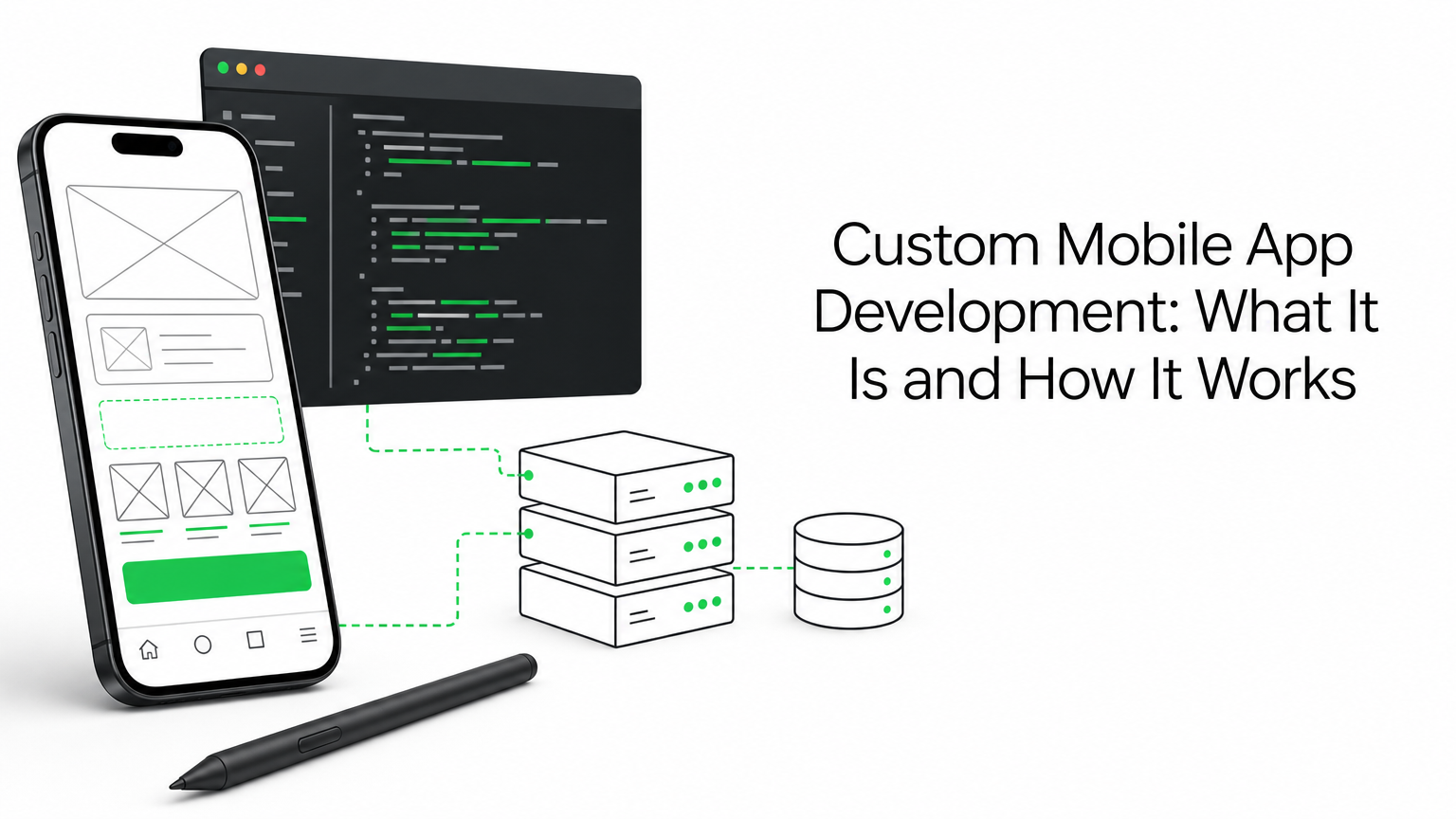
At its core, custom mobile app development means building software from scratch around your specific business logic, users, and systems, rather than configuring a pre-built product. It covers everything from discovery and architecture planning to design, engineering, and long-term support, and it applies whether you’re a startup shipping a first product or an enterprise modernizing legacy systems. The right approach also determines how well your app scales, integrates with your existing stack, and holds up under real user load.
In this article, we’ll break down what custom development actually involves, how the process works step by step, and what separates custom enterprise mobile app development from smaller-scale builds. We’ll also cover how to evaluate a development partner and what results you should realistically expect.
Why custom mobile app development matters for your business
Businesses adopt custom mobile app development because generic software eventually collides with how their operations actually work. A retail chain’s inventory sync, a logistics company’s routing rules, a healthcare provider’s compliance requirements: none of these fit neatly into a one-size-fits-all app. When you build around your own workflows instead of adapting to someone else’s, you remove the friction that slows teams down and frustrates customers.

Where off-the-shelf apps start costing you
Off-the-shelf platforms look cheap and fast at first, but the bill comes due later, which is why it pays to work through the build vs. buy decision honestly. You hit licensing limits on user counts or API calls, plugin conflicts break features overnight, and every workaround adds technical debt that someone eventually has to untangle. Teams end up building manual processes around the software’s gaps, which defeats the purpose of automating anything in the first place.
A generic app that fights your workflow every day is more expensive than a custom one that fits it once.
What a tailored build gives you back
Custom-built software gives you full ownership of the codebase, the data, and the roadmap. Nobody can force a pricing change, deprecate a feature you depend on, or sunset the product entirely. That control matters most for companies running regulated operations or handling sensitive customer data, where every integration and access point needs to be accounted for.
A tailored approach typically delivers:
- Direct integration with your existing CRM, ERP, or legacy databases instead of brittle middleware
- Workflow automation built around your actual approval chains and business rules
- Scalability engineered for your real user load, not a generic ceiling
- Security and compliance controls mapped to your industry’s specific requirements
- Faster iteration since you control the release schedule, not a third-party vendor
The business case in numbers
Results from real deployments make the case better than theory does. Across client engagements, custom mobile app development solutions have driven measurable operational gains rather than just aesthetic improvements:
| Business area | Typical outcome after custom build |
|---|---|
| Insurance operations | Up to 30% lower operating costs |
| Sales and lead handling | Up to 300% increase in conversion capacity |
| Customer engagement | Up to 40% higher engagement rates |
Gains like these come from removing manual steps and building features around actual user behavior, not from a bigger app store rating. You can see how this plays out across industries in our case studies, where the same pattern repeats: teams that outgrow generic tools recover both time and revenue once the software finally matches how they work.
How custom mobile app development works from discovery to launch
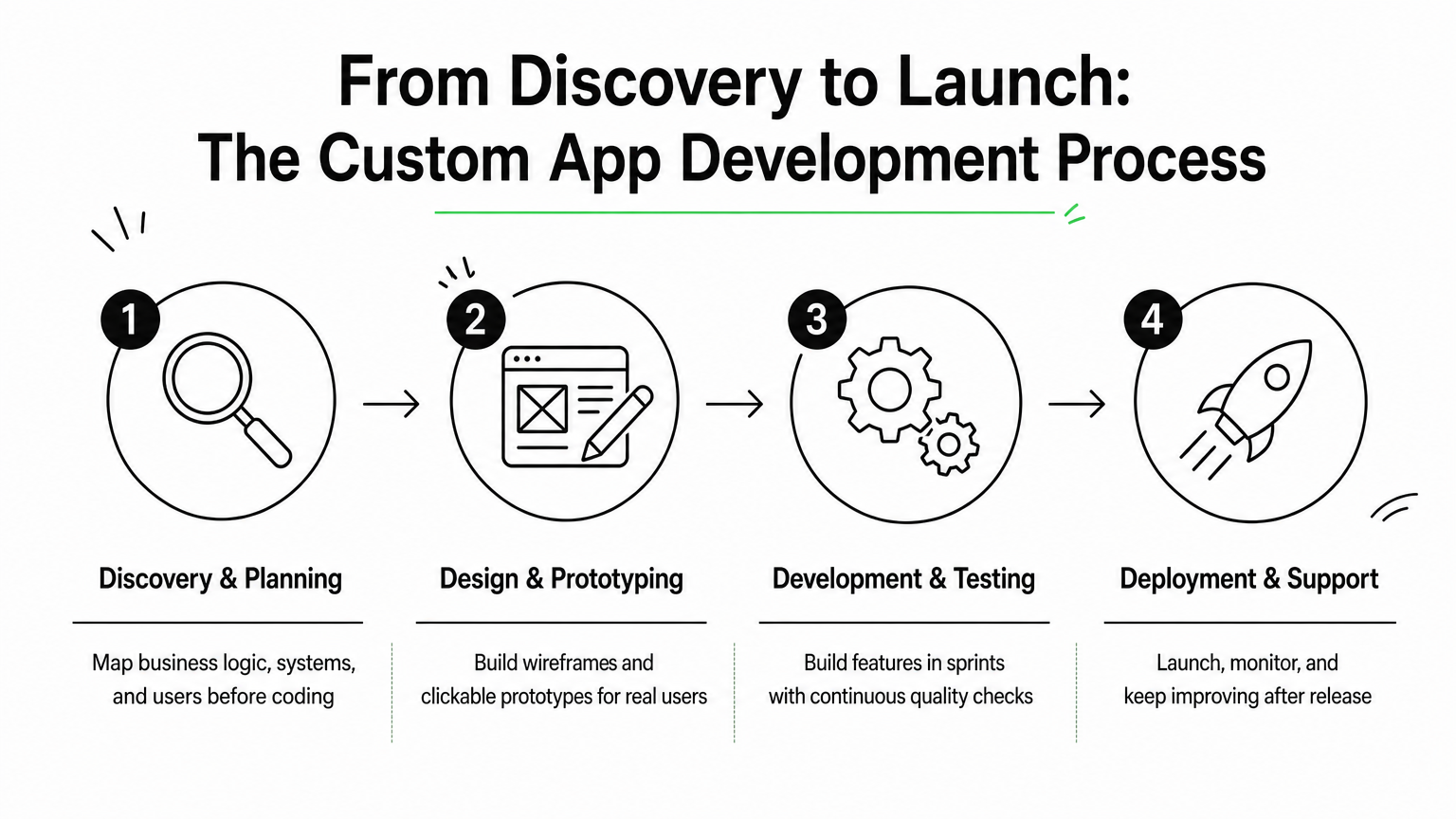
Every serious build follows a similar arc, whether you’re a five-person startup or a Fortune 500 team modernizing a legacy system. The names change from vendor to vendor, but the sequence doesn’t: you validate the idea, design around real users, build and test in cycles, then launch and keep improving. Skipping any of these stages is usually where projects go over budget or ship features nobody uses.
Discovery and planning
Discovery is where a development partner maps your business logic, existing systems, and user needs before writing a line of code. This phase should produce a technical scope, an architecture plan, and a realistic timeline, not just a slide deck. Requirements gathering at this stage prevents the most expensive mistake in software: building the wrong thing efficiently.
Skipping discovery doesn’t save time, it just moves the delay to the middle of the build.
Design and prototyping
Once the scope is locked, designers translate requirements into wireframes and clickable prototypes. This is where UI/UX design earns its keep: catching a confusing checkout flow or a clunky field-worker screen here costs a design revision, not a rebuild. Our UX and UI design consultancy work happens in parallel with early architecture decisions so both teams stay aligned.
Development and testing
Engineering teams typically work in two-week sprints, building features in order of business priority rather than all at once. Automated and manual quality assurance testing runs continuously alongside development, not as a final gate before launch. This is also when integrations with your CRM, ERP, or payment systems get built and stress-tested against real data volumes.
Deployment and ongoing support
Launch isn’t the finish line. A proper deployment includes app store submission, server provisioning, and monitoring setup so issues surface before users report them. Post-launch, ongoing support means shipping updates, patching vulnerabilities, and adjusting features as your business changes. Companies that treat launch as the end of the relationship usually end up rebuilding within two years, because the app never adapted to new requirements.
Native, hybrid, or cross-platform: choosing your build approach
Picking a build approach is a technical decision with real budget consequences, and like deciding which platform to target first, it should happen during discovery, not after your first sprint. Native development means writing separate codebases in Swift for iOS and Kotlin for Android, which gives you the best performance and full access to device features like camera, GPS, and biometrics. Cross-platform frameworks like React Native or Flutter let you share one codebase across both platforms, cutting build time and cost while still producing near-native performance for most business apps.
Where each approach actually fits
Hybrid apps, built with web technologies wrapped in a native shell, sit at the cheapest end but struggle with complex animations, offline functionality, and heavy device integration. They fit simple internal tools or MVPs where speed to market matters more than polish, much like a progressive web app does for mobile web experiences. Cross-platform frameworks now handle most enterprise use cases well, including apps with camera access, push notifications, and offline sync, which is why they’ve become the default choice in custom mobile app development solutions aimed at startups and mid-sized companies alike.
The right build approach isn’t the most powerful one, it’s the one that matches your users, timeline, and budget.
Comparing the three approaches
| Approach | Best for | Trade-off |
|---|---|---|
| Native (Swift/Kotlin) | High-performance apps, heavy device integration, gaming | Two codebases, higher cost and timeline |
| Cross-platform (React Native, Flutter) | Most business apps, faster time to market | Slight performance gap for graphics-heavy features |
| Hybrid (web-based shell) | Simple MVPs, internal tools, low budget | Weak offline support, limited device access |
Enterprises running apps with heavy real-time data, AR features, or hardware integrations, think field service scanners or medical devices, usually still need native builds despite the added cost. Startups validating a market fit almost always come out ahead choosing cross-platform, since it lets them test the concept across both app stores without doubling engineering spend. Our teams at Hatzs Dimensions evaluate this trade-off during discovery, using your user base and feature roadmap, not a default preference, to make the call.
What custom mobile app development really costs
Cost is the question every founder and CTO asks first, and the honest answer is: it depends on scope, not on a fixed price list, as our breakdown of what drives software development cost explains. Custom mobile app development services typically range from $30,000 for a simple MVP to well over $500,000 for a full enterprise platform with multiple integrations, custom AI features, and compliance requirements. Vendors who quote a flat number before discovery either haven’t scoped your project properly or are padding the estimate to cover surprises later.
Where the budget actually goes
Discovery and design usually consume 15-20% of total budget, engineering takes the largest share at 50-60%, and testing plus deployment fills out the rest. Backend complexity drives cost more than the interface does: a simple booking app with one database is cheap, but an app syncing real-time inventory across five warehouses is not. Third-party integrations, each API connection, each legacy system handshake, add both time and long-term maintenance cost that many quotes leave out entirely.
The cheapest quote almost never becomes the cheapest app once you count the rebuild.
Typical cost ranges by project type
| Project type | Typical cost range | Timeline |
|---|---|---|
| Simple MVP (single platform) | $30,000 – $80,000 | 2-4 months |
| Mid-size business app (cross-platform) | $80,000 – $250,000 | 4-8 months |
| Enterprise app (multiple integrations, AI features) | $250,000 – $500,000+ | 8-14 months |
Engagement models change the math
Fixed-price models suit projects with a locked scope, like a defined MVP with a clear feature list, since you know the total cost upfront. Dedicated team models fit longer-term builds where requirements evolve, letting you scale engineers up or down as priorities shift without renegotiating a contract every sprint. Growth-stage companies pursuing custom mobile app development for startups often start fixed-price to prove the concept, then shift to a dedicated team once the product finds traction and the roadmap gets less predictable. You can review both models on our software development pricing and engagement models page before scoping your own project.
How to choose the right development partner
Selecting a vendor is the decision that determines whether your budget turns into a working product or a stalled contract. Look for a senior-only engineering team with a track record of shipping enterprise-grade systems into production, not a roster padded with junior developers learning on your project. Ask for case studies in your specific industry, since a team that’s solved healthcare compliance or logistics routing before will spot problems you haven’t thought of yet, and run them through a proper checklist for evaluating a development company.
What separates a real partner from a vendor
Genuine partners push back on your assumptions during discovery instead of just building whatever you ask for. Reputation matters here too: a company recognized on platforms like Clutch or backed by client retention above 90% has already survived the scrutiny you’re about to apply. Retention numbers tell you more than marketing copy does, because unhappy clients don’t stick around for a second project.
The best development partner argues with you before the build starts, not after launch fails.
Questions worth asking before you sign
Run every shortlisted vendor through the same checklist so you’re comparing apples to apples:
- Do they offer both fixed-price and dedicated team models, or only one rigid structure?
- Can they show a live app they built, not just a case study slide?
- Who owns the code and IP after the contract ends?
- What does post-launch support actually include, and for how long?
- Do they have in-house AI, data, and cloud expertise, or will they subcontract it?
Startups evaluating custom mobile app development solutions should also check how a vendor scales a team as the roadmap grows, since the agency that ships your MVP well isn’t always equipped to support you three years later. Teams like ours at Hatzs Dimensions combine engineering, AI, data, and cloud specialists under one roof specifically so you’re not stitching together three vendors as your product matures. That structure matters more once you’re past the first release and into the harder work of scaling.
Putting it all into perspective
Custom mobile app development isn’t a luxury reserved for enterprises with unlimited budgets. It’s the practical answer once a generic tool starts costing you more in workarounds than a tailored build would cost outright. The process itself is predictable: discovery, design, development, and support, each stage protecting you from the expensive mistakes that come from skipping ahead. Your build approach, your budget, and your choice of partner all flow from decisions made honestly during those early conversations, not from a template pulled off a shelf.
If you’re weighing whether a generic platform can still carry your business, or you already know it can’t, the next step is a real scoping conversation, not another demo. Talk to a team that’s shipped enterprise-grade apps into production for 250+ clients and can tell you within weeks what yours actually requires. Get in touch with the iOS and Android app development team at Hatzs Dimensions to start scoping your project properly.
Want to grow your business?
Categories
Tags
Designed for the Bold
We help ambitious companies turn ideas into production-ready AI, software, and enterprise systems. Get insights on AI, automation, and digital transformation delivered to your inbox.
200+ solutions delivered across 11+ industries — let's build what's next.