







The right dating app development company has already shipped real-time chat, matching, moderation and subscription billing, and can show you how it handled each one. Of the six teams below, Hatzs Dimensions suits product teams that want senior engineers on native or React Native builds. Appinventiv suits enterprise platforms with heavy compliance needs. Dev Story and Devstree suit startups building a swipe-style MVP. AppMakers USA suits design-led products, and 75way suits teams that want AI matchmaking and monetization planned from the start.
Most agency pages promise "scalable, secure, AI-powered" apps, so it is hard to tell the teams apart. A dating app is also harder than a typical consumer app. You have to handle trust and safety, sensitive location data, age gating, and App Store review rules, and your first users will leave quickly if the matches feel random.
This article compares the six companies on what each one states on its own pages, and it flags what you still need to verify. Hatzs Dimensions publishes this article, so read its entry with that in mind. After the list you get a short checklist for vetting any team, plus the cost drivers and timeline you should expect.
1. Hatzs Dimensions
Hatzs Dimensions is a custom software and AI company that has completed 200+ long-term projects since 2019. It fits a dating app build when you want one team covering design, native or cross-platform mobile engineering, and ongoing maintenance.
What it offers
The relevant services are native iOS apps in Swift and SwiftUI, native Android apps in Kotlin and Jetpack Compose, and React Native apps from a single codebase. Product design and app maintenance sit alongside them. Its AI and data practice, which includes machine learning, is the skill set you need for match ranking and moderation support.
- Cross-platform: React Native builds with a stated 95% code reusability and 40% faster time to market.
- Android: Material 3 design and compatibility across 10,000+ devices.
- Maintenance: a stated 99.9% crash-free rate with 24/7 monitoring after launch.
Hatzs Dimensions is strongest when a dating app needs senior mobile engineering and AI in one team.
Who it suits and what to confirm
It suits founders and product leaders who want a senior team and a choice of commercial model. The Fixed Price Model locks scope, timeline and budget upfront, which works for a first MVP. Dedicated Teams grow with you, which works once user feedback starts reshaping the roadmap. Either way, the first workflow follows the same four steps: discovery and planning, design and prototyping, development and testing, then deployment and support.
Hatzs Dimensions does not present a dating-specific product line on its pages. Judge it on mobile and AI depth, and ask for a written plan covering matching logic, profile verification, reporting and blocking, and an example of a real-time messaging app it has shipped.
2. Appinventiv
Appinventiv is a large engineering firm that markets dating app development at enterprise scale. It is the heaviest option in this list, with the broadest range of dating models and compliance coverage.
What it offers
Its page lists AI-based matchmaking, real-time chat and video, native Kotlin and Swift apps, cross-platform builds, and trust and safety workflows. It names 13 dating app models, from matchmaking and niche apps to video, event-based and senior dating apps. It also states 11+ years of experience and 100M+ client app downloads, and these figures are self-reported.
- Certifications: ISO 9001, ISO 27001 and CMMI Level 3.
- Compliance: GDPR, CCPA, SOC 2 Type II and others are listed.
- Budget signal: its FAQ says an MVP may start in the low six figures and take four to six months.
Appinventiv is built for platforms where compliance and concurrency matter more than speed to a cheap MVP.
Who it suits and what to confirm
It suits funded startups and enterprises planning a large user base, multiple markets, or strict data-protection requirements. A team that needs a lean prototype will likely find the engagement scale more than it needs.
The case studies shown on its dating page are social and real-time platforms, not dating apps. Ask directly for dating-specific references, and ask which team members would actually work on your project.
3. Dev Story
Dev Story offers custom dating app development and frames its work around apps in the style of Tinder. It is a practical pick when your product follows the swipe-and-match model.
What it offers
Its page covers Android, iOS and web platforms, which matters because many dating products now need a browser version for sign-up or account management. The pitch centers on feature-rich, scalable builds rather than one standout technology.
- Platforms: Android, iOS and web from one vendor.
- Product pattern: swipe-based discovery with matching and messaging.
- Positioning: custom builds instead of white-label scripts.
A swipe-style app is a good fit for a focused vendor, as long as you test what sits behind the swipe.
Who it suits and what to confirm
It suits startups validating a familiar format before investing in anything novel. Swipe mechanics are easy to copy, so the real differences are in matching quality and safety tooling.
Ask what the quote includes for chat, photo moderation and reporting, and whether you own the source code outright. Ask for a staged plan with a launch milestone, so you can judge progress on working software rather than slide decks.
4. Devstree
Devstree pitches custom dating app development that combines engaging design, real-time chat and smart matching. Those are the three features that decide whether early users stay.
What it offers
The three promised building blocks are design, real-time messaging and matching logic. If your product idea is a familiar dating app with a distinct look, that scope is enough to get to launch.
- Design: interface work aimed at engagement.
- Chat: live messaging with presence and notifications.
- Matching: algorithmic suggestions rather than a plain search list.
Real-time chat is where dating apps usually break first, so make a vendor prove it under load.
Who it suits and what to confirm
It suits teams that want a custom build around core features rather than a long list of modes. Keep the first release small, ship it, and add video or events once retention data supports them.
Ask whether chat runs on its own infrastructure or a third-party messaging service, since this affects monthly cost and data control. Also ask how it load-tests messaging and how push notifications are handled on both iOS and Android.
5. AppMakers USA
AppMakers USA describes premium dating app development focused on high-performance, aesthetically pleasing apps. It leans toward design polish and brand feel.
What it offers
The pitch is visual quality and speed in the hand. This matters because dating is a first-impression product, and clumsy onboarding or slow photo loading drives sign-ups away before any match happens.
- Interface: polished, brand-forward design.
- Performance: attention to smooth interactions on mobile.
- Fit: custom apps rather than templates.
In dating, a slow or ugly onboarding flow loses users before matching even starts.
Who it suits and what to confirm
It suits founders building a niche or community-led dating product where brand and look set the app apart. A name and a visual identity can carry a niche audience further than a generic matching engine can.
Design-first agencies still need engineering depth underneath. Ask who builds the backend, how profile verification and reporting are handled, and how the design team and engineers work together during sprints.
6. 75way
75way markets a dating app development service built around AI-powered matchmaking, chat and monetization features. It is the option for teams that want revenue mechanics designed in from the start.
What it offers
Its listing highlights secure, scalable apps with matchmaking, chat and monetization. For a dating business, the monetization layer typically means subscriptions, in-app purchases and premium access tiers, and these have to follow Apple and Google billing rules.
- Matching: AI-assisted recommendations.
- Messaging: in-app chat.
- Revenue: subscriptions and paid features planned in the build.
AI matching only helps once you have behavior data, so plan a rules-based start.
Who it suits and what to confirm
It suits teams whose business case depends on paid conversion, such as a premium niche community. Ask what "AI" means in practice. A new app has no behavior data, so a sensible vendor starts with preference-based filters and adds learned ranking as activity grows.
Also confirm how it handles store billing for digital subscriptions, how it tests paywall variants, and what analytics you will have after launch.
How to compare dating app development companies
Compare teams on proof of shipped products, safety design, and commercial clarity, not on adjectives like "scalable" or "AI-powered". Use the same questions with every vendor so the answers line up.
Side-by-side snapshot
| Company | Stated focus | Best for |
|---|---|---|
| Hatzs Dimensions | Native iOS and Android, React Native, product design, AI and data | Senior-team MVPs and evolving roadmaps |
| Appinventiv | Enterprise-scale platforms, 13 dating models, compliance | Large or regulated platforms |
| Dev Story | Tinder-style apps for Android, iOS and web | Swipe-model startups |
| Devstree | Design, real-time chat, smart matching | Core-feature custom builds |
| AppMakers USA | Premium, high-performance, polished design | Brand-led niche apps |
| 75way | AI matchmaking, chat, monetization | Revenue-first products |
What to test before you sign
Ask each vendor for the following, and treat vague answers as a warning.
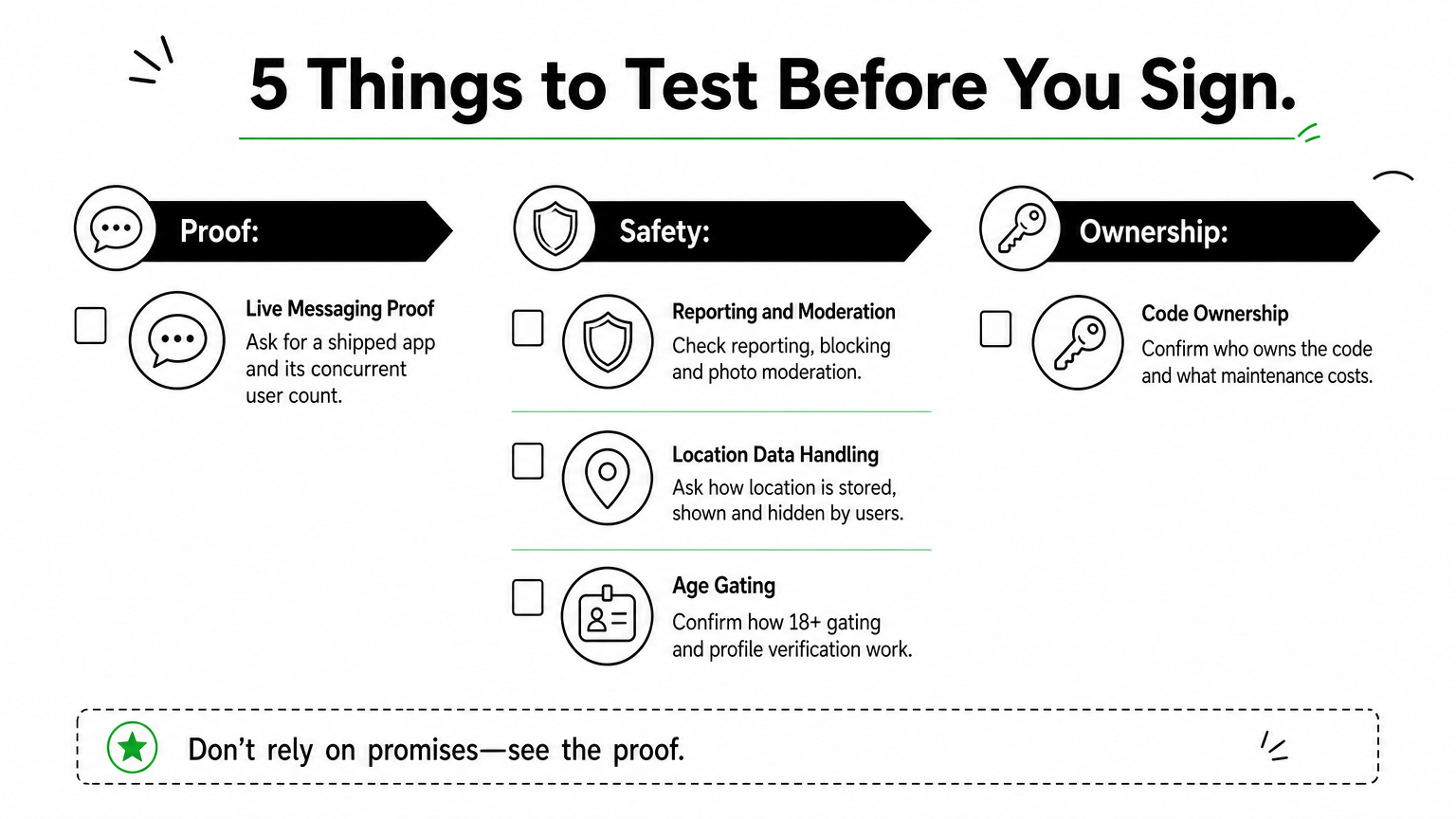
- A shipped app with live real-time messaging, and the number of concurrent users it has handled.
- Its approach to reporting, blocking and photo moderation. Apple’s App Store Review Guidelines expect user-generated content apps to offer these.
- How location data is stored, how precisely it is shown to other users, and how users can hide it.
- How 18+ gating and profile verification work.
- Who owns the code, and what ongoing maintenance costs after launch.
If a vendor cannot explain its safety design in plain terms, it has not built it.
What a dating app build costs and how long it takes
Expect a dating app MVP to take roughly four to six months and to cost low six figures, according to one vendor’s published guidance. Your quote will depend on scope more than on the company’s brand.
Cost drivers and a worked example
The biggest drivers are the number of platforms, real-time chat and video, matching logic, moderation tooling, verification, and billing. Team rate and region come next. Use this arithmetic to sanity-check any quote. The rates are assumptions, so replace them with the numbers you are quoted.
| Team | Duration | Hours (160 per month) | At $100/hour | At $150/hour |
|---|---|---|---|---|
| 4 people | 4 months | 2,560 | $256,000 | $384,000 |
Add maintenance after launch, store fees, cloud hosting, and the marketing needed to seed the first users. A dating app is only useful once enough profiles exist locally.
Scope decides the price, so cut features before you cut safety or testing.
Timeline from idea to launch
A typical sequence has four stages. Discovery and design take the first month or so. Core development covers profiles, matching, chat and billing. Testing includes load tests and App Store pre-checks. Launch follows, ideally in one city or niche first.
If you are building your own app, start with a narrow audience and a small feature set. Add video, events or AI ranking only after retention data supports them.
Picking your build partner
No single dating app development company is best for everyone. Pick on fit: enterprise compliance, a lean swipe MVP, a design-led niche product, or a revenue-first build each point to a different team. Whoever you choose, insist on shipped examples of real-time chat, a written safety plan, and a quote you can check with simple arithmetic.
Start narrow, launch to one audience, and let usage data decide what to build next. If you want a senior mobile and AI team to scope your dating app, talk to Hatzs Dimensions about your project.
هل تريدون تنمية أعمالكم؟
التصنيفات
صُمّم للجريئين
نساعد الشركات الطموحة على تحويل أفكارها إلى أنظمة ذكاء اصطناعي وبرمجيات ومؤسسات جاهزة للإنتاج. احصل على رؤى حول الذكاء الاصطناعي والأتمتة والتحول الرقمي تصلك مباشرة إلى بريدك الإلكتروني.
200+ حلاً تم تسليمها في 11+ قطاعاً، فلنبنِ معاً ما هو قادم.