







Picking a US mobile app development company is a high-stakes call. The wrong partner burns six figures, misses launch dates, and hands you code your own team can’t maintain. Plenty of agencies look the same on a landing page. The real differences show up in who actually builds your app, how they price it, and what past clients say after launch.
This list is built for shortlisting. You’ll find the best mobile app development company options based in the US, with what each one does well, typical cost ranges, and review signals from platforms like Clutch. Expect most serious projects to start around $50,000 and climb past $250,000 for complex, AI-enabled apps.
Full disclosure: Hatzs Dimensions is one of the seven. We build custom web and mobile apps with a senior-only team, so we know what to ask vendors. Below, each company gets the same treatment: core services, ideal client, pricing signals, and where it may not fit. Use it to cut your list to two or three and start those calls this week.
1. Hatzs Dimensions
Services and specialties
Hatzs Dimensions builds custom web and mobile apps for companies ranging from Series A startups to Fortune 500 teams. The standout is AI built into the product: AI agents, machine learning, and GenAI features that ship inside the app instead of being bolted on later.
Around that core sit UI/UX design, cloud infrastructure, data engineering, and financial software. Delivery runs in four stages: discovery, design and prototyping, development and testing, then deployment and support. You get one team from strategy to long-term support, which saves you from stitching together three vendors.
Best for
This is the right fit when your app depends on data, automation, or compliance. Typical clients come from insurance, healthcare, banking, logistics, and retail, where the app has to connect to legacy systems and satisfy auditors. Hatzs Dimensions also suits teams that are weighing AI governance and readiness before they commit.
Hatzs Dimensions fits teams whose app depends on AI, data, or compliance, not just good-looking screens.
Pricing and engagement models
Expect a scoped quote after discovery, not a published rate card. Two engagement models cover most projects, and choosing the right one matters as much as the hourly rate.
| Model | Best when | Budget behavior |
|---|---|---|
| Fixed-price project | Scope is defined, such as an MVP or a rebuild | Cost is set up front |
| Dedicated team | Roadmap evolves or you need to scale | Cost flexes with team size |
Strengths and trade-offs
Strengths are easy to verify. The team is senior-only with 7+ years of shipping enterprise AI into production, backed by 250+ clients, 100+ specialists, and 98% client retention. Case studies include a 30% cut in insurance operations costs, 300% more lead conversion capacity, and 40% higher customer engagement. Clutch has recognized the company with awards.
The trade-off is cost. A senior-only model is not the cheapest route for a simple MVP or a template-style app, and a smaller shop may quote less for that. We also run this list, so weigh our entry against the same criteria you apply to the other six.
2. Zco Corporation
Services and specialties
Zco is a New Hampshire company that has built software since 1989. That three-decade track record is rare among app agencies, and its teams handle iOS, Android, and cross-platform builds alongside:
- AR/VR and game development
- IoT and connected-device apps
- AI features, backend, and web work
Best for
Mid-sized businesses and funded startups get the most from Zco. It suits end-to-end builds where you want strategy, design, development, and QA from one vendor, especially if you need emerging tech like AR or IoT.
Teams that only need a few extra developers may find a full-service agency heavier than necessary.
Zco is a long-tenured, full-service builder, best when you want one vendor to own the whole app.
Pricing and engagement models
Zco does not publish rates, so expect a custom quote after a scoping call. Comparable projects usually land in the mid five to low six figures, and larger builds go higher. Ask for two versions of your quote:
- A fixed-price estimate for a tightly defined MVP
- A time-and-materials estimate for scope that may shift
Strengths and trade-offs
Longevity and breadth are the draw. Few agencies can show 30+ years of delivery across this many platforms, and a mature process means fewer surprises mid-project.
The trade-off is focus. Zco is a generalist, so AI depth may trail specialists, and a larger agency can put account managers between you and engineers. Ask who will actually write your code.
3. Dogtown Media
Services and specialties
Dogtown Media is a Los Angeles agency founded in 2009. It builds native iOS and Android apps and is best known for digital health products. Its teams also work on:
- AI and machine learning features
- Wearables and IoT connections
- AR/VR and blockchain builds
Best for
Startups and health-tech founders get the most from Dogtown. It suits teams that want product strategy alongside development, and companies ready to test emerging tech like wearables or voice interfaces before competitors do.
Dogtown Media works best when you need a partner to shape a new product idea, not just code a finished spec.
Pricing and engagement models
Dogtown does not publish a rate card, so expect a custom quote after discovery. Public agency listings suggest MVPs start in the low to mid five figures, with cost rising as integrations and platforms grow. Confirm the numbers on your own scoping call. Ask for:
- A phased estimate, so you can launch an MVP first
- A clear split between design, build, and post-launch support
Strengths and trade-offs
Over 15 years in business gives Dogtown a mature process and real depth in regulated health apps. It also publishes a lot of educational content, which shows how the team thinks.
The trade-off is scale. Dogtown is a boutique, so large enterprise rollouts with heavy legacy integration may stretch it. Check who staffs your project, and whether your app’s compliance needs, such as HIPAA, are covered in writing.
4. WillowTree
Services and specialties
WillowTree is a Charlottesville, Virginia firm founded in 2007, and it is now part of TELUS Digital. It builds iOS, Android, and web apps for large consumer brands, with a growing focus on AI and data work. Core offerings include:
- Product strategy and UX design
- Native mobile engineering
- Machine learning and GenAI features
Best for
Enterprise product teams get the most from WillowTree. It suits brands that need a large, polished consumer app and a partner that can staff multiple squads at once.
WillowTree fits enterprises that want a design-led team to scale a consumer app, not a bargain MVP.
Startups with a tight MVP budget will likely find the process and price heavier than they need.
Pricing and engagement models
Rates are not published, so expect a custom quote after discovery. Given its client profile, budgets typically sit in the six-figure range and up. Ask for:
- A scoped estimate for one release
- Team composition and seniority by role
Strengths and trade-offs
Design and engineering quality are the draw. Nearly two decades of work and a strong enterprise client roster show it can run complex, high-traffic apps. TELUS Digital backing adds scale.
Cost is the trade-off. WillowTree is priced for enterprise budgets, and because of its parent company you should ask whether the team stays dedicated to your project from kickoff to launch.
5. ArcTouch
Services and specialties
ArcTouch is a San Francisco agency founded in 2009. It builds iOS and Android apps and stands out for work beyond the phone screen, including:
- Voice assistants and conversational interfaces
- Connected TV and wearable apps
- AI and GenAI features inside mobile products
Best for
Mid-market and enterprise brands get the most from ArcTouch. It suits teams planning a multi-platform product, such as a mobile app that also ships on TV or voice, and companies that want design-led strategy before any code gets written.
ArcTouch fits brands that need one app experience to work across phone, TV, and voice.
Founders with a one-screen MVP and a small budget will usually move faster with a leaner shop.
Pricing and engagement models
ArcTouch does not publish rates, so expect a custom quote after discovery. Based on its client profile, projects typically land in the six-figure range, so confirm the numbers on your own scoping call. Ask for:
- A phased estimate that lets you launch one platform first
- A retainer option for post-launch updates
Strengths and trade-offs
Mobile focus is the draw. More than 15 years of app-only work, strong UX craft, and solid review scores on Clutch make it a safe pick for polished consumer products.
The trade-off is team location. A meaningful share of ArcTouch engineering sits in Brazil, so check time zone overlap and whether your data-handling rules allow it. Also confirm how deep the AI bench goes if intelligence is central to your app.
6. Simpalm
Services and specialties
Simpalm is a US mobile app development company based near Chicago and founded in 2009. It builds iOS, Android, and cross-platform apps using a hybrid model that pairs US project leads with offshore engineers. Core work includes:
- Enterprise mobility and custom business apps
- IoT and wearable integrations
- AI and chatbot features
Best for
Small and mid-sized businesses get the most from Simpalm. It suits teams that want US-based project management at a lower blended rate than onshore-only agencies, such as an internal workflow app or a first customer-facing release.
Simpalm fits budget-aware teams that want US oversight without a fully onshore price tag.
Pricing and engagement models
Rates are not published, so expect a custom quote after scoping. Agency directories typically list hourly rates in the $25 to $49 range, and simple MVPs can start in the low five figures. Confirm these numbers on your own call. Ask for:
- A fixed-price estimate for a defined MVP
- A dedicated-developer option for ongoing work
Strengths and trade-offs
Value is the draw. More than 15 years in business, broad platform coverage, and lower rates make Simpalm a practical choice for straightforward apps and internal tools.
The trade-off is distance. Much of the engineering is offshore, so check time zone overlap and whether your data-handling requirements allow it. Ask who writes your code, and how senior those engineers are, before you sign.
7. Chop Dawg
Services and specialties
Chop Dawg is a US studio built around startups and first-time founders. It builds iOS, Android, and web apps, with a heavy emphasis on MVP development, meaning a lean first version you can put in front of real users. Typical work covers:
- Product discovery and UX design
- Native and cross-platform app builds
- Backend, APIs, and post-launch support
Best for
Founders with an idea and no in-house engineers get the most from Chop Dawg. It suits early-stage startups that want a studio to help define scope and launch a first release fast. Enterprise teams with legacy systems or strict audit requirements will likely want a larger partner.
Chop Dawg works best when a founder needs a partner to turn an idea into a testable first release.
Pricing and engagement models
Rates are not published, so expect a custom quote after a scoping call. Startup-style MVPs from studios like this usually fall in the mid five figures, though your features and platforms will move that number. Confirm it on your own call. Ask for:
- A fixed scope and price for the MVP
- Full ownership of your source code and developer accounts
Strengths and trade-offs
Startup focus is the draw. A studio that ships first versions often can keep scope tight and help you avoid paying for features users never asked for.
The trade-off is scale. Chop Dawg is a smaller shop, so large enterprise rollouts and deep AI work may stretch it. Ask how it handles security and compliance, and what support looks like once your user base grows.
8. How we chose these companies and what apps cost
How we chose them
Every company here is a US-based agency with a public record of shipped iOS and Android apps. We compared them on four points:
- Service breadth, from MVPs to AI features
- Review signals on Clutch and similar platforms
- Team model, onshore or hybrid
- Fit for a specific buyer, such as founders or enterprise teams
Most agencies don’t publish rates, so pricing figures are estimates from public listings and client profiles. Confirm each one on a scoping call before you budget around it.
What apps cost
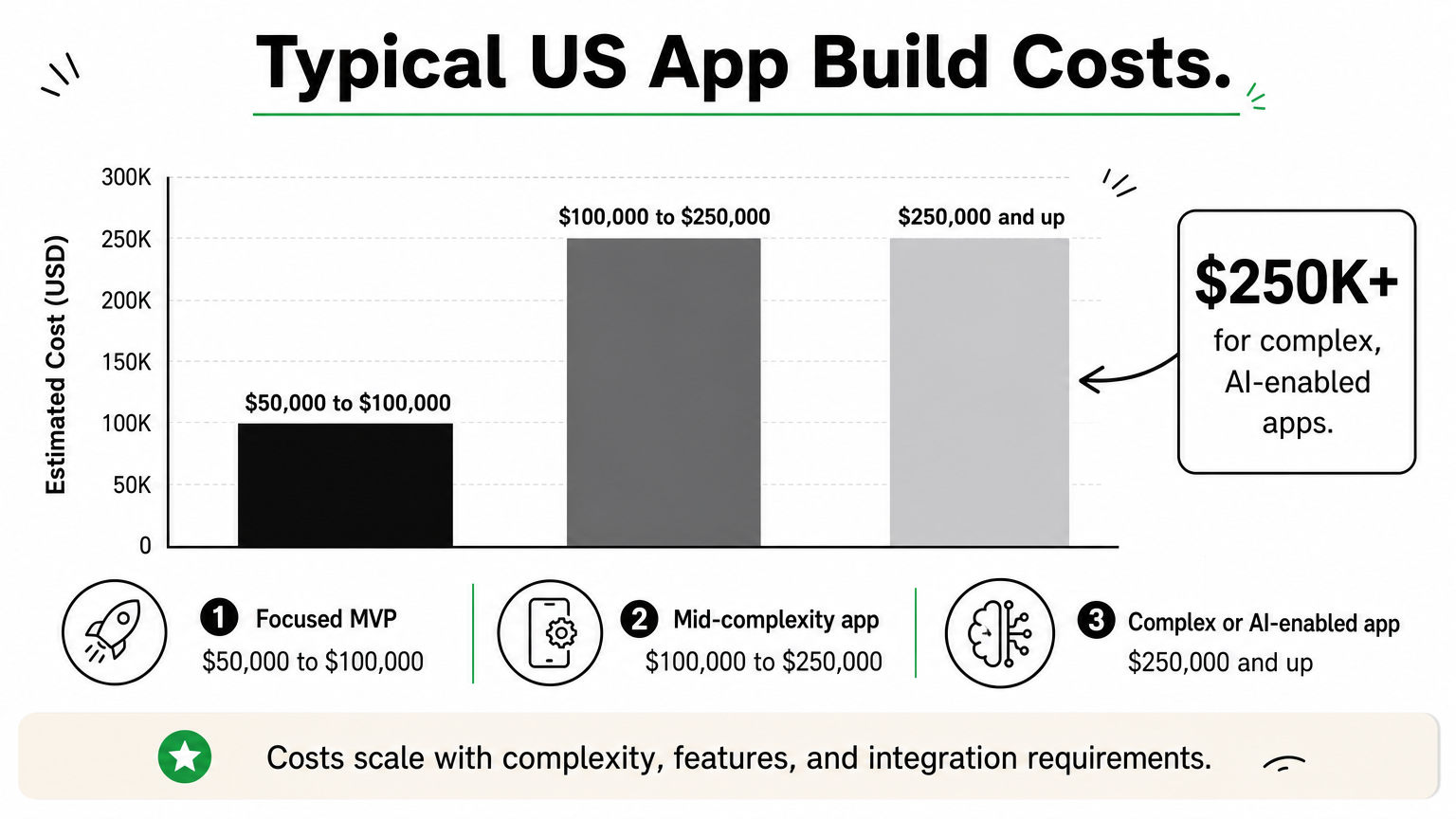
Budget follows complexity more than platform. A simple MVP can cost less with a hybrid team, but a US-built, production-grade app usually falls into these bands:
| App type | Typical range | Example |
|---|---|---|
| Focused MVP | $50,000 to $100,000 | One platform, core features, basic backend |
| Mid-complexity app | $100,000 to $250,000 | iOS and Android, integrations, admin tools |
| Complex or AI-enabled app | $250,000 and up | Legacy systems, compliance, ML or GenAI features |
Integrations, compliance work, and AI features push software development cost up fastest. Ask for a phased estimate so you launch small, then fund the next release with what real users teach you.
Scope, not platform, drives what your app costs, so define the first release before you ask for quotes.
9. How to pick the right company for your app
Match the company to your app
Start with your app, not the agency. The best mobile app development company for you is the one whose strengths match your scope, budget, and risk. A founder with a first idea needs a different partner than a bank rebuilding its customer app.
Use this map as a first filter:
| Your situation | Strongest fits |
|---|---|
| AI, data, or compliance-heavy app | Hatzs Dimensions |
| First MVP on a tight budget | Chop Dawg, Simpalm |
| Health or emerging-tech product | Dogtown Media |
| Large consumer or multi-platform app | WillowTree, ArcTouch |
| Full-service build with AR or IoT | Zco Corporation |
Questions to ask before you sign
Then test your shortlist against a guide to choosing a software development company. Put the same questions to every finalist and compare the answers side by side. Vague replies are a warning sign, and slow replies during sales rarely speed up after you sign.
- Who will write my code, and how senior are they?
- Can I speak with two clients whose apps are live?
- Do I own the source code and developer accounts?
- How do you handle security, compliance, and post-launch support?
Ask who actually builds your app, and get the answer in writing.
Finally, reduce risk with a paid discovery phase before you commit to a full build. A few weeks of scoping and prototyping shows you how the team communicates, and it gives you a realistic estimate you can compare across vendors.
Choosing your app partner
The right US mobile app development company is the one that fits your scope, not the one with the loudest brand. Each of the seven earns its place for a different buyer: Chop Dawg and Simpalm for lean MVPs, Dogtown Media for health products, WillowTree and ArcTouch for large consumer apps, Zco for full-service builds, and Hatzs Dimensions for AI, data, and compliance-heavy apps.
Before you sign with anyone, confirm who writes your code and that you own the source. Then run a paid discovery phase. Those checks protect you better than any ranking, including this one.
When you’re ready to compare real numbers, talk to Hatzs Dimensions about your mobile app. Bring your scope, your budget, and your hardest questions, and we’ll give you a straight answer.
Want to grow your business?
Categories
Designed for the Bold
We help ambitious companies turn ideas into production-ready AI, software, and enterprise systems. Get insights on AI, automation, and digital transformation delivered to your inbox.
200+ solutions delivered across 11+ industries — let's build what's next.