











The best data governance solutions combine a searchable catalog, lineage, access control, and stewardship workflows, and they fit the stack you already run. Most shortlists come down to seven options. Hatzs Dimensions suits teams that need governance and BI built around their own workflows. Collibra suits stewardship-heavy enterprises, and Alation suits catalog-first teams that need business users on board. Informatica fits multi-cloud estates, Microsoft Purview fits Microsoft shops, Atlan fits modern data stacks, and Databricks Unity Catalog fits lakehouse teams.
The problem is rarely a lack of tools. It is picking one that matches your data environment, your team’s skills, and the way your people work. A platform built for a 20-person governance office will stall in a team of three. A lightweight catalog will not satisfy an auditor.
Below, each option gets the same treatment: what it does, who it suits, and what it costs and where it falls short. A final section shows how to test any of them against your framework, security needs, and data management scope before you book a demo.
1. Hatzs Dimensions
Hatzs Dimensions is a services partner, not a packaged tool. It designs and builds your governance program and connects it to dashboards, which makes it the pick when no off-the-shelf platform fits your workflows.
What it does
The Data Governance & BI service gives teams one set of data standards, clear ownership, and audit-ready controls. It then turns that trusted data into BI dashboards that leaders can act on. The program runs in five stages and follows the same four-step delivery process as all of the company’s work: discovery and planning, design and prototyping, development and testing, deployment and support.
- Standards, ownership, and controls built around your industry’s compliance requirements
- Data engineering and integration to connect silos and modernize pipelines when source data is messy
- AI governance and compliance mapped to the EU AI Act, NIST AI RMF, and ISO/IEC 42001 when AI systems are in scope
Who it suits
Choose it when your workflows are specific enough that a licensed catalog would need heavy customization, or when you want governance and BI delivered together. Regulated sectors such as insurance, healthcare, and banking are a natural fit, because the team builds to the compliance requirements of each client’s industry.
It also works alongside a platform. Many companies license a catalog and still need someone to define owners, wire up pipelines, and build dashboards. Hatzs Dimensions has completed 200+ long-term projects since 2019, and it cut insurance operations costs by 30% for BrokerOS.
Pricing and limits
You pay for an engagement, not a license. A Fixed Price Model sets scope, timeline, and budget upfront, while a Dedicated Team model grows with your needs. Request a quote based on your data sources and stakeholders.
The limit is that you buy people and delivery, not a finished product you can log into on day one. If you want to crawl your sources next week, start with one of the platforms below.
Pick a services partner when your workflows are unusual, and a platform when your problem is standard.
2. Collibra
Collibra is the enterprise standard for formal, stewardship-heavy governance. It suits large organizations that need policies, approvals, and accountability across many business domains.
What it does
Collibra combines a data catalog, governance workflows, privacy, and data quality in one platform. If you wonder what Collibra is used for, the answer is mostly this: it is where stewards define business terms, assign owners, approve policies, and trace lineage across systems.
- Policy management and a business glossary
- Workflow automation for approvals and stewardship tasks
- Lineage and metadata search across business and technical domains
Who it suits
It fits large enterprises with a dedicated governance office, especially in banking, insurance, and healthcare, where policy evidence matters as much as the data itself.
It fits poorly when nobody owns governance full time. The tool assumes you have stewards and data owners to run its workflows.
Pricing and limits
Pricing is quote-based and modular, and implementations often involve professional services, so budget beyond the license itself. Total cost grows with each module you add.
Confirm your deployment model early. Collibra has announced end of life for its on-premises Data Governance Center and points customers to its cloud platform or a self-hosted option.
Collibra rewards organizations that already have governance roles in place and punishes those hoping the tool creates them.
3. Alation
Alation is a catalog-first platform built to get both technical and business users to adopt governance. It is a strong choice when your core problem is that people cannot find or trust data.

What it does
Alation’s catalog ranks search results by popularity and relevance using behavioral signals, so the datasets people actually use surface first. It adds governance on top, with stewardship workflows and role-based access. It also offers a Data Products Marketplace for packaging and sharing trusted datasets.
- 100+ connectors to databases, warehouses, and BI tools
- Lineage that can trace data through to Power BI reports
- Cloud-hosted, hybrid, and customer-managed deployment options
Who it suits
Pick it if analysts and business stewards must use the tool daily, not just engineers. Gartner has named Alation a Leader in its Magic Quadrant for Metadata Management Solutions, which helps when you need to justify the choice to a buying committee.
Teams moving toward governed data products also benefit, since the marketplace gives them a place to publish and reuse them.
Pricing and limits
Pricing is quote-based and scales with your deployment. Expect to spend up-front planning time tailoring workflows to how your organization works, because the platform’s depth does not configure itself.
A team that needs only a lightweight catalog may find the full governance scope more than it needs.
Alation wins when adoption is the bottleneck, not when the goal is the lightest possible catalog.
4. Informatica Cloud Data Governance and Catalog
Informatica’s Cloud Data Governance and Catalog is the single-vendor option for large, hybrid or multi-cloud estates. It makes the most sense if Informatica already runs part of your data stack.
What it does
The product combines cataloging, governance, quality, and privacy and sits inside Informatica’s Intelligent Data Management Cloud. AI-assisted tools harvest metadata from structured and unstructured sources, which cuts manual cataloging work.
- Automated classification of sensitive data
- Lineage views across sources
- Policy enforcement tied to data access
Who it suits
It suits large enterprises that want one vendor across integration, quality, and governance instead of stitching point tools together. Organizations already using Informatica for integration or master data gain the most, since governance then connects to the pipelines it governs.
Smaller teams rarely need this breadth. For them, a narrower tool gets live sooner.
Pricing and limits
Pricing is quote-based, and licensing can be expensive for smaller organizations. Deployment and configuration can also be complex, especially if your governance framework is still immature, which adds overhead before you see value.
Informatica pays off when consolidation is the goal, and costs you when it is not.
5. Microsoft Purview
Microsoft Purview is the natural pick for organizations built on Azure, Power BI, and Microsoft 365. It combines cataloging, classification, and compliance tooling in one Microsoft-native service.

What it does
Purview maps data across on-premises, multi-cloud, and SaaS sources, then applies automated classification and sensitivity labels. Its tight links to Azure, Power BI, and Microsoft 365 mean policies and labels follow data into tools your people already use.
- Data map and catalog for discovery
- Sensitivity labeling and compliance features
- Integration with the wider Microsoft security and compliance suite
Who it suits
It suits Microsoft-centric organizations where security and compliance teams already live in Microsoft tools. If your main worries are regulated data in Microsoft 365 and Azure, Purview shortens the path to a working program.
Business users may need training, since the interface and workflows lean technical.
Pricing and limits
Billing is usage-based rather than a flat license, so model your scan volume before you commit. Coverage outside Azure varies by source. Microsoft publishes a supported-sources matrix, and you should check classification and lineage support for every source you rely on.
Purview is strongest inside the Microsoft ecosystem, so test it on your non-Microsoft sources first.
6. Atlan
Atlan is a cloud-native catalog aimed at data teams on the modern data stack. It leans on collaboration and AI-assisted search to make metadata easy to use.
What it does
Atlan offers a metadata catalog with AI-assisted search, collaboration features, and native integrations with cloud warehouses and lakehouses. Its Data Quality Studio supports Snowflake, Databricks, and BigQuery, so quality checks sit next to the assets they test.
- Search and discovery across connected sources
- Metadata management and collaboration in one workspace
- Native connectors for popular modern data stack tools
Who it suits
It fits data engineering and analytics teams on Snowflake, Databricks, or BigQuery who want a catalog people enjoy using. Smaller, fast-moving teams often prefer it to heavier suites.
Reviewers say it is more intuitive for engineers than for business users, so test it with your analysts and stewards during a trial.
Pricing and limits
Pricing is quote-based, and some capabilities need extra enablement or licensing, so ask which features your quote includes. Check how it handles lineage across connections and how deep its partner-built connectors go, since coverage differs between native and partner integrations.
Atlan is a strong fit for engineering-led teams, provided you verify connector depth for your own sources.
7. Databricks Unity Catalog
Unity Catalog is the governance layer built into Databricks. It is the simplest way to govern data and AI assets when your data already lives in the lakehouse.
What it does
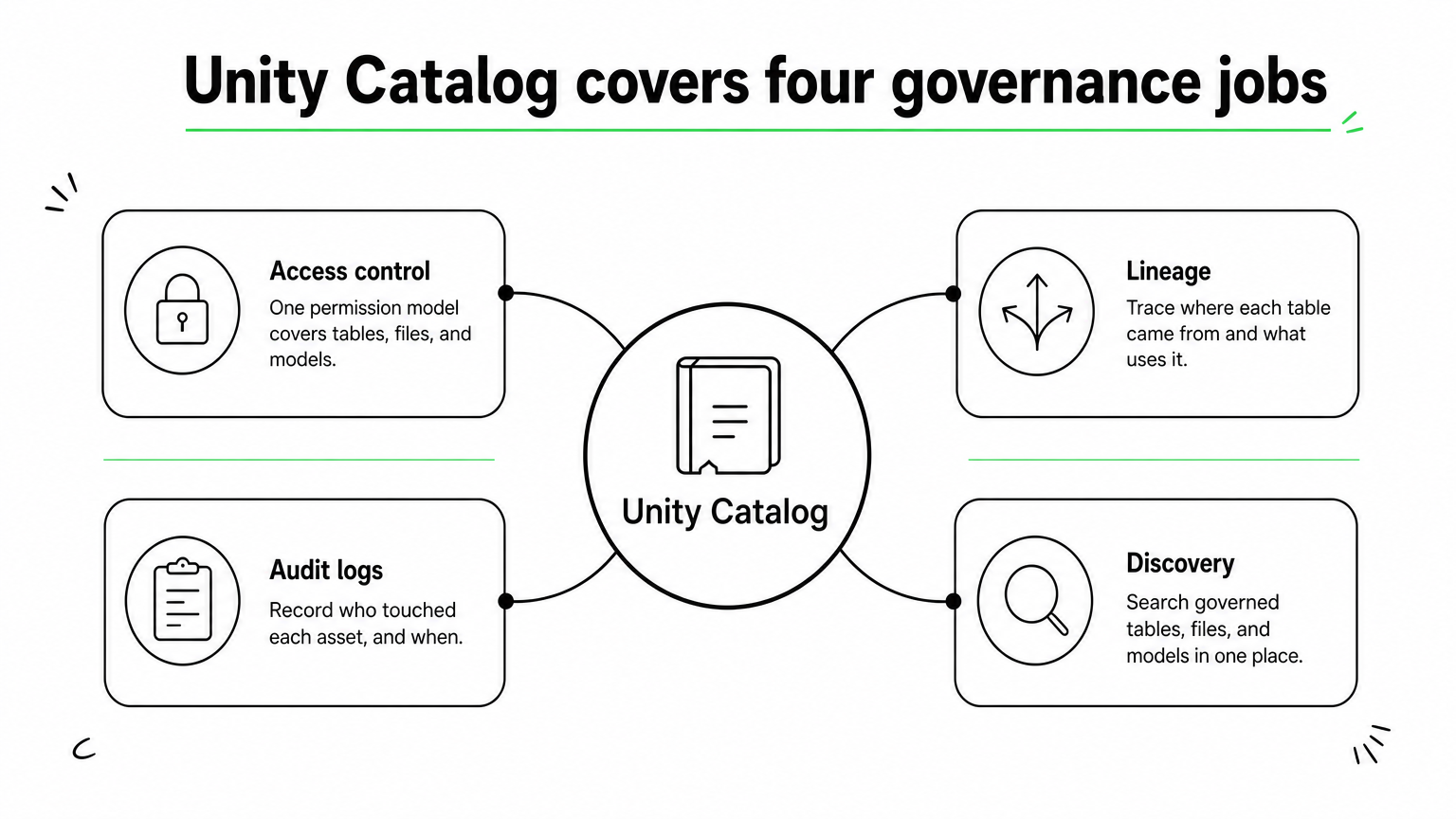
Unity Catalog centralizes access control, lineage, auditing, and discovery for tables, files, and models across Databricks workspaces. One permission model covers analytics and machine learning, which avoids setting up the same rules twice.
- Fine-grained access control across data and AI assets
- Lineage and audit logs built into the platform
- Search and discovery for governed assets
Who it suits
It suits teams whose data and AI work sits mostly in Databricks. For them it avoids buying and integrating a separate tool for basic governance.
It suits a company with sources spread across many platforms less well. Those teams usually pair it with a dedicated catalog.
Pricing and limits
Governance features come with the platform, so your cost is Databricks usage rather than a separate license. Confirm what your tier includes. An open source version of Unity Catalog exists, so compare its scope against the managed product before you rely on it.
Stewardship workflows are lighter than in dedicated governance suites. If your auditors want formal approvals and policy evidence, plan for a complementary tool.
Unity Catalog is the easy answer for Databricks-first teams and an incomplete one for everyone else.
How to choose between data governance solutions
Choose by testing each candidate against your framework, your security obligations, and how much data management you want in one product. Features matter less than fit.
Check that the tool carries your framework
A governance framework defines roles, policies, standards, and audits. Data governance framework tools should carry each of those into daily work instead of leaving them in a document. Look for these capabilities in every candidate:
- Catalog and metadata management to find and understand data
- Lineage to trace origins and downstream impact
- Access control and classification to enforce policy
- Stewardship workflows to assign owners and approvals
- Quality monitoring to catch bad data early
Weigh security and data management scope
Data security and governance solutions differ most in how they find and protect sensitive data. Ask whether classification is automatic, whether labels follow data into other tools, and whether audit evidence is captured continuously instead of rebuilt before each review.
Data management and governance solutions also differ in breadth. Governance is one part of data management, and some products bundle integration, quality, and master data while others stay narrow. Buy breadth only if you want one vendor to cover the pipeline. Otherwise a focused tool plus good data engineering usually wins.
Compare and score your shortlist
| Solution | Type | Best fit | How you pay |
|---|---|---|---|
| Hatzs Dimensions | Services partner | Custom governance and BI | Fixed price or dedicated team |
| Collibra | Platform | Stewardship-heavy enterprises | Vendor quote |
| Alation | Platform | Catalog adoption across teams | Vendor quote |
| Informatica CDGC | Platform | Multi-cloud, single vendor | Vendor quote |
| Microsoft Purview | Platform | Azure and Microsoft 365 shops | Usage-based |
| Atlan | Platform | Modern data stack teams | Vendor quote |
| Unity Catalog | Platform feature | Databricks lakehouse teams | Platform usage |
Then score. Weight stack fit 30, business-user adoption 25, security coverage 25, and cost 20, and rate each tool 1 to 5. A team on Azure and Power BI might give Purview 5, 3, 4, and 4, which works out to (5×30 + 3×25 + 4×25 + 4×20) / 5 = 81 out of 100. The same team might give Collibra 3, 4, 5, and 2, for (90 + 100 + 125 + 40) / 5 = 71. Your weights decide the winner, so set them before the demos.
Set your scoring weights before you watch a demo, because vendors are very good at changing your priorities.
Picking your shortlist
The right data governance solution matches your stack, your people, and your auditors. Purview and Unity Catalog fit teams already committed to Microsoft or Databricks. Collibra and Informatica suit large enterprises with formal governance roles, Alation suits teams fighting low adoption, and Atlan suits engineering-led stacks. A services partner fits when your workflows are too specific for a standard product.
Run two or three of these through your scoring weights, test them on your own data sources, and ask each vendor what your quote includes. If you want governance, data engineering, and BI delivered as one program, talk to Hatzs Dimensions about your data governance program.
Want to grow your business?
Categories
Designed for the Bold
We help ambitious companies turn ideas into production-ready AI, software, and enterprise systems. Get insights on AI, automation, and digital transformation delivered to your inbox.
200+ solutions delivered across 11+ industries — let's build what's next.