










The best AI voice agents answer or place phone calls, understand natural speech, act inside your systems, and hand off to a human with context. A good pick responds in under a second, connects to your CRM or calendar, publishes clear pricing, and passes a pilot on your real calls. Developer teams usually do best with Retell AI, and teams without engineers with Synthflow. ElevenLabs suits brands that care most about how the agent sounds, and Bland.ai or Regal suit outbound sales. PolyAI and Cognigy fit enterprise contact centers, and a custom build from Hatzs Dimensions fits companies whose workflows no platform covers.
The problem is that every vendor promises a "human-like" agent, and every demo sounds good. The real differences show up later, in latency under load, in how billing scales, and in whether the agent can update a record or only take a message. Meanwhile you still have calls going to voicemail, and staff spending hours on the same five questions.
This guide explains what voice AI agents do, then reviews nine options with the same structure: what each does, what it costs, and who it suits. You will also find a cost table with a worked example and a checklist for piloting before you sign. Hatzs Dimensions builds custom AI agents, so the build-it-yourself route sits next to the packaged platforms.
What AI voice agents do and how they work
AI voice agents are software that hold a spoken phone conversation, work out what the caller wants, and complete the task, such as booking an appointment or qualifying a lead. The terms AI phone agents and voice AI agents describe the same thing. The useful distinction is between an agent that only talks and one that acts in your systems.
What an AI voice agent does on a call
An old IVR makes callers press numbers through a menu. A voice agent lets the caller say "I need to move my Thursday appointment" and then does it. It can handle inbound calls that would otherwise queue or hit voicemail, and it can place outbound calls at a scale a small team cannot match.
Typical jobs fall into two groups:
- Inbound: after-hours answering, FAQs, appointment booking, order status, lead qualification, and routing to the right person
- Outbound: new-lead follow-up, appointment reminders, no-show recovery, surveys, and renewal outreach
The value comes from the action, not the conversation. An agent that books the slot, writes the CRM note, and sends the confirmation has finished the job. An agent that says "someone will call you back" has only moved the problem.
A voice agent is worth what it can do in your systems, not how human it sounds.
How the technology works
Every voice agent stacks four layers, and a weakness in any one shows up as a bad call. Platforms differ mostly in how much of the stack they hand you and how much they hide.
| Layer | Job | What failure sounds like |
|---|---|---|
| Telephony | Connects the call to a phone number or your phone system | Dropped calls, poor audio |
| Speech recognition | Turns the caller’s voice into text | Misheard names, numbers, accents |
| Language model and logic | Decides what to say and which tool to call | Wrong answers, loops, made-up policies |
| Speech synthesis | Turns the reply into a voice | Robotic tone, awkward pauses |
There are two architectures. A chained pipeline runs speech-to-text, a text agent, and text-to-speech as separate stages, so you can inspect each one. A speech-to-speech model handles audio in a single session. OpenAI’s voice agent guide describes both. The number to watch in either case is response latency, the gap between the caller finishing and the agent starting to answer. Platforms reviewed below report roughly 400 to 1,200 milliseconds, and anything near or above a second starts to feel broken on the phone.
1. Hatzs Dimensions
Hatzs Dimensions is the custom route. It is not a packaged voice product. It builds AI agents around your workflow, which makes it the right comparison point when no off-the-shelf platform matches how your business takes calls.
What it does
Hatzs builds custom agents that carry out multi-step tasks, connect to your CRM, ERP, and internal tools, and answer from your own company knowledge. For a phone use case, that means the agent can check an account, update a record, and follow your compliance rules instead of reading from a script. Raise voice in discovery so the team plans telephony and speech components alongside the agent logic.
- Multi-step task execution rather than fixed call flows
- Connections to CRM, ERP, and internal systems
- Answers grounded in your own documents and data
- Four-step delivery: discovery and planning, design and prototyping, development and testing, deployment and support
Pricing
There is no per-minute rate, because you are commissioning a build. Hatzs offers two engagement models:
- Fixed Price Model: scope, timeline, and budget defined upfront
- Dedicated Teams: a team that grows with your needs
Best for and trade-offs
Best for companies in regulated or process-heavy industries such as insurance, healthcare, or banking, where a call has to trigger real back-office work. Hatzs builds software around the workflows and compliance requirements of each client’s industry, and its senior-only engineering team suits projects where the integration is the hard part.
Trade-offs are real. A build takes longer than switching on a SaaS tool, and you pay for engineering rather than minutes. If your needs are a standard receptionist or appointment setter, a platform below will be faster and cheaper.
Build custom only when your workflow is the hard part. Otherwise, buy a platform.
2. Retell AI
Retell AI is an API-first platform for developers who want control over how a phone agent is built. It supplies the voice infrastructure and leaves the logic to you.
What it does
Retell handles inbound and outbound calling, turn-taking, and speech, and lets you connect your own prompts and business logic. Its model-agnostic design lets you use different language models and switch for cost or complexity. Because it exposes webhooks, an agent can look up a record or book a slot mid-call without ending the conversation.
- Reported latency around 600 to 800 ms
- Barge-in handling, so callers can interrupt naturally
- Custom pronunciation for brand and product names
- 31+ languages, with HIPAA, GDPR, and SOC 2 compliance listed
Pricing
Retell is pay-as-you-go and self-serve, so you can start without a sales call.
- From $0.07 per minute
- Custom volume discounts for spend above $3,000 per month
- Ask which components the per-minute rate covers, since language model and telephony usage can add to the total
Best for and trade-offs
Best for engineering teams that want to design conversations, models, and integrations themselves, or that need an agent tied to proprietary systems. If you can write the logic and want fine control over latency and cost, this is a strong base.
Expect to own the complexity. You build the error handling, the monitoring, and the quality checks. A team without developers will get more from a no-code builder.
Retell gives you the parts. You own the result, and the quality bar that comes with it.
3. ElevenLabs
ElevenLabs comes from the speech side, and its agents are known for natural voice quality. It fits brands where callers judge the experience by how the agent sounds.
What it does
ElevenLabs lets you configure one agent and deploy it across phone, web widget, and API. It offers a large voice library, brand voice cloning from a short sample, and expressive modes that adjust tone to context. Warm transfers pass the conversation context to a human instead of dropping the caller into a cold queue.
- Telephony through Twilio, Genesys, Telnyx, Amazon Connect, and SIP trunking
- Support for dozens of languages with consistent voice quality
- Enterprise options for regional data residency and zero-retention processing
Pricing
ElevenLabs uses plans with credits plus metered usage.
- Free starter allowance for building and testing
- Paid plans from $6 per month (30k credits) up to $990 per month (6 million credits, 10 seats)
- Data residency and zero retention sit on enterprise agreements, not self-serve plans
Best for and trade-offs
Best for consumer-facing brands, hospitality, and multilingual operations that want a distinctive, consistent voice across channels. It is also a good pick if you want phone and web voice from one configuration.
CRM and helpdesk connections are lighter than at support-focused vendors, so expect to bridge systems through the API. High-volume outbound campaigns can also cost more here than at per-minute specialists.
Choose ElevenLabs when the sound of the call is part of your brand.
4. Synthflow
Synthflow is a no-code voice agent platform for teams that want to launch without engineers. You build the call flow visually and connect it to your tools.
What it does
Synthflow positions itself as an end-to-end platform for call automation. Its visual builder lets an operations or marketing person design inbound and outbound call flows, and voice cloning lets you match a brand voice. Reviews report low latency of roughly 400 to 500 ms, which is among the quickest figures in this list.
- Visual flow builder with no code required
- Voice cloning for a branded voice
- HIPAA compliance, encryption, and zero data retention options listed
- Moderate integration depth, so check your CRM is supported
Pricing
Synthflow’s pricing is usage-based, and plans have changed over time, so confirm current rates.
- Reviews have listed plans of roughly $375 to $1,250 per month
- A rate of about $0.13 per minute has been reported
- Ask about minimum commitments before piloting
Best for and trade-offs
Best for small and mid-sized teams, agencies, and operations leads who want a working agent in days. It suits appointment setting, lead qualification, and routine support calls.
The trade-off is depth. A visual builder is quick for standard flows, but unusual logic, deep system writes, or strict custom compliance rules may push you toward a developer platform or a custom build.
No-code gets you live fast. Complex logic is where it starts to strain.
5. Bland.ai
Bland.ai is built for high-volume calling at predictable per-minute prices. It is most often chosen for outbound campaigns.
What it does
Bland runs large volumes of inbound and outbound AI phone agents with minimal setup. It suits repetitive, structured calls, such as reminders, surveys, and lead follow-up at scale, where the value is reaching every contact quickly. Integrations are basic compared with platform-native competitors, so complex CRM write-backs need extra work.
- Reported latency around 800 ms
- Security listings include SOC 2 Type II, HIPAA, GDPR, and PCI-DSS
- Easy setup for common call types
Pricing
Bland combines subscription tiers with per-minute usage.
- $0.11 to $0.14 per minute
- Paid plans from $99 per month
- Per-minute pricing makes budgeting simple for steady campaign volume
Best for and trade-offs
Best for teams that need thousands of structured calls and want to forecast cost per minute. Debt reminders, appointment confirmations, and survey calls are natural fits, provided you have the consent required for outbound calling.
Trade-offs: basic integration depth, and less suited to nuanced, multi-turn support conversations. If the call must resolve a tricky issue, compare it with PolyAI or a custom build.
Pick Bland when volume and predictable per-minute cost matter more than conversational nuance.
6. Regal
Regal is an outbound sales platform, not a general voice agent. Its agents qualify leads, move prospects through the funnel, and book meetings.
What it does
Regal optimizes for sales metrics such as contact rate, conversion rate, and meetings set. Its agents use behavioral signals, such as a pricing-page visit or email open, to decide who to call and when. Voice sits inside multi-channel sequences that mix calls, texts, and email.
- Lead qualification and appointment booking
- Adaptive call timing based on prospect responsiveness
- Integrations with Salesforce, HubSpot, Outreach, Salesloft, Gong, and Calendly
- TCPA compliance, SOC 2, and HIPAA listed
Pricing
Regal does not bill per minute.
- Platform fee based on contacts and outreach volume
- Annual contracts, with discounts for larger commitments
- Custom integrations may cost extra
Best for and trade-offs
Best for B2B teams where lead volume exceeds rep capacity and speed-to-contact decides conversion. If your marketing sends hundreds of leads a day, an agent that calls the hottest ones first earns its fee.
It depends on clean CRM and engagement data. Teams with messy records will struggle, and short pilots are hard under annual contracts. It is also the wrong choice for support calls.
Regal wins on sales timing and follow-up, and it needs clean data to do it.
7. Nextiva XBert
Nextiva XBert is the AI voice agent inside Nextiva’s business phone platform. Its main advantage is that your phone system, messaging, and customer records already live in the same place.
What it does
XBert answers calls, identifies intent, and pulls customer context from data the platform already holds, so callers do not re-identify themselves. It either resolves the request or routes to a person with the transcript attached. Because voice and messaging share one platform, a conversation that starts on a call can continue over text.
- Native access to call, text, and customer data
- Warm handoff with conversation context
- After-hours and overflow coverage
- Integrations include Salesforce, HubSpot, Microsoft Teams, Zendesk, and Google Workspace
Pricing
XBert is an add-on, so you pay for both the agent and the phone plan.
- Add-on from $99 per month
- Nextiva plans from $15 per user per month, with contact center features in higher tiers
- Quote with your expected call volume in hand
Best for and trade-offs
Best for small and mid-sized businesses already on Nextiva, or ready to move their phone system, that want automation without a separate vendor or an integration project.
Most of its strength disappears if you are not on Nextiva for telephony. Specialist platforms also give you more control over conversation design and voice tuning, and moving up plan tiers raises cost for every seat.
If you already run your phones on Nextiva, XBert skips most of the integration work.
8. PolyAI
PolyAI focuses on complex, higher-stakes customer service calls in banking, healthcare, and hospitality, where conversation quality and reliability matter more than price.
What it does
PolyAI handles calls with vague requests, multiple turns, and background noise. Its speech recognition is trained on real customer calls, which helps with accents and regional dialects, and its agents ask natural clarifying questions rather than pushing callers through menus. Integrations cover major contact center platforms, so it can sit inside an existing contact center stack.
- Reported latency around 800 to 1,200 ms
- Integrations with Genesys Cloud, Five9, Avaya, NICE CXone, and Salesforce
- ISO 27001, SOC 2 Type II, HIPAA, and PCI-DSS listed
- 99.9% uptime SLA
Pricing
PolyAI does not publish rates.
- Custom per-minute rate based on call volume
- Maintenance and 24/7 support included
- Expect a sales process and a business case
Best for and trade-offs
Best for large enterprises with thousands of calls a month, strict compliance needs, and callers who do not always say things in a tidy way. Banks and healthcare providers are the typical buyers.
The cost is time and money. Implementation involves discovery, voice design, and integration work, and reviews describe a timeline of months. Small teams will find it heavy.
PolyAI is built for messy, high-stakes calls, and priced like it.
9. Cognigy
Cognigy, now part of NICE, is a contact center automation platform for very large operations. It pairs language model reasoning with visual conversation design and monitoring tools.
What it does
Cognigy automates voice at scale, with a voice gateway that connects to telephony providers such as Avaya, Amazon Connect, and Genesys. It supports 100+ languages and offers both cloud and on-premise deployment, which matters for organizations that cannot send call audio to a vendor’s cloud.
- Visual conversation design with an operations dashboard
- Pre-built skills for common enterprise call types
- Governance features for regulated environments
- Used by large enterprises across automotive, retail, and airlines
Pricing
Cognigy does not publish pricing.
- Reported average contracts of about $115,000 per year, with large deployments above $300,000
- Voice, chat, and language model workloads may be billed separately
- Add-on modules raise the total
Best for and trade-offs
Best for large contact centers replacing legacy IVR across many languages and high concurrent call volumes, especially where on-premise deployment is required.
Reported enterprise implementations run three to six months and need engineering support. The recent NICE acquisition also raises questions about roadmap and independence. A small business would pay for scale it will never use.
Cognigy is for contact centers measured in thousands of agents, not single offices.
What AI voice agents cost
AI voice agents cost anywhere from a few cents per minute to six figures a year, depending on the billing model. Always confirm current rates on the vendor’s site, since this market changes its prices often.
Pricing models side by side
| Model | How you pay | Examples from this list |
|---|---|---|
| Per minute | Talk time, often self-serve | Retell from $0.07, Bland.ai $0.11 to $0.14, Synthflow about $0.13 reported |
| Subscription plus usage | Monthly plan with credits or minutes | ElevenLabs from $6 per month, Bland.ai plans from $99 per month, Nextiva XBert add-on from $99 per month plus seats |
| Platform fee by volume | Contacts and outreach, no per-minute fee | Regal |
| Custom contract | Negotiated per deal | PolyAI per-minute, Cognigy about $115,000 per year reported, Hatzs Dimensions fixed price or dedicated team |
Worked example: a clinic with 4,800 minutes a month
Take a clinic with 1,200 calls a month averaging 4 minutes each. That is 4,800 minutes. The table shows the minute charge at the per-minute rates quoted above.
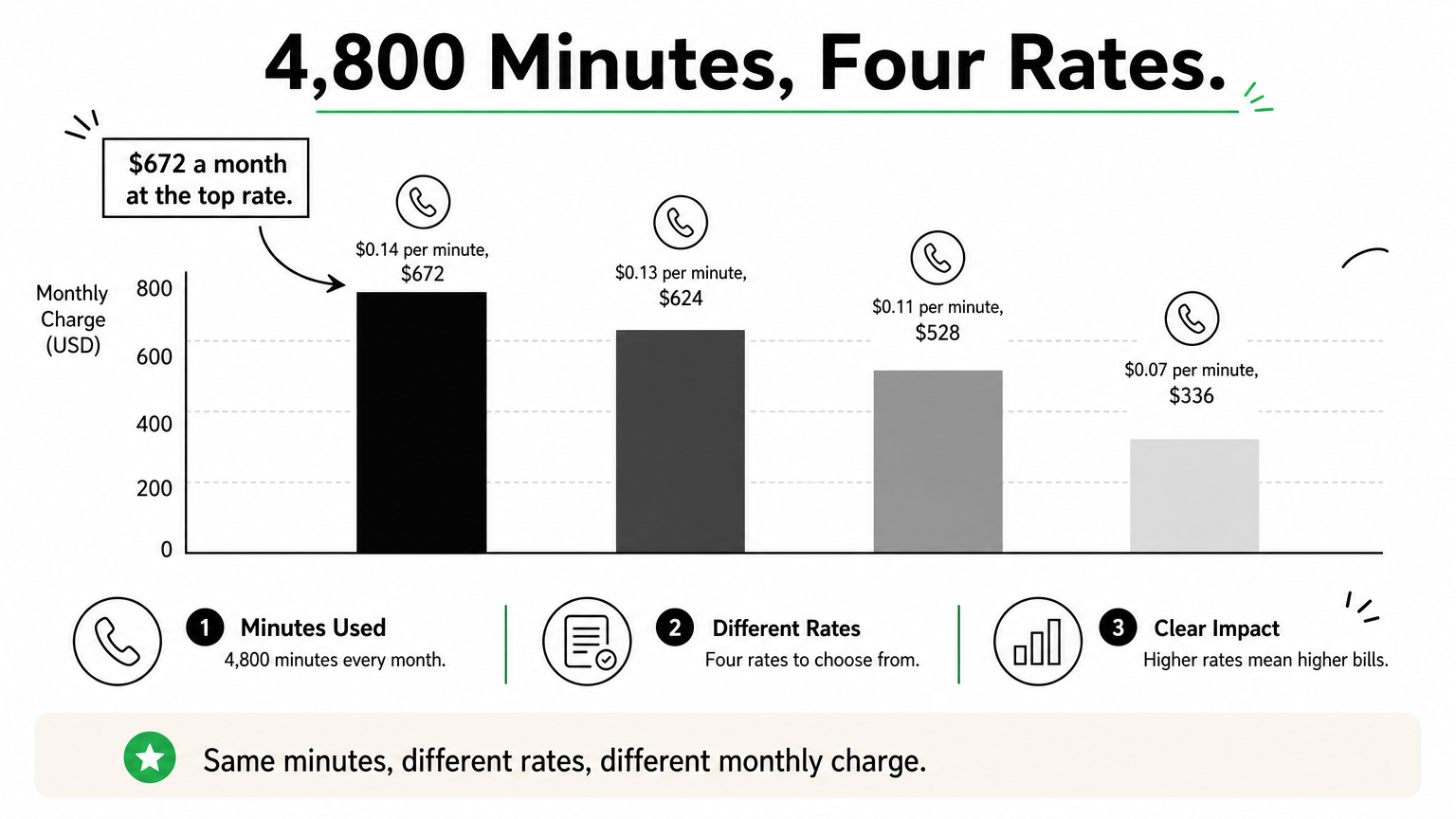
| Rate per minute | Monthly minute charge |
|---|---|
| $0.07 | $336 |
| $0.11 | $528 |
| $0.13 | $624 |
| $0.14 | $672 |
These figures cover minutes only. Add language model usage, telephony, phone numbers, and any subscription minimum. Compare quotes on the all-in cost per resolved call, not the headline rate.
The advertised per-minute rate is the floor. Your real cost is the all-in price per resolved call.
How to choose and test an AI voice agent
Choose by who will run the agent and what a call must accomplish, then prove it on your own calls before you sign anything.
Match the platform to your situation
| Your situation | Start with |
|---|---|
| Developers, custom logic, usage billing | Retell AI |
| No engineers, need to launch in days | Synthflow |
| Voice quality is part of the brand | ElevenLabs |
| High-volume outbound reminders and follow-ups | Bland.ai |
| B2B outbound sales and lead qualification | Regal |
| Already on Nextiva for business phones | Nextiva XBert |
| Regulated enterprise with complex calls | PolyAI or Cognigy |
| Calls must trigger CRM or ERP work no platform supports | Hatzs Dimensions |
Run a pilot on real calls
Demos use clean audio and friendly callers. A pilot on your own traffic shows what matters:
- Pick one repeatable call type with enough volume, such as booking or order status.
- Route real callers, not scripted tests, for at least a few weeks.
- Track resolution without a human, response latency, and call abandonment.
- Review transfers. Check that the human received the full context.
- Listen to a sample of calls every week, especially misheard names and numbers.
Check compliance before outbound calls
For outbound AI phone agents, consent comes first. In the US, the FCC has ruled that AI-generated voices count as artificial voices under the TCPA, so outbound calls generally need prior express consent. Call recording rules also vary by state. Confirm your use case with counsel, and ask each vendor for its security attestations, such as SOC 2, and for a HIPAA business associate agreement if you handle health data.
Consent is not a vendor feature. It is your responsibility, so settle it before the first outbound call.
Where to start with AI voice agents
Start narrow. Pick one call type, choose the platform that matches your team and call volume, and pilot it on real calls. Developer teams will like Retell, no-code teams Synthflow, brand-led companies ElevenLabs, outbound sales teams Bland.ai or Regal, and large contact centers PolyAI or Cognigy. Judge every option on cost per resolved call and on what the agent can do inside your systems.
If your calls need to trigger work in a CRM, ERP, or compliance process that no platform handles, a custom agent is worth scoping. You can talk to Hatzs Dimensions about a custom AI agent and walk through your call flows, systems, and constraints before committing to a build.
هل تريدون تنمية أعمالكم؟
التصنيفات
صُمّم للجريئين
نساعد الشركات الطموحة على تحويل أفكارها إلى أنظمة ذكاء اصطناعي وبرمجيات ومؤسسات جاهزة للإنتاج. احصل على رؤى حول الذكاء الاصطناعي والأتمتة والتحول الرقمي تصلك مباشرة إلى بريدك الإلكتروني.
200+ حلاً تم تسليمها في 11+ قطاعاً، فلنبنِ معاً ما هو قادم.