










A good e commerce mobile app development company has shipped real stores or marketplaces, connects payments, inventory, and shipping without drama, and stays with you after launch. Hatzs Dimensions suits growth-stage and enterprise teams that want AI and data built into the app. Chop Dawg and Goji Labs suit founders who want a strategy-led build. Space-O Technologies and Light IT Global suit buyers who want scale or offshore pricing. Designli, Mobcoder, Trango Tech, and NMG Technologies each fit a narrower need.
The problem is that every agency claims ecommerce experience. Their websites use the same words, and quotes for similar apps can run from about $40,000 to $220,000. A wrong pick costs you months and often a rebuild. This article puts nine companies side by side so you can see what each builds, who it fits, and how it prices its work. It then shows you how to choose and what an ecommerce app really costs.
Hatzs Dimensions builds custom web and mobile products, so it sits first on the list, and we hold ourselves to the same checklist as the other eight. The details on those eight come from their public claims. Confirm every figure in a discovery call before you sign anything.
1. Hatzs Dimensions
Hatzs Dimensions is a software development and AI company that builds custom web and mobile apps. It is a strong ecommerce app development company pick when your store app has to do more than show a catalog and take a payment.
Services and focus
Hatzs Dimensions covers custom web and mobile app development, application architecture, UI/UX design, cloud infrastructure, and AI and data engineering under one roof. For a store, that means the app and the systems behind it, such as recommendations, support automation, and reporting, come from one team. Delivery follows four stages: discovery and planning, design and prototyping, development and testing, then deployment and support.
- Custom iOS, Android, and web app development with scalable architecture
- UI/UX design and prototyping for browse, cart, and checkout flows
- Machine learning, AI agents, data engineering and integration, and BI
- Cloud solutions and secure infrastructure management
Who it suits
Hatzs Dimensions fits mid-sized and large retailers, ecommerce brands, and growth-stage companies that treat the app as a core system. The team is senior-only, with 7+ years of experience shipping enterprise-grade AI systems into production. It reports 250+ clients worldwide, 100+ software experts, and 98% client retention.
Its published case studies show how it measures outcomes, for example a 30% cut in insurance operations costs, 300% more lead conversion capacity, and 40% higher customer engagement. Those projects are outside retail, so ask for the closest retail equivalent. If you only need a basic storefront wrapper on a tight budget, a smaller shop will fit better.
Choose Hatzs Dimensions when your app must connect to your data and AI, not sit apart as a standalone storefront.
Pricing and engagement
You can work with Hatzs Dimensions through a dedicated team or a fixed-price project. Fixed price suits a defined MVP with a clear feature list. A dedicated team suits a roadmap that will keep changing after launch.
Pricing comes from a scoped proposal after discovery. Arrive with your must-have features, your platform choice, and the systems the app must connect to, and you will get a tighter number.
2. Chop Dawg
Chop Dawg is a full-service app studio that has been operating since 2009 and has delivered more than 500 apps. It builds online stores, two-sided marketplaces, and mobile commerce apps for iOS, Android, and the web.

Services and focus
The ecommerce work covers product catalogs, secure checkout, subscription billing, and connected admin dashboards. One reported project is The Showcase, a collectibles marketplace with secure auctions, advanced bidding, and in-app transactions. That kind of two-sided logic is where many agencies struggle.
- Custom store, marketplace, and mobile commerce builds
- UX/UI design and prototyping for product, cart, and checkout
- Stripe, PayPal, shipping, tax, inventory, and analytics integrations
- Post-launch support, performance tuning, and scaling help
Who it suits
Chop Dawg suits founders launching a first store and established sellers who want to scale online. It is especially relevant if your idea is a marketplace, because buyers, sellers, payouts, and disputes multiply the work.
It is a less obvious match if your main goal is AI-driven personalization or deep enterprise system integration. In that case, ask what data and ERP work it has done before.
Chop Dawg is the pick when your idea is a marketplace and you want a team that has built several.
Pricing and engagement
Chop Dawg offers a free 45-minute consultation and proposals with fixed budgets and timelines. That fixed-scope approach gives you a number you can compare against other bids.
Bring a ranked feature list to the call. Ask which features sit in the first release and which wait for later, because that split decides most of the price.
3. Goji Labs
Goji Labs is a Los Angeles digital product agency, founded in 2014, that has shipped more than 500 digital products. Ecommerce and retail are both on its list of verticals, which makes it a credible e-commerce app development company for teams that want strategy before code.
Services and focus
Its process starts with product strategy, then moves through UX/UI design, development, and launch. Past clients include WWF, Mitsubishi, and KCRW, which shows it handles brands with real audiences.
- Mobile app development for ecommerce and retail brands
- Custom software for online selling platforms
- UX/UI design and product strategy consulting
Who it suits
Goji Labs suits teams that know the business problem but not the exact product. If you are still deciding between a native app, a marketplace, or a loyalty-first build, its strategy-first process is useful.
The trade-off is that a strategy phase adds time before development starts. If you already have a signed-off spec and wireframes, you may pay for work you do not need.
Goji Labs is strongest when you still need to decide what to build, not only how to build it.
Pricing and engagement
Expect a scoped quote after a strategy conversation rather than a rate card. Costs usually follow the number of screens, integrations, and platforms.
Ask whether strategy and design are priced separately from development. A separate first phase lets you leave with a spec and tender the build if the fit is poor.
4. Space-O Technologies
Space-O Technologies has operated since 2010 with global delivery and reports more than 4,400 mobile apps built. It is an e commerce mobile app development company with a wide track record and a broad bench.
Services and focus
Its ecommerce work includes multi-vendor marketplaces, payment integrations, inventory management, and scalable storefront architecture. The team stresses product discovery and checkout friction, which are the two places most store apps lose sales.
- Multi-vendor marketplace and storefront development
- Payment and inventory management integrations
- Mobile apps for iOS and Android
- Design and strategy for startups, SMEs, and enterprises
Who it suits
Space-O suits buyers who want volume of experience and a team large enough to staff a project quickly. Multi-vendor marketplaces are a clear strength.
A headline app count covers every category, not just stores. Ask how many of those apps were ecommerce and request two live examples you can download and test yourself.
A big app count proves capacity, not ecommerce skill, so ask for live retail apps you can install.
Pricing and engagement
Global delivery often means lower hourly rates than a US-only team, though rates vary by team location and seniority. Request an itemized estimate that separates design, development, QA, and project management.
Also ask who will be your day-to-day contact and what hours they work. Time-zone overlap affects how quickly bugs and feedback loops close.
5. Light IT Global
Light IT Global was founded in 2006 in Ukraine and now employs more than 100 professionals. It reports over 500 custom projects for clients in Europe, the United States, and Japan.
Services and focus
The team builds iOS and Android apps, ecommerce platforms that connect to payment gateways, and the interfaces on top. It reports a mobile commerce platform built for Pfizer’s global operations, covering transactions, inventory management, and real-time analytics.
- Native iOS and Android apps for commerce and customer engagement
- Secure, scalable ecommerce platforms with payment gateway integration
- UX and visual design to lift engagement
Who it suits
Light IT Global suits B2B and operations-heavy commerce, where ordering, stock, and reporting matter as much as the shopping screens. Its long history also suits buyers who prefer an established vendor to a young studio.
It is less of a fit if you want an in-person workshop with your team each week. Remote delivery works well, but you need to plan for it.
Light IT Global fits commerce where inventory and reporting carry as much weight as the shopping screens.
Pricing and engagement
Offshore teams typically cost less per hour than US-based ones, but the saving only holds if scope stays tight. Agree on a written feature list and change-request process before kickoff.
Ask for a sample sprint report and a reference client in a similar industry. Both reveal how it communicates when a timeline slips.
6. Designli
Designli is a software firm founded in 2013 by Joshua Tucker and Keith Shields, based in Greenville, South Carolina. It combines UX/UI design with mobile, web, and cross-platform development, which suits an ecommerce mobile app development company shortlist for design-led builds.

Services and focus
Designli helps clients define product goals, target users, and market strategy before building. It markets itself to non-technical founders and advertises a working MVP in 30 days.
- Professional UX/UI design for intuitive interfaces
- Product definition covering goals, users, and market strategy
- Cross-platform apps for iOS, Android, and the web
Who it suits
Designli suits first-time founders who need a partner to translate an idea into a clear product. A fast MVP also lets you test demand before committing a full budget.
Its public portfolio includes a surgeon learning platform and a rental management web app, not a storefront. That is not a flaw, but ask to see retail or checkout work before you sign.
Designli is a good fit for design-led MVPs, as long as you verify its checkout experience first.
Pricing and engagement
A 30-day MVP implies a tight, fixed scope. Pin down what is inside that scope, such as payments, push notifications, and an admin panel, and what costs extra.
Then ask what happens after day 30. A good plan names who owns the roadmap, the bug fixes, and the first round of user feedback.
7. Mobcoder
Mobcoder is a mobile app and custom software company founded in 2011. Its clients span healthcare, finance, and retail, and it offers app design, development, testing, and deployment.
Services and focus
Its best-known ecommerce example is a B2B ecommerce app reportedly built for General Mills, with a dedicated rewards program that made vendors more engaged. It also builds native iPhone and iPad apps in Swift and Objective-C.
- Native iOS ecommerce apps using Swift and Objective-C
- Mobile and web experiences designed for ease of use
- Continuous support and updates after launch
Who it suits
Mobcoder suits companies that sell to other businesses and want ordering plus loyalty or rewards in the same app. Teams that care about a native iOS experience will also find its skill set relevant.
If you need a cross-platform build for a consumer audience on both iOS and Android, confirm which frameworks it would use and why.
Mobcoder fits B2B ordering and rewards, where repeat purchase matters more than browsing.
Pricing and engagement
Mobcoder’s offer includes ongoing support and updates, so ask for that as a separate monthly line item. Support is easy to underprice and hard to replace later.
Ask who owns the code and the app store accounts at handover. You want your company name on both from day one.
8. Trango Tech
Trango Tech was founded in 2017 and works across mobile app development, web development, and IT consulting. It offers Shopify development, including store builds, app development, and integrations, which makes it practical for platform-based stores.
Services and focus
Trango Tech builds customized ecommerce platforms and also does enterprise software, automation, integration, and cloud-based infrastructure. It is reported to serve niches such as food delivery, fashion, and fitness, with stacks including Flutter, React Native, Angular, and Laravel.
- Customized ecommerce platforms and Shopify development
- Software for enterprise systems, automation, and integration
- Cloud solutions for storage, scalability, and infrastructure
Who it suits
Trango Tech suits brands already on Shopify that want a custom mobile app on top, or startups in the niches above. Flexible stacks mean you are not locked into one framework.
It is a younger firm than several others here. Ask for a recent reference and talk to that client directly.
Trango Tech makes sense when your store already runs on Shopify and you want an app layered on top.
Pricing and engagement
Because Trango Tech sells both platform work and custom builds, quotes can vary widely. Ask whether you are paying for a Shopify theme, a custom app, or both, and what each deliverable includes.
A cross-platform build with Flutter or React Native usually costs less than two native apps. Ask for both estimates so you can see the gap.
9. NMG Technologies
NMG Technologies offers web and mobile app development, ecommerce solutions, custom software, and digital marketing. It serves startups, SMEs, and large enterprises in sectors such as healthcare, finance, retail, and education.
Services and focus
NMG builds custom ecommerce platforms on Shopify, Magento, and WooCommerce, plus native and cross-platform apps for iOS and Android. A reported project is the Musicbed mobile app, where users browse and purchase music licenses directly from their devices.
- Custom ecommerce development on Shopify, Magento, and WooCommerce
- Native and cross-platform mobile apps
- Scalable, user-friendly apps tailored to each client
Who it suits
NMG suits brands that already run on a major commerce platform and want a mobile app plus marketing support from one vendor. The digital marketing line helps when you need launch traffic, not just a finished app.
If you plan to build a headless or fully custom backend, check its architecture experience beyond the platform plugins.
NMG is a practical choice when you want a store, an app, and launch marketing from one vendor.
Pricing and engagement
Start by asking NMG to split the quote into platform work, app work, and marketing. Bundled proposals hide where the money goes.
Then ask which parts you could buy separately. A good partner will tell you honestly if one piece is cheaper elsewhere.
How to choose an ecommerce app development company
Choose the e commerce mobile app development company that can show live retail apps, explain its integration approach, and commit to a fixed first-release scope. Everything else is secondary to those three tests.
Criteria that separate strong from average
Weigh each candidate against the same list, and see how to choose a software development company for the wider checks. Skip any firm that cannot answer the first three.
- Live retail apps you can download, with a reference client you can call
- Experience with your payment gateway, ERP, inventory, and shipping systems
- A written scope for the first release, with a change-request process
- Security practices for card and personal data, including PCI DSS awareness
- Post-launch support terms and who owns the code and store accounts
- Review quality, since three-star directory reviews on Clutch and similar platforms are often more informative than five-star ones
Side-by-side comparison
The table condenses what each company publicly claims. Treat the track record column as a starting point for questions, not proof.
| Company | Public track record | Best fit |
|---|---|---|
| Hatzs Dimensions | 250+ clients, 100+ experts, 98% retention | Enterprise and growth-stage stores needing AI and data |
| Chop Dawg | 500+ apps since 2009 | Marketplaces and first-store founders |
| Goji Labs | 500+ digital products since 2014 | Strategy-led builds |
| Space-O Technologies | 4,400+ mobile apps reported, since 2010 | Multi-vendor and high-volume projects |
| Light IT Global | 500+ projects since 2006 | B2B and operations-heavy commerce |
| Designli | Founded 2013 | Design-led MVPs |
| Mobcoder | Founded 2011 | B2B ordering and loyalty |
| Trango Tech | Founded 2017 | Shopify-based stores and niche verticals |
| NMG Technologies | Musicbed app, three commerce platforms | Platform-based stores with marketing |
Questions to ask before you sign
Use the same questions on every call so the answers compare cleanly.
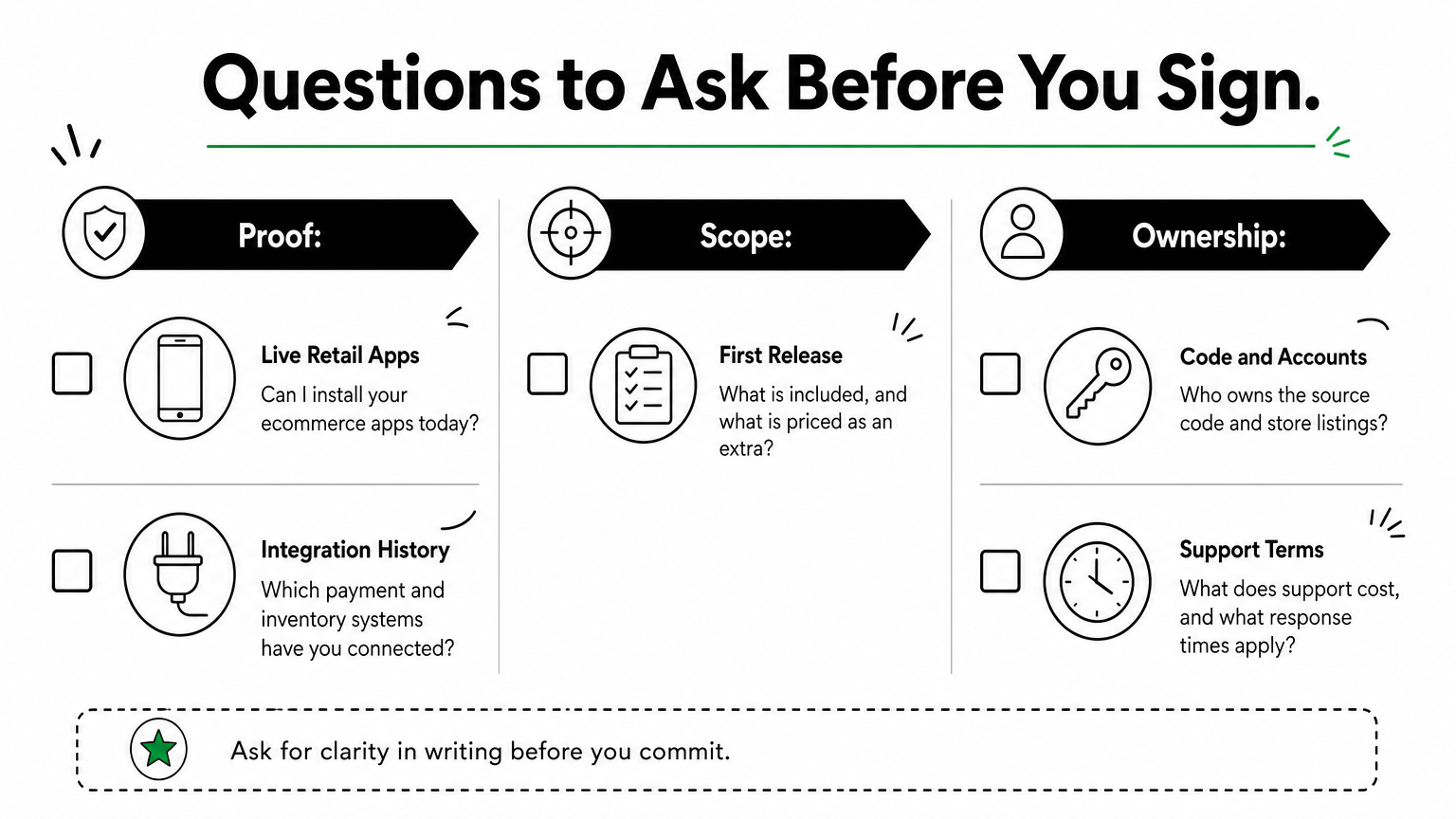
- Which of your shipped apps are ecommerce, and can I install them today?
- Who will be on my team, and how many years has each person shipped?
- What is in the first release, and what is priced as an extra?
- Which payment, shipping, and inventory systems have you integrated before?
- Who owns the source code, the cloud accounts, and the app store listings?
- What does support cost after launch, and what response times do you commit to?
The best vendor is the one whose answers stay specific when you ask for proof.
How much an ecommerce mobile app costs
Most ecommerce mobile apps cost between $40,000 and $220,000 for a first version, depending on features, platforms, and integrations. Treat those figures as a planning range, not a quote, because your scope decides where you land.
Typical price ranges
A first version commonly takes three to four months and somewhere around 1,090 to 1,400 developer hours. Multiply that by the team’s hourly rate and you see why quotes spread so widely. Commonly cited hourly estimates by country look like this:
| Region | Typical hourly rate |
|---|---|
| USA | $50 to $200 |
| Canada | $50 to $150 |
| Mexico | $40 to $120 |
| UK | $50 to $125 |
| Australia | $50 to $125 |
| India | $25 to $100 |
| Philippines | $25 to $75 |
What drives the price up
Scope drives cost more than location, as this guide to what drives custom software cost explains. Two native apps cost more than one cross-platform build. Marketplace logic, subscription billing, and custom admin dashboards add hours. So do integrations with your ERP, CRM, or warehouse system.
Advanced features raise the bill again. Voice search, image search, recommendations, chatbots, and multi-currency support are valuable, but none belongs in a first release unless it directly drives sales.
How to keep the budget under control
Ship a lean first release with search, filters, a wish list, solid checkout, push notifications, and an admin panel. Then let real user behavior tell you which advanced features earn their cost. Budget for app maintenance as well. Operating system updates, bug fixes, and security patches continue long after launch.
Pay for the features that move conversion first, and let user data justify the rest.
Picking your shortlist
The best ecommerce partner is the one that can prove retail experience, explain how it connects your payments and inventory, and commit to a clear first-release scope. Use the nine companies above to build a shortlist of three, run the same questions on each, and compare fixed-scope quotes rather than headline rates.
Start with the team that matches your situation. Marketplaces point to Chop Dawg or Space-O Technologies. Strategy-first builds point to Goji Labs. Platform-based brands point to Trango Tech or NMG Technologies. B2B ordering points to Mobcoder or Light IT Global, and design-led MVPs point to Designli.
If your store app needs to connect to data, automation, and AI from day one, book a scoping conversation with Hatzs Dimensions about your ecommerce software development and bring your feature list.
Want to grow your business?
Categories
Tags
Designed for the Bold
We help ambitious companies turn ideas into production-ready AI, software, and enterprise systems. Get insights on AI, automation, and digital transformation delivered to your inbox.
200+ solutions delivered across 11+ industries — let's build what's next.