











The best AI agent development company for you is the one that has already shipped agents into systems like yours, not the one with the slickest demo. Of the six below, Hatzs Dimensions fits teams that want agents wired into CRM, ERP and internal tools on a fixed budget. Neurons Lab fits regulated financial firms. HatchWorks AI fits companies modernizing their data stack alongside custom AI. Azumo fits US teams that want time zone overlap. Master of Code Global fits customer-facing assistants. Deviniti fits enterprises built around Jira and ITSM.
Most buyers hit the same wall. Many vendors say "agents" and deliver chatbots or scripted automations. Prototypes work in a demo, then break against legacy systems, stall in security review, or need an engineer for every small change. Sorting real builders from marketing takes weeks if you start from a search results page.
This article compares six providers on the same points: what they build, who they suit, and where to be careful. After the list, you get the questions to ask every vendor, a way to choose between an agency, a platform and a large consultancy, and a side-by-side table. Hatzs Dimensions publishes this blog and appears first, so confirm every provider’s details, pricing and references directly before you commit.
1. Hatzs Dimensions
Hatzs Dimensions is a custom AI agent and software development company that covers the full path from agent design to data, governance and long-term support. It is listed first because it is our company, and the facts below come from our own services.
What they build
Hatzs Dimensions builds custom AI agents that carry out multi-step tasks, connect to your CRM, ERP and internal tools, and answer from your own company knowledge. The agents service covers six agent types. Around it sit LLM and chatbot development with RAG, intelligent automation, and data engineering and integration, so the data an agent reads arrives reliable.
Governance is part of the offer. The AI governance and compliance service maps your systems against the EU AI Act, NIST AI RMF and ISO/IEC 42001, which helps when legal and security teams review every deployment.
An agent is only as useful as the systems it can reach and the data it can trust.
Who it suits
It suits mid-sized and enterprise teams, and growth-stage companies, that need agents inside real workflows in insurance, finance, retail, logistics and similar industries. The company has completed 200+ long-term projects since 2019, most partners stay for over three years, and it cut insurance operations costs by 30% for BrokerOS.
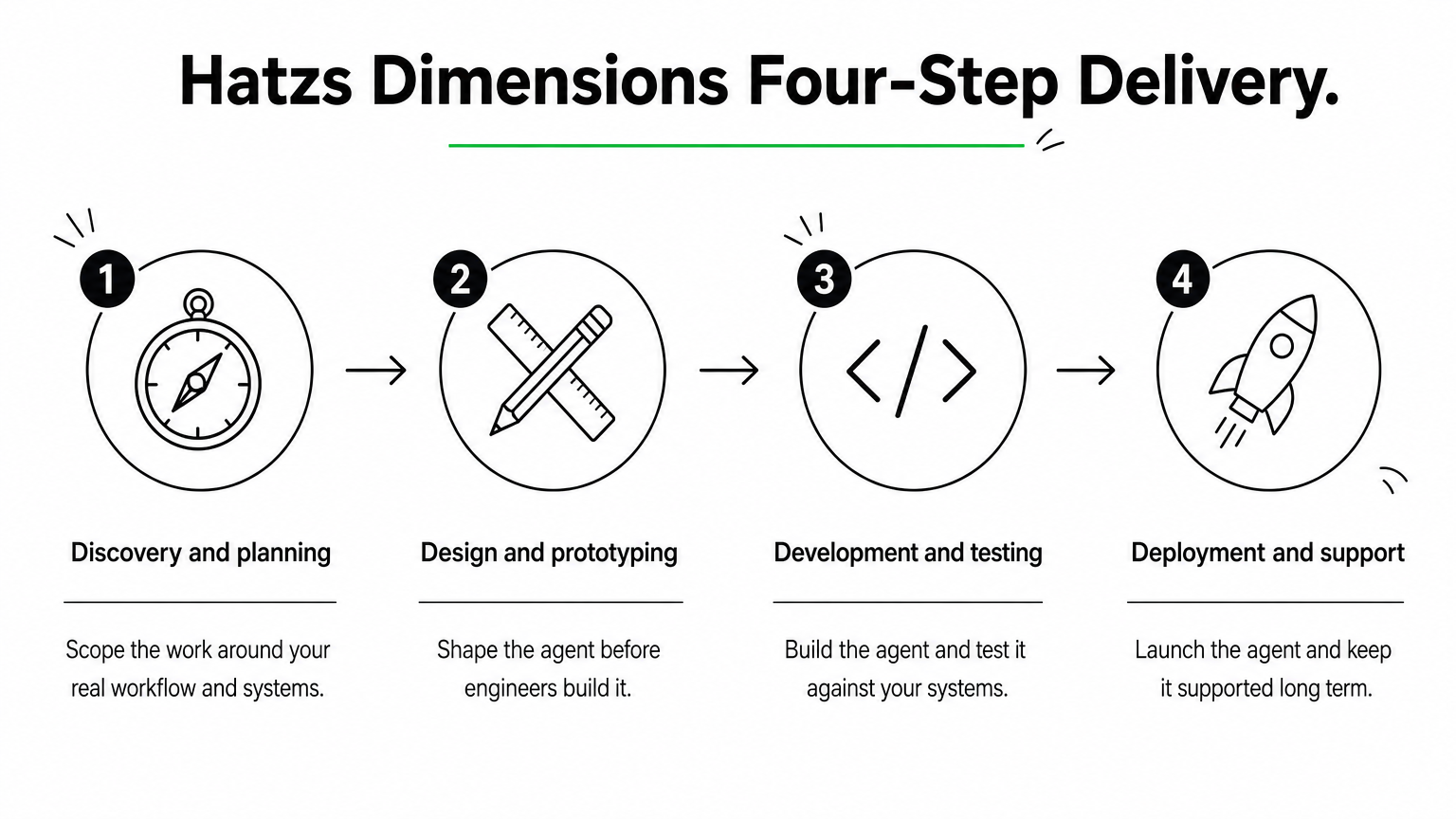
You choose between Dedicated Teams that grow with you and a Fixed Price Model that sets scope, timeline and budget upfront. Both follow the same four steps: discovery and planning, design and prototyping, development and testing, then deployment and support. Rates are not published, so ask for a scoped quote. If you only want a narrow single-industry specialist, compare it against the next pick.
2. Neurons Lab
Neurons Lab is an AI-exclusive consultancy that builds agentic systems for financial institutions. It is based in the UK and Singapore.
What they build
Neurons Lab focuses on banks, insurers and wealth managers, where agents must handle data-heavy, compliance-heavy workflows. One example it describes is a multi-agent assistant for a wealth firm. The assistant pulls client portfolios, live market data and the product catalogue, and the firm reports a 30% gain in relationship manager capacity.
Speed is part of the pitch. It cites proofs of concept in as little as two weeks and accelerator-based builds delivered in two to four months. It is also an AWS Advanced Tier partner.
If your industry has audit requirements, a vendor that already knows them saves months of rework.
Who it suits
It suits mid-sized to enterprise financial institutions that treat AI as a strategic priority but struggle to move past pilots. It lists HSBC, Visa and AXA among its clients and says it has delivered 100+ AI projects since 2019.
The trade-off is focus. Outside financial services its domain edge matters much less. Because the team is based in the UK and Singapore, confirm how much working-hour overlap you would get with your own team.
3. HatchWorks AI
HatchWorks AI is a technology company that delivers AI and software work end to end, with agentic automation in human resources as its most visible specialty.
What they build
HatchWorks covers AI strategy roadmaps, data engineering and analytics, AI-powered software development and AI agent automation. It also supplies AI engineering teams. That mix makes it a candidate when the agent depends on cleaning up the data underneath it.
Its showcased clients include Recruitics, StaffWRX and PeopleReady, so its agent track record is strongest in recruiting and staffing workflows.
When the data is the real problem, pick a partner that treats data engineering as part of the agent project.
Who it suits
It suits mid-sized to larger organizations that want custom AI and a modernized data stack, with ownership of the intellectual property staying with them. That IP point is worth writing into any contract you sign.
HatchWorks is not AI-exclusive, so ask which of its engineers have shipped agents rather than general software. If your industry is outside human resources, ask for references from your own sector before you shortlist it.
4. Azumo
Azumo is a nearshore software development company that delivers AI and machine learning work, including agent-driven workflows.

What they build
Azumo’s strengths are natural language processing and machine learning, custom agent builds and deep integration work. It positions its AI-driven automation for enterprise operations rather than for one industry.
The nearshore model means engineers work in time zones close to US business hours. For agent projects that need daily iteration with your product and operations people, time zone alignment can matter more than a lower rate.
Agents improve through fast feedback, so overlapping working hours are a real advantage.
Who it suits
It suits US-based enterprises that want a long-term dedicated team or staff augmentation to extend their own engineering group. If you already have strong product ownership in-house, this model works well.
The trade-off is that embedded teams put more direction on you. Ask who owns architecture decisions, who is accountable for delivery risk, and how knowledge transfers to your staff if the engagement ends.
5. Master of Code Global
Master of Code Global builds conversational AI, including chatbots and virtual assistants for customer engagement.
What they build
Its work centers on customer-facing agents with attention to user experience and engagement. It offers strategy and implementation services, with experience in retail, finance and healthcare.
For support, sales assistance and service journeys, a conversational specialist often beats a generalist. It designs the dialogue, the escalation paths and the customer experience around the model, not just the model itself.
For customer-facing agents, conversation design counts as much as the model behind it.
Who it suits
It suits companies whose main goal is better customer interactions: support deflection, guided shopping, or service assistants that must stay reliable at enterprise scale.
The trade-off is scope. If you need back-office agents that act across ERP, finance or internal tools, ask for examples of agents that take actions in backend systems, not just answer questions. Check, too, how it hands off to human agents when confidence is low.
6. Deviniti
Deviniti is a global software development agency with expertise in enterprise AI adoption and the Atlassian and Jira ecosystems.
What they build
Deviniti handles AI agent design and implementation with experience in enterprise integrations across ERP, CRM and ITSM. It works with agile and DevOps methods and runs R&D teams for innovation-focused projects.
Its Atlassian background shows where it is strongest. Agents that triage tickets, route requests and automate IT service workflows sit close to what it already does.
If your workflows live in Jira and ITSM tools, a partner who knows that ecosystem skips months of learning.
Who it suits
It suits large organizations with complex, established infrastructure and heavy use of Atlassian tools, where the agent must fit into existing processes without disruption.
The trade-off is stack. If your core systems sit elsewhere, ask what integration experience it has beyond Atlassian. Also confirm its delivery cadence for pilots, since its enterprise orientation may mean longer scoping.
How to choose an AI agent development company
Choose by evidence, not by pitch: ask for agents in production, integration depth, failure handling and ownership terms. Then test every shortlisted vendor with the same scoping task.
Questions to ask every vendor
Put these to every provider, and weigh the answers against each other.
- Which agents are in production today? Ask to speak with a client whose stack resembles yours.
- What happens when the agent is unsure? Strong answers include retry logic, confidence thresholds, human escalation and clear stopping conditions.
- Which of your systems will it connect to? Name your CRM, ERP and ticketing tools, and ask who builds and maintains each integration.
- How are security and compliance handled? Look for access controls, audit logs, data handling rules and alignment with frameworks such as NIST AI RMF.
- Who owns the code, prompts and logic after delivery? Get this in writing.
- How is the work priced and how long until a first workflow runs? Compare a fixed price with a dedicated team.
If you hire for a US business, add time zone overlap and where your data is processed to that list.
Agency, platform or large consultancy
A specialist agency designs, builds and integrates agents for you. Platforms such as OpenAI, Google Vertex AI and Microsoft Copilot Studio provide models and tooling, but you still need a team to design the workflow, connect systems and govern the result. Large consultancies like Accenture and IBM suit enterprise-wide transformation programs, though expect longer engagements and higher cost.
Pick an agency when you want one valuable workflow in production within months. Pick a platform when you already have engineers. Pick a consultancy when AI is one part of a much larger program.
Platforms give you materials, and an agency gives you a finished, integrated agent.
At-a-glance comparison
This table sets the six providers side by side, using each firm’s own public positioning.
| Company | Focus | Best for | Engagement |
|---|---|---|---|
| Hatzs Dimensions | Custom agents, data, governance | Agents inside CRM, ERP and internal tools | Dedicated Teams or Fixed Price |
| Neurons Lab | Financial services | Banks, insurers, wealth managers | Phased, PoC in as little as two weeks |
| HatchWorks AI | AI strategy, data, software | Data stack modernization with IP ownership | AI engineering teams |
| Azumo | Nearshore AI and ML | US teams wanting time zone overlap | Dedicated teams, staff augmentation |
| Master of Code Global | Conversational AI | Customer-facing assistants | Strategy and implementation |
| Deviniti | Enterprise AI, Atlassian, ITSM | Jira-heavy enterprises | Agile and DevOps delivery |
Shortlist three, give each the same workflow to scope, and compare how specifically they describe integrations, failure handling and timeline.
Where to go from here
The right AI agent development company matches your industry, your systems and the way you want to work. Neurons Lab and Deviniti are strongest when the vertical or toolset fits. HatchWorks AI and Azumo are strong when data or team capacity is the constraint. Master of Code Global fits customer conversations, and Hatzs Dimensions fits agents embedded in your business systems with governance built in.
Whichever you shortlist, scope one real workflow, ask the hard questions about failure handling and ownership, and judge by specifics. If you want to see how that scoping looks in practice, talk to Hatzs Dimensions about your first agent.
Want to grow your business?
Categories
Designed for the Bold
We help ambitious companies turn ideas into production-ready AI, software, and enterprise systems. Get insights on AI, automation, and digital transformation delivered to your inbox.
200+ solutions delivered across 11+ industries — let's build what's next.